Shenzhen Electronics Market: What It Is, What to Buy, and How to Shop It Without Wasting a Day (2026–2027)
SEO title: Shenzhen Electronics Market Guide (2026–2027): How to Buy Smart Meta description: Shenzhen electronics market, explained for first-time buyers: what to buy, how to compare stalls, test samples, bargain, pay, and ship home — plus the Mingtong trap to avoid.
The short answer
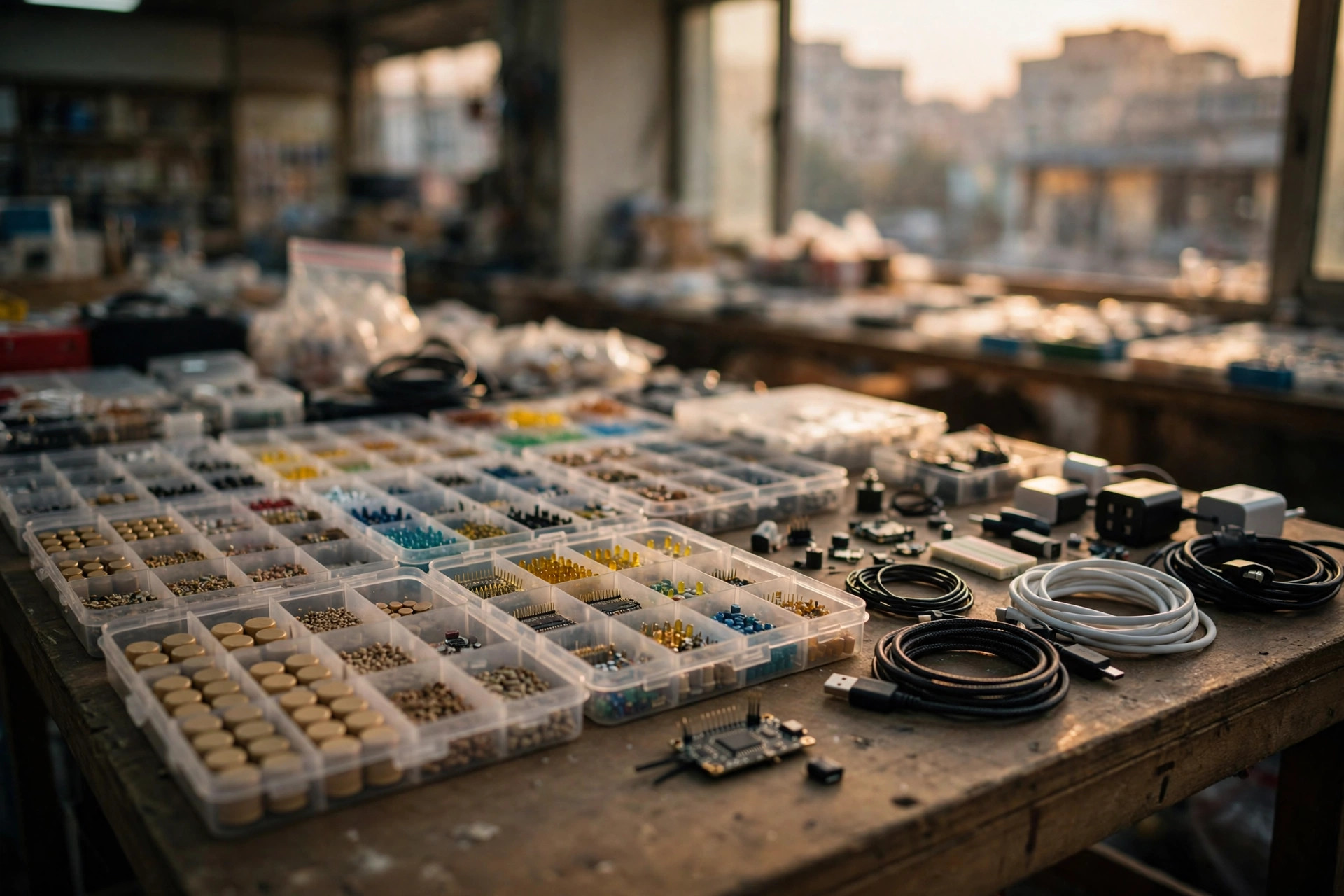
Shenzhen's electronics market is not one building. It is a whole district — Huaqiangbei, in Futian District — of about 35 specialised markets and more than 115,000 merchants packed into roughly 1.45 square kilometres, with annual trade over ¥480 billion, according to a February 2026 Futian district report. One street of buildings covers almost everything with a chip, a battery or a screen in it: electronic components, finished gadgets, phone accessories, PC parts, LED lighting, cameras, and second-hand phones.
That density is the whole point. A buyer who knows what they need can compare five stalls selling the same item within one hour, buy a sample the same day, and test it on the spot before paying. A buyer who walks in without a list will spend the day looking at everything and buying nothing — or worse, buying the wrong thing at twice the price. This guide is for the first kind of buyer.
Who this is for
- Hardware founders and product teams who need components, a working sample, or a shortlist of suppliers before committing to a production order.
- Amazon and direct-to-consumer sellers testing a new electronics product with a small batch instead of ordering thousands of units blind.
- Buyers and procurement managers who need to see, touch and test a product in person before signing anything.
- Makers and engineers hunting for a specific part that is hard to find anywhere else.
If you only want to look around and take photos, an afternoon wandering the ground floors will do that. If you are spending real money, read on.
How the market works
Think of Huaqiangbei as a supply chain you can walk through, not a shopping mall. Each building specialises. The stalls inside are mostly small, family-run counters, not brand stores. The same product is often sold by a dozen stalls in the same building at a dozen different prices, because the chip inside can be different even when the outside looks identical.
Three things follow from that. First, you buy by comparing, not by browsing: the first price you hear is an opening price, not the market price. Second, you buy in person, on the spot: samples are bought and tested at the counter, and a stall that will not let you test a powered product before you pay is a stall to walk away from. Third, you buy small first: buying 5–10 units of a mixed batch to test a market before committing to volume is normal practice here.
Most buildings open around 10:00–10:30 and close around 18:30. Stalls are often still setting up before 10:30, and the best window is the afternoon, 14:00–18:00. Sundays are quiet — many family-run stalls stay closed. The main metro station is Huaqiangbei Station (Lines 2 and 7); Huaqiang Road Station (Line 1) sits at the southern edge of the district.
What to buy, and where to start
Start from what you need, not from a building name.
Electronic components. Chips, resistors, capacitors, connectors, power supplies and industrial parts — the market's original business and still its deepest stock. Start at SEG Plaza, working by zones (components on the lower floors, brand computers in the middle, DIY hardware and repair above), and at Huaqiang Electronics World, whose top floor, according to a November 2026 local sourcing guide, is a components trading centre where authorised agents and distributors sell brand chips and industrial components with offices, warehousing and spot stock in one place.
Finished consumer electronics. Smartwatches, earphones, power banks, speakers, drones, smart glasses and robot toys. Huaqiang Electronics World is the most foreign-buyer-friendly market in the district — founded in 1998, two buildings of six floors each — and its second floor was rebuilt in late October 2026 as a wholesale centre for trendy digital products aimed at cross-border sellers and bulk buyers. The ground-floor brand zone is for looking, not buying: prices there are high.
Phone accessories and small parts. Phone cases, screen protectors, cables, chargers and laptop sleeves. Go to the SEG Communications Market, next door to SEG Plaza, rather than the main tower. Phone cases typically run ¥3–15 retail and ¥1.5–6 in bulk, according to one local buying guide.
PC parts and DIY hardware. Graphics cards, memory, storage, power supplies and repair benches on SEG's upper market floors. One caution from mid-November 2026 reporting: prices move fast. An RTX 5080 was selling for about ¥14,000 in Huaqiangbei in mid-November, down from a late-October peak near ¥20,000, but still almost double the official ¥8,299 guide price. Check the price on the day, and be suspicious of any price far below the market.
LED lighting and photography gear. Huaqiang Electronics World has a dedicated LED trading centre for displays and commercial lighting, and a photography, live-streaming and gaming zone for cameras, lenses, gimbals and streaming gear, with second-hand camera trade-in and repair on the same floors.
Second-hand phones and repair parts. Feiyang Times Building, at 66 Huafa South Road, is China's largest wholesale market for second-hand Apple products. It has four floors: small accessories on the first, phone repair parts on the second, second-hand China-market Apple devices on the third, and overseas-version devices on the fourth. Its hours are different — see below.
Timing: when to go, and when not to
- Most buildings: arrive after 10:30; do your serious buying between 14:00 and 18:00.
- Feiyang Times Building: do not go in the morning. Its trading floors do not open until 14:00. Stalls mostly open between 14:00 and 15:00, the busiest time is 17:00–21:00, and the building stays open until 23:00.
- Sundays: quiet, many stalls closed. Go on a weekday if you can.
- Best season: October–November and March–April, on a weekday afternoon.
November 2026 is an unusually busy moment. Shenzhen hosted the APEC leaders' meeting on November 18–19, 2026, NBC News broadcast from inside the markets on November 19–20, and reports put the daily number of foreign buyers at roughly 8,000–10,000. AI hardware is the story of the season: AI products account for 61% of the district's electronics sales in 2026, up from 41% in 2025, with AI glasses sales doubling and drones and robots up 60–70% in the first seven months of 2026.
A one-day buying plan
Morning — prepare, don't shop. Write down exact models, specs and quantities, and show the list on your phone rather than trying to explain it. Look each item up on Amazon or Taobao first and note the online price — that is your anchor. If the Huaqiangbei quote comes in above the online price, walk away. Set up WeChat Pay or Alipay with a foreign card before you travel, and bring ¥500–1,000 in cash.
Midday — components and finished goods. Start at SEG Plaza for components and DIY hardware, then Huaqiang Electronics World for finished gadgets and accessories. For each item, ask three to five stalls. For electronics, open at 30–40% of the quoted price; for accessories, around 50%. Expect to meet in the middle. Use the calculator on your phone — the seller types a price, you type a lower one. It works in every building.
Afternoon — the specialist building. After 14:00, go to Feiyang if your product involves phones. Remember: almost nothing there is brand-new sealed stock — what is sold is second-hand, official refurbished, refurbished, or overseas-version stock. If you want a brand-new phone, go to Yuanwang instead.
End of day — verify and pack. Test everything powered on, in full, before you pay. Ask for a stamped receipt stating the model, serial number and warranty terms, and add the stall owner on WeChat for follow-up. Keep every receipt — you will need them for tax refunds and for any problem after you leave.
How to check a product before you pay
- Test it powered on, on the spot. Every function, not just power-on. Never accept "it will be unlocked later" or "test it at your hotel".
- Ask what chip is inside. The same-looking product can differ 50–200% in price because the chip is different. If the seller cannot or will not say, that is your answer.
- Genuine, refurbished and counterfeit goods often sit on the same counter. Assume nothing from the packaging.
- Power banks must carry the 3C mark, or you cannot take them on a domestic flight in China.
- For used phones, check in this order: functions first, then software tests, then pay. Confirm the iCloud account is signed out, the activation lock is off, and there is no hidden Apple ID. Check the screen on pure white and pure black backgrounds, battery health in Settings, the IMEI (dial *#06# for the serial number, activation date and warranty), and every function — Face ID, cameras, speakers, compass, charging port. Ask the stall owner to stick their own label on the phone — that label is your only proof of after-sales, and the usual warranty is about 3 days, only if the label is intact.
- Never pay deposits to strangers. Pay at the stall, after inspection.
Paying and getting it home
Payment. Most stalls take Alipay or WeChat Pay, both of which can be linked to a foreign Visa or Mastercard before you travel. Many stalls do not accept foreign credit cards at all, and some older components and repair stalls take cash or domestic transfer only. Feiyang stalls take WeChat Pay or cash only — most do not take international credit cards or PayPal.
Language. Assume almost nobody speaks English beyond "hello" and "cheap price". Bring a translation app. For orders worth thousands of dollars, or anything involving certification and shipping, hire a translator or sourcing agent for the day — a local guide quotes roughly ¥400–800 a day.
Shipping. Anything with a lithium battery — phones, power banks, drones — is dangerous goods for shipping. Do not send it by ordinary postal parcel. Use a DHL, FedEx or UPS battery channel (with MSDS and UN38.3 paperwork) or a dedicated air or sea line that handles customs and tax.
US buyers, take note: the $800 duty-free exemption is gone. The US de minimis exemption for goods from China ended on May 2, 2025, and was suspended for all countries from August 29, 2025. Samples and small orders now need a customs declaration and full duties. The "small parcel, no paperwork" era is over — budget for customs and use a forwarder who handles it.
Tax refunds. Huaqiangbei has departure tax-refund self-service terminals, so visitors can process refunds without leaving the district. Keep your receipts.
The mistakes that cost first-timers the most
Going to Mingtong for electronics. This is the most expensive mistake in the district, and the most common. Mingtong Digital City stopped being an electronics market in 2017. It is now a cosmetics wholesale market — one of China's largest, with more than 1,400 shops, open 10:00 to 02:00 the next day, all year round. The switch happened because domestic brands such as Huawei and Xiaomi squeezed electronics margins and intellectual-property enforcement tightened; by 2016 some floors were half empty, and by 2020 the transformation to cosmetics was complete. Most English guides still get this wrong, including some updated as recently as October 2026. If you go to Mingtong looking for electronics, you will waste half a day. For phone cases and accessories, go to the SEG Communications Market. For phones, go to Yuanwang.
Going to Feiyang in the morning. The trading floors do not open until 14:00. Turn up at 10:00 and you will find a closed building.
Buying on the brand ground floor. The ground-floor brand zones are showrooms with showroom prices. Look there, buy upstairs or in the wholesale zones.
Accepting the first price. The first price is an opening price. Compare three to five stalls for the same item before you buy.
Paying before testing. Once you have paid, getting a refund becomes a long argument. Test first, pay last.
Trusting a floor plan from an old guide. Floors get rearranged — Huaqiang Electronics World's second floor was rebuilt in late October 2026, and the old floor plan no longer applies. Treat the signs on the day as final.
Quick answers
Is one day enough? For a first look, yes — components and gadgets in the morning and midday, Feiyang after 14:00. For serious buying, plan two days.
Do I need a guide? If you only want to look around, no. If you are buying samples, negotiating, or visiting factories, a local English-speaking guide pays for itself in the first hour.
Can I pay by card? Mostly no. Set up WeChat Pay or Alipay with a foreign card before you travel, and bring ¥500–1,000 in cash.
Is it safe? Huaqiangbei is a busy commercial district, not a dangerous one. The risks are commercial — fakes, bad units, wrong prices — not personal safety.
What should I buy first? The sample, not the volume. Buy 5–10 units of a mixed batch, test the market, then order in volume.
Plan your buying trip
Shenzhen's electronics market rewards buyers who arrive with a list, compare stalls, test samples on the spot, and buy small before they buy big. If you want help planning that trip — which buildings fit your product, what to ask, and how to get samples home properly — send your product list, quantities and timing through the Sourcing Inquiry form at the bottom of this site's homepage, and we will come back with what a trip can cover before you commit to anything.