What Should a First-Time Buyer Buy at Huaqiangbei? (2026 Guide)
The short answer
Buy what Huaqiangbei is actually selling in late 2026: AI glasses, AI toys and robot dogs, small drones, translation devices, massage guns, and — if you know how to check one — a used phone. Skip the generic phone cases and cables unless you are buying in bulk, and do not go to Mingtong for electronics: it stopped being an electronics market in 2017 and is now a cosmetics wholesale hub. Start at Huaqiangbei Electronics World for the AI gadgets, go to SEG for computer parts, and save Feiyang for used phones after 2 p.m. Test everything on the spot, pay by mobile wallet, and keep your receipts.
What foreign buyers are actually buying right now
Huaqiangbei is about 1.45 square kilometres of market buildings — 35 professional markets and more than 115,000 registered businesses, with annual turnover above ¥480 billion (official Futian district figures, September 2026). Around 8,000 foreign buyers a day walk through it, rising past 10,000 during big events; reports since mid-October put the daily figure anywhere from 8,000 to 12,000, so treat the exact number as a range, not a fact. What is consistent across every recent report is what those buyers are carrying out. Six categories dominate.
| Category | What to know | Where to buy it |
|---|---|---|
| AI glasses | Sales doubled in the first seven months of 2026; the single hottest item of late 2026 | Huaqiangbei Electronics World |
| AI toys and robot dogs | Best seller is an AI robot dog at about ¥390; AI products are 61% of the district's electronics sales | Huaqiangbei Electronics World |
| Small drones | About ¥158 each; drones and robots together grew 60-70% in sales in the first seven months of 2026 | Huaqiangbei Electronics World |
| Translation devices | Test in thirty seconds: speak into it, check the language you need, confirm it works offline or on your own hotspot | Huaqiangbei Electronics World, on the AI wall |
| Massage guns | The price spread between stalls is widest here — compare three stalls before you buy | Same stalls as the earbuds and power banks |
| Used phones | Damaged iPhone 13 Pro and 14 Pro models about ¥1,000-2,000 each; only if you know how to check one | Feiyang Times Building, after 14:00 |
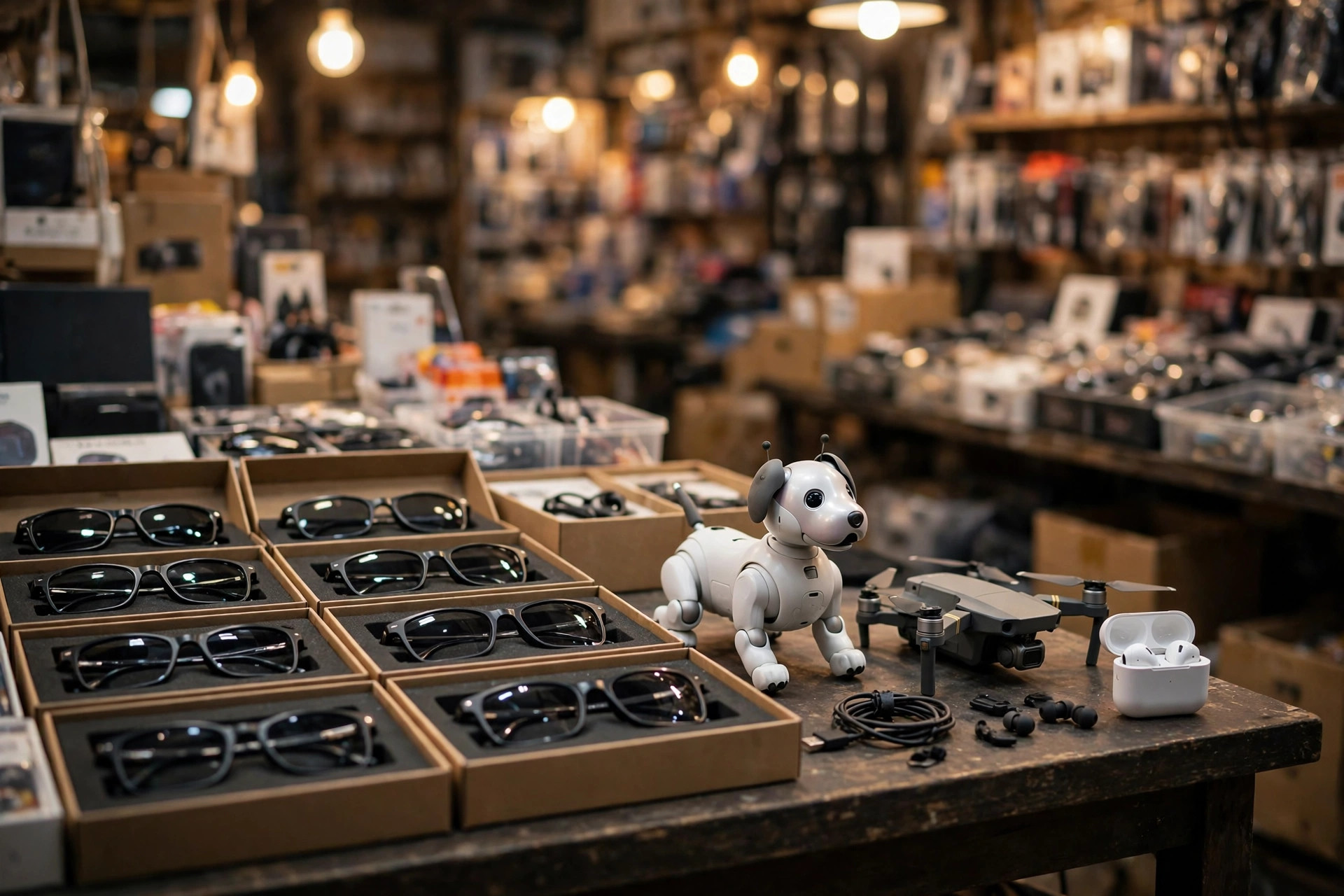
1. AI glasses. The single hottest item of late 2026. AI glasses sales doubled in the first seven months of 2026, and one shop told TVB in mid-November that overseas tourists were 80% of its customers. A member of a Peruvian delegation spent about $400 on AI glasses and a massage gun in one stop (NewsPim, 2026-11-21). They are on the "AI Eight Steeds" board on the district's main street — a street display, not an official ranking — and they are the item most likely to be demonstrated at you the moment you stop at a stall.
2. AI toys and robot dogs. The other breakout of the autumn. An AI toy shop told NewsPim its foreign customers had risen from about 20% to more than 40% of foot traffic, and its best seller was an AI robot dog at about ¥390. AI products as a whole made up 61% of the district's electronics sales in the first seven months of 2026, up from 41% in 2025, with AI product sales up more than 55% year on year. If you are buying for a store, this is the category where a small test batch makes most sense — the products are cheap, visual, and easy to demonstrate.
3. Small drones. The classic Huaqiangbei souvenir that still sells. A French customer bought two small drones at ¥158 each and told the reporter the same model costs €100 in France (NewsPim, 2026-11-21). Drones and robots together grew 60–70% in sales in the first seven months of 2026. Buy the small, ready-to-fly models first; the professional camera drones are a different market with different prices and different rules.
4. Translation devices. Translation earbuds and handheld translators are on the AI wall at Huaqiangbei Electronics World and on every "AI Eight Steeds" list. They are also the most practical thing a first-time buyer can test in thirty seconds: speak into it, check the language you actually need, and confirm it works offline or on your own hotspot before you pay.
5. Massage guns. The quiet best seller of the bunch. They appear in the same stalls as the earbuds and power banks, and they were half of that Peruvian buyer's $400 spend. They are also the item where the price spread between stalls is widest — same shape, different motor, different battery — so compare three stalls before you buy one.
6. Used phones — but only if you know how to check one. This is the biggest-volume trade in the district and the riskiest for a first-timer. African and Bangladeshi buyers buy dozens of used phones at a time, even with cracked screens; one Nigerian buyer bought about 40 in a single day (AFP, 2026-11-19). Damaged iPhone 13 Pro and 14 Pro models were going for about ¥1,000–2,000 each. The global used-smartphone market grew 13% in the first half of 2026 to 150 million units (Counterpoint). If you have never graded a used phone, do not start here — buy your gadgets first, watch how the phone stalls work, and read the checking section below before you spend anything on a handset.
Where to buy each thing
Huaqiangbei is not one building. Four buildings matter for a first-time buyer, and each has a different job.
Huaqiangbei Electronics World — your first stop, for AI gadgets. Two main buildings of six floors each, founded in 1998. The ground floor is a brand experience zone — Huawei, DJI, HP, Lenovo, Apple and Xiaomi stores, plus Switch, PS5 and Xbox consoles and accessories — with marked prices that are high; look, do not buy there. The floor to shop is the second floor, upgraded in late October 2026 into a wholesale centre for trendy digital and smart tech: earbuds, power banks, massage devices, gimbals, drones, VR/AR glasses, smart robots, AI robot dogs, own-brand tablets, Bluetooth speakers, projectors, action cameras and health electronics. One note: an independent foreign-buyer's guide puts the AI wall on the first floor, not the second, so if you do not see it on one floor, check the other. The third floor is photography, livestreaming and esports — Sony, Canon, DJI and Insta360 cameras and lenses, livestream gear, esports peripherals, plus used-camera trade-in and phone repair. The fourth floor is DIY computers and IT accessories: PC build hardware, graphics cards, memory, printer consumables, maker development boards, microcontrollers and electronic tools. The fifth floor is the LED trading centre; the sixth is electronic components — branded chips, resistors, capacitors and industrial parts, where authorised distributors concentrate.
SEG Plaza — for computer parts. The market floors are the lower ten floors of the tower (the tower itself is 71 or 72 storeys depending on the source — the height, 292 metres, is the agreed figure). The first floor is components; the fourth floor is brand computers — Dell, Huawei, HP, Samsung and Lenovo; the fifth and sixth floors are DIY hardware — graphics cards, memory, USB drives, SD cards, card readers and power supplies — plus computer repair. The lower floors of SEG are the most disputed in the district: different guides give different floor plans, so treat the zone (low floors components, middle floors brand computers, higher floors DIY and repair) as the reliable picture and confirm the exact floor from the signs on the day. Next door, the SEG communications market (floors 3–4) is the place for phone cases, iPad covers, laptop sleeves and tempered glass — phone cases retail at about ¥3–15, or ¥1.5–6 in bulk. The SEG Kang Le building, nearby, wholesales smart consumer electronics — earbuds, watches, hair dryers, power banks, speakers and massage guns — with fewer tourists and better unit prices, but it expects volume.
Feiyang Times Building — for used phones, after 2 p.m. Four floors at 66 Huafa South Road, and the most verified building in the district. The ground floor is small electronics and accessories — watches, earbuds, phone cases, tempered glass, data cables — aimed at walk-in tourists, with higher prices; not your main buying floor. The second floor is phone repair parts: screens, batteries, mainboards, cameras and shells — the saying is you can assemble a whole phone from a single screw. The third floor is used domestic iPhones, iPads, Apple Watches and AirPods, with the widest selection in the building. The fourth floor is overseas versions — US, Japanese and Korean models, locked and unlocked. Trading floors open at 14:00, stalls mostly open after 14:00–15:00, and the busiest window is 17:00–21:00; the building stays open until 23:00. Do not arrive in the morning expecting to buy. Single units are fine on floors one to three; fourth-floor wholesalers often want 5–10 units minimum. Note also that the fourth floor was cleared during a two-month renovation before the November APEC summit, and stallholders said overseas iPhones were no longer allowed to be sold there — there is no official announcement and no seizure figure, so check what is actually on the shelves rather than assuming either way.
Tong Tian Di — for phone parts, not whole phones. A phone-accessories market where phones are taken apart and sold as screens, batteries and cameras separately. Useful if you repair or refurbish; not a place to buy a working handset.
Do not go to Mingtong for electronics
Most English guides still list Mingtong Digital City as an electronics market. It is not, and has not been since 2017. It converted fully to cosmetics wholesale that year — it is now China's largest cosmetics wholesale hub, with more than 1,400 shops, open 10:00 to 02:00 the next day, all year round, selling MAC, Chanel, Dior, YSL, La Mer, Lancôme, SK-II, Estée Lauder and the rest. The conversion happened because domestic brands such as Huawei and Xiaomi squeezed electronics margins and intellectual-property enforcement tightened; by 2016 some floors were 50% empty. If a guide tells you to buy phones on Mingtong's first three floors, that guide is out of date. Go to Feiyang for used phones, to SEG communications market for cases and accessories, and to Huaqiangbei Electronics World for gadgets.
How to pay, and how much to pay
Payment. Alipay and WeChat Pay are the norm, and both can be linked to an overseas Visa or Mastercard. Most stalls do not take foreign credit cards directly, and some older components and repair stalls take cash or domestic transfer only. Keep ¥500–1,000 in cash. A few shops now accept international credit cards and other overseas e-payment — one smart-glasses shop told TVB in November that it does — but do not count on it. The departure tax refund now works on a "buy now, refund now" basis, with self-service terminals in the district, so keep your receipts if you qualify.
Bargaining. Start at 30–40% below the asking price for electronics and about 50% for accessories, then meet in the middle. Compare the same item at three to five stalls before buying. The same-looking product with a different chip inside can cost 50–200% more or less, so the cheapest stall is not always the cheapest product — ask what chip, what battery and what warranty, and compare like with like. Check the Amazon or Taobao price as an anchor before you start talking.
Reference prices — what things actually sold for. These are recorded deal prices from one local buying guide, March to October 2026, not quotes: a hair straightener about ¥95; a Huaqiangbei hair dryer ¥185–280 (top specification with 3C certification, 1,600W); a magnetic power bank about ¥95; a high-speed cooling fan about ¥45; a budget smartwatch ¥170–200; a used Bose speaker about ¥200. From news reports in November: a small drone ¥158, an AI robot dog about ¥390, a red handheld games console with tens of thousands of games $20, smartwatches $10–20 (NBC, 2026-11-19). Graphics cards are the exception to every rule here — an RTX 5080 was about ¥14,000 and an RTX 5090 about ¥46,000–51,000 across reports from 10–15 November 2026, and memory has surged (32GB DDR5 went from ¥900 to ¥3,800 within a year, up 322%). If you are buying PC parts, check the price on the day; do not rely on any figure printed here.
How to check quality before you pay
Power it on, in front of the seller. Genuine, refurbished and counterfeit goods often sit on the same counter. Never accept "unlock it later" or "test it at your hotel". For a power bank, check for the 3C mark — without it, it cannot go on a domestic flight.
For AI gadgets. Test the actual function, not the demo loop: pair the earbuds to your own phone, speak a sentence into the translator in the language you need, run the massage gun for a full minute, fly the drone in the stall if they allow it. Ask about the battery and the warranty in writing — many stalls offer about a year of stall warranty on proper electronics and computer hardware, but only if the receipt states the model, serial number and warranty terms.
For used phones. Check in this order: functions first, then software checks, then pay — never the other way round. Confirm iCloud is signed out, the activation lock is off and there is no hidden Apple ID. Check the screen on a plain white and plain black background for dead pixels, light bleed and yellowing; check battery health in Settings and cross-check it against a tool such as Aisi Assistant, because battery readings can be faked. Dial *#06# for the IMEI and check the serial number, activation date and warranty. Test Face ID, both cameras and focus, speakers, compass and charging port, and look at the liquid-contact indicator inside the SIM tray — red means water damage. Learn the grade words: "like-new" means near-new with battery health 90–100%, "lightly used" means minor marks. On US models, check Settings → General → About → Carrier Lock: "No SIM restrictions" means unlocked; "SIM locked" means it needs a carrier or a SIM adapter, and most US models ship without a physical SIM slot — a slot is usually added later. After you buy, make the seller stick their own shop label on the phone: that label is your only after-sales proof, it typically covers about three days, and the label must stay intact and the phone unopened if you need to bring it back.
For PC parts. Buy the chip, not the box. Ask for the exact model and check it against the price you anchored before you came. Memory prices have moved fast in 2026, so a price that was right last month can be wrong today.
Getting it home
Lithium batteries are the trap. A used phone contains a lithium battery, which is Class 9 dangerous goods. Do not send phones by ordinary postal parcel. Use a DHL, FedEx or UPS battery channel (with MSDS and UN38.3 documents) or a dedicated air or sea line that includes customs clearance and tax.
US buyers: the $800 exemption is gone. The US de minimis exemption ended — samples and small orders shipped to the US now need a customs declaration and full duties, and the postal formal-declaration compliance deadline is 20 January 2027. The old "small parcel, no tax, no paperwork" model no longer exists, so budget duty and paperwork into any test order.
Keep the paperwork. Ask for a stamped receipt stating the model, serial number and warranty terms, and add the seller on WeChat before you leave so you can follow up on an order or a fault. If you are buying for a business, that receipt is also your only record of what you bought and from whom.
A first-timer's one-day route
Morning: Huaqiangbei Electronics World, floors two and three — AI glasses, robot dogs, drones, earbuds, cameras. Touch everything, buy nothing on the first pass; note prices at three stalls per item. Midday: SEG, floors four to six, for computer parts and repair stalls, and the SEG communications market for cases and accessories. Afternoon from 14:00: Feiyang, floors three and four, for used phones — this is when the stalls open and the serious trading starts. Evening: back to Huaqiangbei Electronics World to buy the items you shortlisted in the morning, when you know the going price. If you are a hardware founder rather than a shopper, stop at the Huaqiangbei Hardware Maker Hub, a maker centre that opened in the district centre in early November 2026, where visitors can build a small AI gadget — a voice assistant or a translator — in 10–20 minutes, with a 3D-printed case and laser engraving on site; its manager says it draws more than 1,000 visitors a day, 30–40% of them foreign, and claims a concept can become a physical product in as little as 20 days. Most buildings run about 10:00–18:30, stalls mostly open after 10:30, and the best window is 14:00–18:00; Sundays are quieter, with many family stalls closed. Get there by metro: Huaqiangbei station (lines 2 and 7) is the core stop, Huaqiang Road station (line 1) is on the southern edge.
What we charge
Our own Huaqiangbei guide days are listed at $299 per day, $599 for two days, and $2,499 per person for a four-day founder group — reference pricing, to be confirmed, as of November 2026; final rates are confirmed before booking. If you want that kind of help, send your list through our Sourcing Inquiry form: what you need, how many days you have, and what you want to buy.
FAQ
What should a first-time buyer buy at Huaqiangbei? Start with AI glasses, AI toys and robot dogs, small drones, translation devices and massage guns — the six categories foreign buyers are actually buying in late 2026. Leave used phones until you know how to check one.
What electronics to buy in Shenzhen, China? At the Huaqiangbei electronics market, the best first buys are AI glasses, AI robot dogs, drones and translation devices from Huaqiangbei Electronics World, computer parts from SEG, and used phones from Feiyang after 2 p.m.
Is Huaqiangbei still worth visiting in 2026? Yes. Around 8,000–12,000 foreign buyers a day visit the district, AI products are 61% of its electronics sales, and the market has shifted from copycat phones to drones, smart glasses and AI hardware since 2017.
Is Mingtong still an electronics market? No. Mingtong stopped being an electronics market in 2017 and is now China's largest cosmetics wholesale hub. Do not go there for electronics — go to Feiyang for used phones and Huaqiangbei Electronics World for gadgets.
Can I buy a single item, or do I need to buy in bulk? Single items are fine for gadgets and accessories. On Feiyang's fourth floor, wholesalers often want 5–10 units minimum for used phones, while floors one to three will sell a single unit.
How do I pay at Huaqiangbei? Alipay and WeChat Pay, linked to an overseas Visa or Mastercard, plus ¥500–1,000 in cash. Most stalls do not take foreign credit cards directly.
How do I get a used phone home? A phone's lithium battery is Class 9 dangerous goods — do not use ordinary postal parcels. Use a DHL, FedEx or UPS battery channel with MSDS and UN38.3 documents, or a dedicated line with customs clearance. US buyers should also note the $800 de minimis exemption has ended.
How we report prices
All prices here are attributed to a named source and a date, or given as a range where sources disagree. They are orientation figures, not quotes — prices move, pages change, and the cheapest listing is not always the price charged. Check the price on the day and confirm what is included before you buy. Our own figures are reference pricing, to be confirmed (November 2026).