How Do I Ship Electronics from Huaqiangbei to My Country? (2026 Guide)
The short answer
Buy the goods at a stall in the Huaqiangbei electronics market, get a stamped receipt with the model and serial number, then ship them one of three ways: carry them home yourself, send them by an express courier such as DHL, FedEx or UPS, or hand them to a freight forwarder on a dedicated air or sea line that clears customs and tax for you. Anything with a lithium battery — phones, power banks, drones — goes by a courier battery channel with MSDS and UN38.3 paperwork, never an ordinary postal parcel. And if you are shipping to the United States, the $800 de minimis exemption is gone: every parcel now needs a customs declaration and full duties, as of November 2026.
Step 1 — Know what you are shipping
The right channel depends on what is in the box. Huaqiangbei buyers usually fall into three buckets, and each one ships differently.
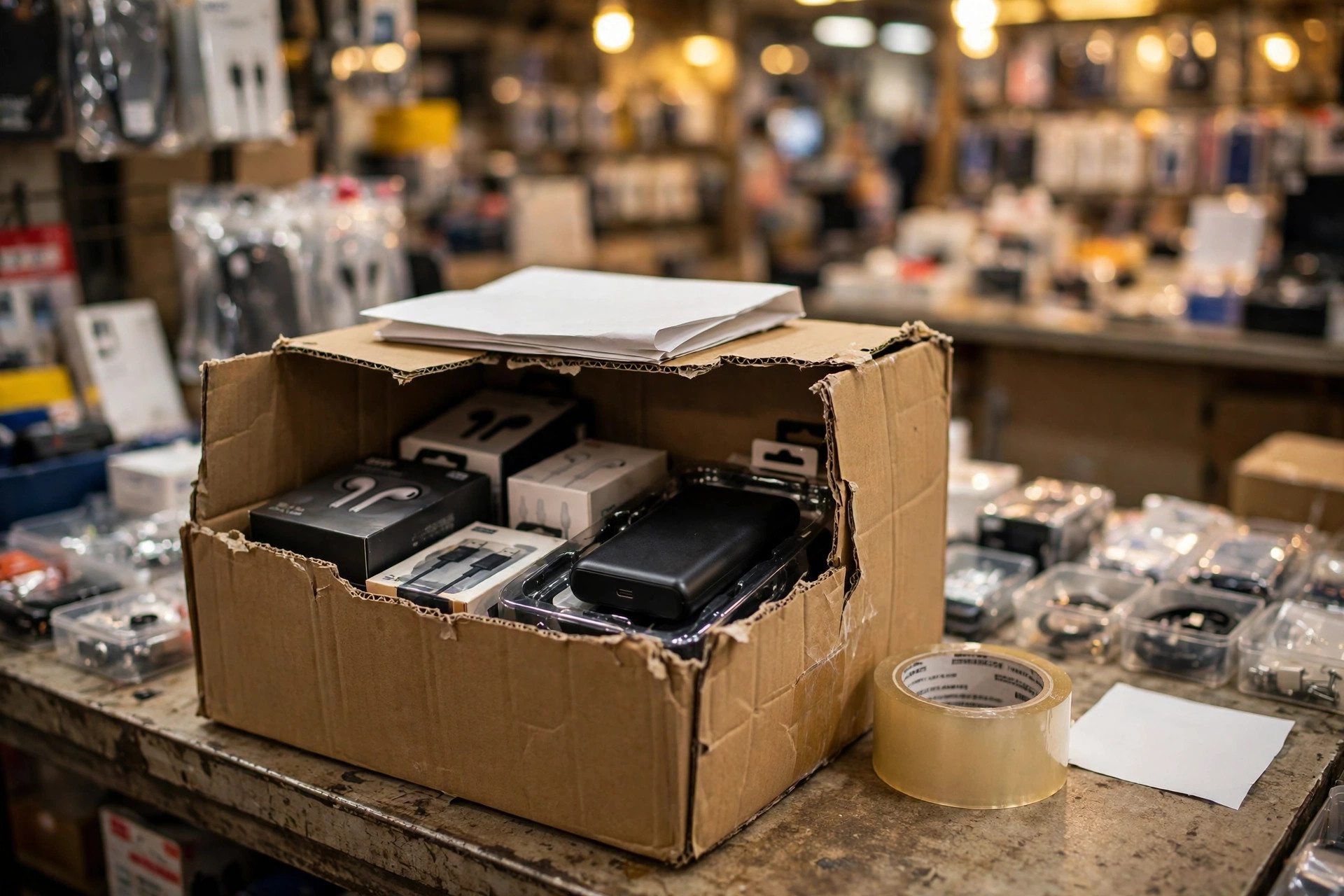
New consumer electronics. Headphones, smart watches, power banks, drones, AI glasses, projectors, Bluetooth speakers — the shelves of Huaqiang Electronics World and SEG. These are the easiest to ship: they are new, boxed, and have a clear model name for the customs form. Keep the box and the receipt. If the stall gives you a warranty, get it written on the receipt with the model and serial number — that paper is your only proof if something arrives dead.
Used phones and parts. The Feiyang Times Building is the used-phone market: the third floor is used domestic iPhones, iPads and Apple Watches, the fourth floor is overseas versions, and the second floor is repair parts — screens, batteries, boards, cameras. Used phones ship under the same battery rules as new ones, plus two checks before you pay: confirm iCloud is signed out, the activation lock is off and there is no hidden Apple ID, and check the IMEI (dial *#06#) against the serial number on the receipt. Almost nothing here is "brand new, factory sealed" — what you are buying is used, official-refurbished, or an overseas version — so verify function first and pay after.
Anything with a lithium battery. This is the category that causes the most trouble, and it cuts across the other two. A phone, a power bank, a drone, a laptop — if it has a lithium battery, it is Class 9 dangerous goods for shipping. That is not a courier's policy, it is the shipping rule. The rest of this guide keeps coming back to it because it decides which channel you can use.
Step 2 — The three ways out of Huaqiangbei
1. Carry it yourself. The simplest option for a small haul. Huaqiangbei has departure tax refund self-service terminals, and the "buy now, refund now" instant refund is available in the area — ask at the counter before you leave the market. Two things to watch: a power bank must carry the 3C mark or it cannot board a domestic flight in China, and a used phone should be checked and paid for before you walk away, because the stall's warranty is usually only a few days and the stall's own label on the device is the only proof of sale. Keep every receipt.
2. Express courier — DHL, FedEx or UPS. The standard choice for samples and small orders. You book a pickup, or the courier collects from your hotel or your agent's office. Couriers handle the export paperwork and the destination customs clearance, and they track the parcel door to door. This is also the only channel for anything with a lithium battery: ask for the courier's battery channel and provide the MSDS and UN38.3 paperwork (see Step 4). Get the quote in writing before you hand over the goods — courier prices move daily and the price you are quoted in the morning may not be the price at pickup.
3. Freight forwarder or a dedicated air/sea line. The choice for larger orders. A forwarder collects the goods from several stalls, packs them into one shipment, and books air or sea freight. Dedicated lines to the US, Europe and Southeast Asia usually advertise "customs and tax included" — the forwarder clears destination customs and pays the duty for you. This is the cheapest per-kilo option once the order is big enough, but it is also the slowest, and you need a forwarder you trust: ask who clears customs at the destination, what happens if the shipment is held, and whether the quoted price really includes duty — in writing, before you pay.
In practice, most stalls sell at the counter and do not arrange international shipping themselves. The shipping is arranged by you, your sourcing agent, or your forwarder — which is one reason buyers who come with an agent end up with fewer problems: the agent knows which forwarder handles your country and your product.
Step 3 — Shipping to the United States: de minimis is gone
This is the single biggest change for US buyers, and it catches people who last ordered from China before 2025.
The $800 de minimis exemption for parcels from China ended on May 2, 2025, and for all countries on August 29, 2025. In June 2026 the US Customs and Border Protection (CBP) issued an interim final rule suspending the exemption indefinitely, and the exemption is scheduled to be repealed by law on July 1, 2027. A February 2026 US Supreme Court ruling on tariff authority did not restore it — CBP continues the suspension under its own regulatory authority.
What that means in practice, as of November 2026:
- Every parcel needs a customs declaration and full duties. The old "small parcel under $800, no paperwork, no duty" route no longer exists. Duties are the most-favoured-nation rate plus the applicable additional tariffs, and they apply to samples and small top-up orders too.
- Postal parcels have a new process. Since July 24, 2026, postal parcels valued at $2,500 or less go through a new postal informal entry process: a 10-digit HS code, a bonded declaration, and duty paid monthly. Some mail that needs a formal entry has a compliance deadline of January 20, 2027.
- The rules are still moving. On October 8, 2026, CBP proposed tightening the low-value shipment declaration rules further, with public comments due December 7, 2026. Check the current CBP position before you ship, not the position from six months ago.
If you are buying for resale in the US, work the duty into your landed cost before you buy the goods — not after the parcel arrives with a bill attached. And tell your forwarder the goods are going to the US: a forwarder that quotes you a pre-2025 "tax-free small parcel" price is quoting a route that no longer exists.
Step 4 — Lithium batteries are dangerous goods
Anything with a lithium battery — phones, power banks, drones — ships by a DHL, FedEx or UPS battery channel (MSDS and UN38.3 paperwork), never an ordinary postal parcel. A standalone battery is Class 9 dangerous goods. A postal parcel will be rejected or returned, and a misdeclared battery shipment can be held or fined.
What to prepare:
- MSDS (Material Safety Data Sheet) for the battery — your supplier or the battery maker provides it.
- UN38.3 test report — the battery's transport safety test. Ask the supplier for it before you buy; a supplier that cannot produce it is a supplier to avoid for battery goods.
- Correct declaration on the shipping form — battery type, watt-hours, and quantity. Do not under-declare, and do not describe a phone as "electronics accessories" to dodge the battery rule.
If you are buying used phones, the same rule applies — the battery inside a used iPhone is still a lithium battery. Use the courier battery channel, or a dedicated air/sea line that handles batteries, and keep the MSDS and UN38.3 with the shipment.
Step 5 — The paperwork checklist
Before the goods leave Shenzhen, make sure you have these:
- Commercial invoice — what the goods are, how many, and their value. The value you declare is the value duty is calculated on.
- Packing list — what is in each box, by model and quantity.
- Stamped receipt from the stall — with the model, serial number and warranty terms written on it. This is your proof of purchase and your only warranty document.
- MSDS and UN38.3 — for anything with a lithium battery.
- The correct HS code — your forwarder or courier will usually assign it, but check it matches the product. Since July 2026, US postal parcels need a 10-digit HS code.
Keep a photo of every document on your phone. If a parcel is held at destination customs, the first thing anyone asks for is the paperwork.
What to ask before you hand over the goods
Take these questions to your courier or forwarder before you pay for shipping:
- What is the total price, and does it include destination duty and tax?
- Who clears customs at the destination, and what happens if the shipment is held?
- How are lithium batteries handled, and what paperwork do you need from me?
- What is the tracking, and what is the claims process if the parcel is lost or damaged?
- What is the declared value, and who is responsible if customs disagrees with it?
If the forwarder answers all five in writing, you can compare it against the next forwarder. If it answers two and waves the rest away, you have your answer.
Mistakes that cost buyers money
Four mistakes show up again and again: shipping a battery product by ordinary postal parcel — it will be returned or held; under-declaring the value to save duty — customs can re-value the goods and fine you; buying a used phone without checking iCloud, the activation lock and the IMEI — a locked phone is worth nothing at home; and paying for freight on a "tax-free" quote that no longer exists for the US — check the quote against the current rules, not against what worked in 2024.
One more, specific to Huaqiangbei: do not go to Mingtong Digital City looking for electronics. It has been a cosmetics wholesale market since 2017 — most English guides still list it as an electronics market, and buyers who follow them waste a trip. For phone cases and accessories go to the SEG Communications Market; for phones, go to Feiyang.
What we charge
Our own Huaqiangbei guide days are listed at $299 per day, $599 for two days, and $2,499 per person for a four-day founder group — reference pricing, to be confirmed, as of November 2026; final rates are confirmed before booking. If you want that kind of help, send your list through our Sourcing Inquiry form: what you need, how many days you have, and what you want to buy.
FAQ
How do I ship electronics from Huaqiangbei to my country? Buy at a stall in the Huaqiangbei electronics market, get a stamped receipt, then use an express courier (DHL, FedEx, UPS) for samples and small orders, or a freight forwarder on a dedicated air/sea line for larger orders. Anything with a lithium battery goes by a courier battery channel with MSDS and UN38.3 paperwork.
Can I ship a phone with a lithium battery by ordinary post? No. Phones, power banks and drones are Class 9 dangerous goods for shipping. Use a DHL, FedEx or UPS battery channel with MSDS and UN38.3 paperwork, or a dedicated air/sea line that handles batteries — never an ordinary postal parcel.
How do I ship electronics from Huaqiangbei to the US? The same three channels, but the US $800 de minimis exemption is gone: every parcel needs a customs declaration and full duties as of November 2026. Postal parcels of $2,500 or less use a new informal entry process with a 10-digit HS code; some mail needing formal entry has a compliance deadline of January 20, 2027.
Do I need a freight forwarder, or can the stall ship it for me? Most stalls sell at the counter and do not arrange international shipping. You, your sourcing agent or your forwarder arranges it. A forwarder is worth it once the order is big enough to fill a consolidated shipment.
What paperwork do I need to ship electronics from China? A commercial invoice, a packing list, a stamped receipt with model and serial number, and — for anything with a battery — the MSDS and UN38.3 test report. Keep a photo of every document.
Is it cheaper to carry electronics home myself? For a small haul, usually yes — and Huaqiangbei has departure tax refund self-service terminals with instant refunds. Remember a power bank needs the 3C mark to board a domestic flight in China, and a used phone's warranty is usually only a few days, so check it before you leave the market.
How we report prices
This article publishes no freight rates: courier and forwarder prices change daily and we have not verified any. Get a written quote for your route and your goods before you pay. Our own guide-day figures are reference pricing, to be confirmed (November 2026). All other facts are as of November 2026, with single-source items attributed in-text.