Can I Buy a Single Item at Huaqiangbei, or Is It Wholesale Only? (2026 Guide)
The short answer
Yes, you can buy a single item at Huaqiangbei. It is a wholesale district, but it is not wholesale-only: most stalls will sell you one unit, especially on the retail-oriented floors. The wholesale-oriented floors may ask for 5–10 units as a minimum order quantity (MOQ). Expect to pay more per unit for one piece than for a batch — and expect the answer to depend on which building, and which floor, you are standing on. All prices and floor details below are as of November 2026.
Where buying one item is normal
Huaqiangbei is not one market but a district of separate buildings, and the rules change from floor to floor. On the retail-oriented floors, a single purchase is the normal transaction.
Feiyang Times Building, 1st floor. This is the accessories floor — watches, earphones, phone cases, tempered glass, cables — and it mainly serves walk-in customers and tourists. Single units are normal here; the trade-off is that prices run higher than on the wholesale floors above. (Five sources agree on this floor's character.)
Huaqiang Electronics World, ground floor. The brand zone — Huawei, DJI, HP, Lenovo, Apple, Xiaomi experience stores, plus game consoles — sells single units at listed prices. Prices here are high and this floor is a poor main buying ground, but nobody will ask you for a minimum order.
SEG Communications Market, 3rd–4th floors. Phone cases, iPad covers, laptop sleeves and screen protectors. Retail prices run about ¥3–15 per case, against about ¥1.5–6 in bulk (one foreign-buyer guide, November 2026). Walk in, pick one case, pay, leave — that is how this floor works.
The general rule. Outside the wholesale floors, a stall that refuses to sell one unit is the exception, not the rule. If one stall says no, the stall two doors down will usually say yes — that is why comparing 3–5 stalls is the standard advice in every Huaqiangbei guide.
Where you will hear "minimum order"
The wholesale floors are a different world. Three places where a minimum order is the norm:
Feiyang Times Building, 4th floor. The top floor holds the big wholesalers of overseas-version devices, and they often ask for 5–10 units as a minimum, according to the November 2026 local guide to Feiyang. The same guide notes that overall Feiyang has no fixed high MOQ and that 5–10-unit mixed batches are normal for testing a market. So even here, "minimum" usually means a small batch, not a container.
SEG Kang Le Building. This building wholesales smart consumer electronics — earphones, watches, hair dryers, power banks, speakers, massage guns — with fewer tourists, better unit prices, and more attention to minimum order quantities (one foreign-buyer guide). If you want one unit, this is not your first stop.
Huaqiang Electronics World, 2nd floor. Rebuilt in late October 2026 as a wholesale centre for trendy digital products, this floor is aimed at cross-border sellers and bulk buyers, with factory stalls supplying directly — according to the November 2026 local guide, the only source for the rebuilt floor's full category list. A single unit is not what these stalls are set up to sell.
What "minimum" actually means. In practice, Huaqiangbei MOQs are small. The numbers that appear in the guides are 5–10 units, not 100 or 1,000. That is the gap between this district and a factory: a factory wants a production run, a Huaqiangbei stall wants a small batch. If a stall quotes a minimum above 10 units for a standard gadget, compare it with the stall next door before you accept it — as of November 2026, that is above the usual range.
What one unit costs vs a batch
A single unit costs the retail price; a batch costs the wholesale price. The gap is real but not mysterious. Phone cases again: about ¥3–15 retail against about ¥1.5–6 in bulk — the same case can cost two to three times more bought singly (one foreign-buyer guide). For electronics, the same pattern holds: the stall's first quote is the single-unit price, and the discount starts when you ask "what if I take five?" or "what if I take ten?"
Bargaining still works on single units. For electronics, open at 30–40% of the quote; for accessories, around 50%; expect to meet in the middle. Check Amazon or Taobao first — if the Huaqiangbei quote for one unit is above the online price, walk away. And remember the district's basic rule: two stalls can sell the same-looking product at prices 50–200% apart, because the chip inside is different. Ask what chip it uses before you judge whether a single-unit price is fair.
Two real single-item prices from November 2026 reporting, for calibration: a French customer bought two drones at ¥158 each (about €100 for the same drone back in France), and the hottest item of the month, an AI robot dog, sold at about ¥390. Those are single-unit, walk-in prices, not bulk quotes.
How to buy a single item: five steps
1. Go to the right floor. Retail floors for one unit: Feiyang 1st floor for accessories, Huaqiang Electronics World ground floor for brand goods, SEG Communications Market 3rd–4th floors for cases. Wholesale floors (Feiyang 4th floor, SEG Kang Le, Huaqiang Electronics World 2nd floor) are where you will be asked for a batch.
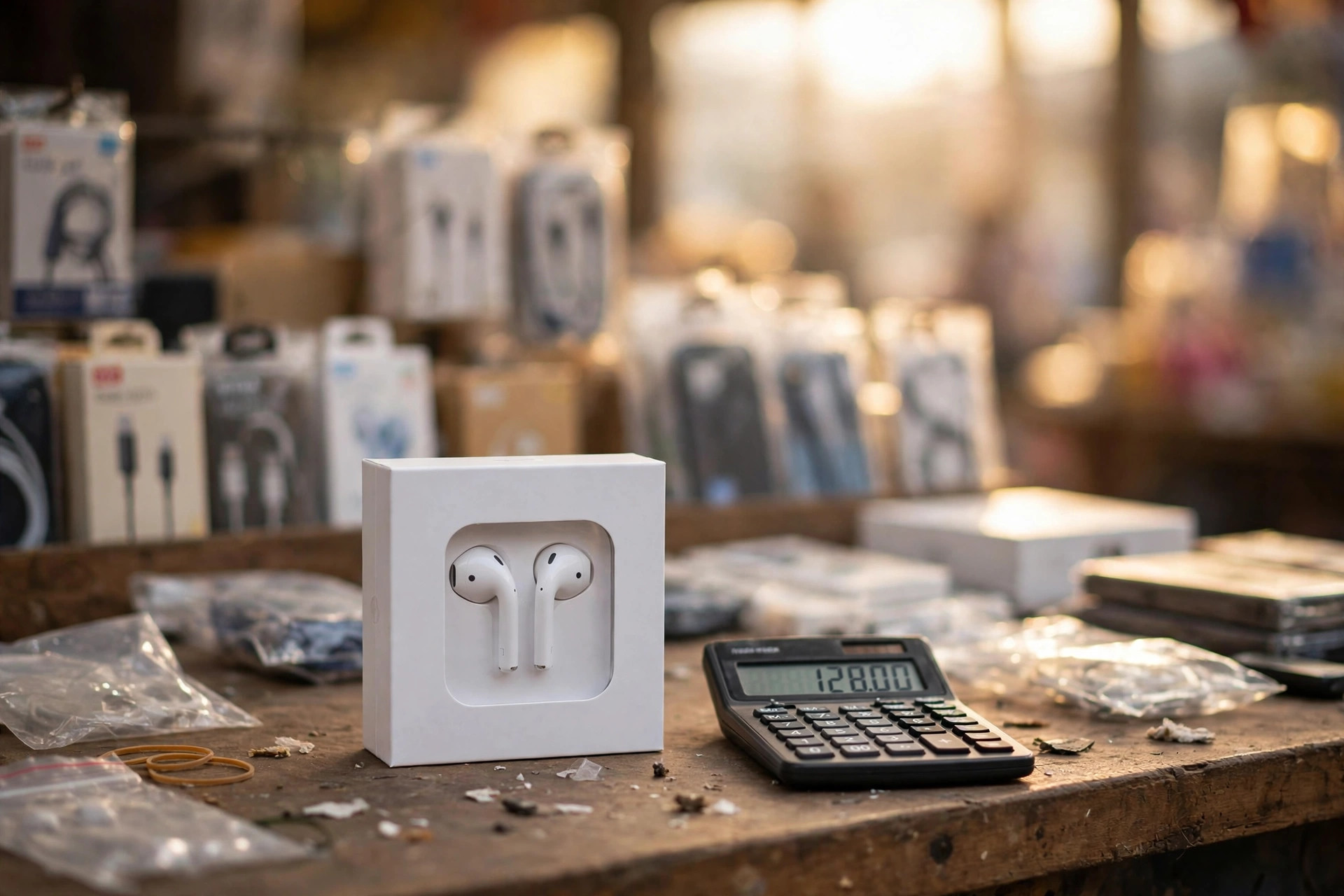
2. Ask plainly. "One piece OK?" works — or write it in a translation app and show the screen. Most stalls do not speak English beyond "hello" and "cheap price", so the phone calculator is the negotiation tool: the stall types a price, you type a lower one.
3. Test it before you pay. Power it on, on the spot, and check every function — not just that it switches on. Never accept "it will be unlocked later". For a second-hand phone, check that iCloud is signed out and the activation lock is off before money changes hands.
4. Pay like a local. Bring ¥500–1,000 in cash. Most stalls take Alipay or WeChat Pay — link one to a foreign card before you travel — but many do not accept foreign credit cards at all.
5. Get a receipt. Ask for a receipt with the model, serial number and warranty terms. At Feiyang, get the stall's own label stuck on the phone — that label is your only after-sales proof, usually 3 days.
Buying samples: the 5–10 unit test batch
If you are a hardware founder rather than a tourist, one unit is rarely the right buy. The standard move is a 5–10 unit test batch: enough to check quality across more than one piece, small enough to walk away from. Feiyang's own pattern supports this — 5–10-unit mixed batches are the normal way buyers test a market there.
What "bulk" actually looks like in Huaqiangbei: Agence France-Presse reported in November 2026 that African and Bangladeshi buyers were taking dozens of second-hand phones at a time — one Nigerian buyer bought about 40 in a single day — and damaged iPhone 13 Pro and 14 Pro models were going for about ¥1,000–2,000 each. That is the wholesale end of the district. Your 5–10 unit sample sits far below it, and stalls are used to it.
Getting one item home
A single item still has to clear shipping and customs. Anything with a lithium battery — phones, power banks, drones — is dangerous goods for shipping: use a DHL, FedEx or UPS battery channel (MSDS and UN38.3 paperwork) or a dedicated line that handles customs and tax. Power banks must carry the 3C mark or you cannot take them on a domestic flight in China.
US buyers, note: the $800 duty-free exemption is gone. De minimis for goods from China ended May 2, 2025, and for all countries on August 29, 2025. Samples and small top-up orders shipped to the US now need a customs declaration and full tariffs — the old "small parcel, no paperwork" route no longer exists, even for a single item.
What we charge
Our own Huaqiangbei guide days are listed at $299 per day, $599 for two days, and $2,499 per person for a four-day founder group — reference pricing, to be confirmed, as of November 2026; final rates are confirmed before booking. If you want that kind of help, send your list through our Sourcing Inquiry form: what you need, how many days you have, and what you want to buy.
FAQ
Can I buy a single item at Huaqiangbei, or is it wholesale only? You can buy a single item. Huaqiangbei is a wholesale district but not wholesale-only — most stalls sell one unit, especially on the retail-oriented floors. The wholesale floors may ask for 5–10 units as a minimum.
What is the minimum order quantity (MOQ) at Huaqiangbei? There is no district-wide MOQ. Retail floors sell single units; wholesale floors usually ask for 5–10 units. A minimum above 10 units for a standard gadget is above the usual range as of November 2026 — compare with the next stall.
Is one unit more expensive than buying in bulk? Yes. A phone case runs about ¥3–15 retail against about ¥1.5–6 in bulk. Bargaining still works on single units: open at 30–40% for electronics, around 50% for accessories.
Which building is best for buying a single item? Feiyang Times Building 1st floor for accessories, Huaqiang Electronics World ground floor for brand goods, and SEG Communications Market 3rd–4th floors for phone cases. Avoid the wholesale floors — Feiyang 4th floor, SEG Kang Le Building, Huaqiang Electronics World 2nd floor — if you only want one piece.
Can I buy one second-hand iPhone at Feiyang? Yes, on the 1st–3rd floors most stalls will sell a single unit; the 4th-floor wholesalers often ask for 5–10 units. Check that iCloud is signed out and the activation lock is off before you pay, and get the stall's label on the phone as your after-sales proof.
Can I ship a single item home from Huaqiangbei? Yes, but anything with a lithium battery must go through a battery channel (DHL, FedEx or UPS, with MSDS and UN38.3 paperwork). US buyers should also know the $800 duty-free exemption ended in 2025 — even a single item now needs a customs declaration and tariffs.
How we report prices
All prices here are the operators' own published prices or reported market prices as of November 2026. They are orientation figures, not quotes — prices move, pages change, and the cheapest listing is not always the price charged. Check the price on the day and confirm what is included before you buy. Our own figures are reference pricing, to be confirmed (November 2026).