Where to Buy Electronics in Shenzhen? (2026 Guide)
The short answer
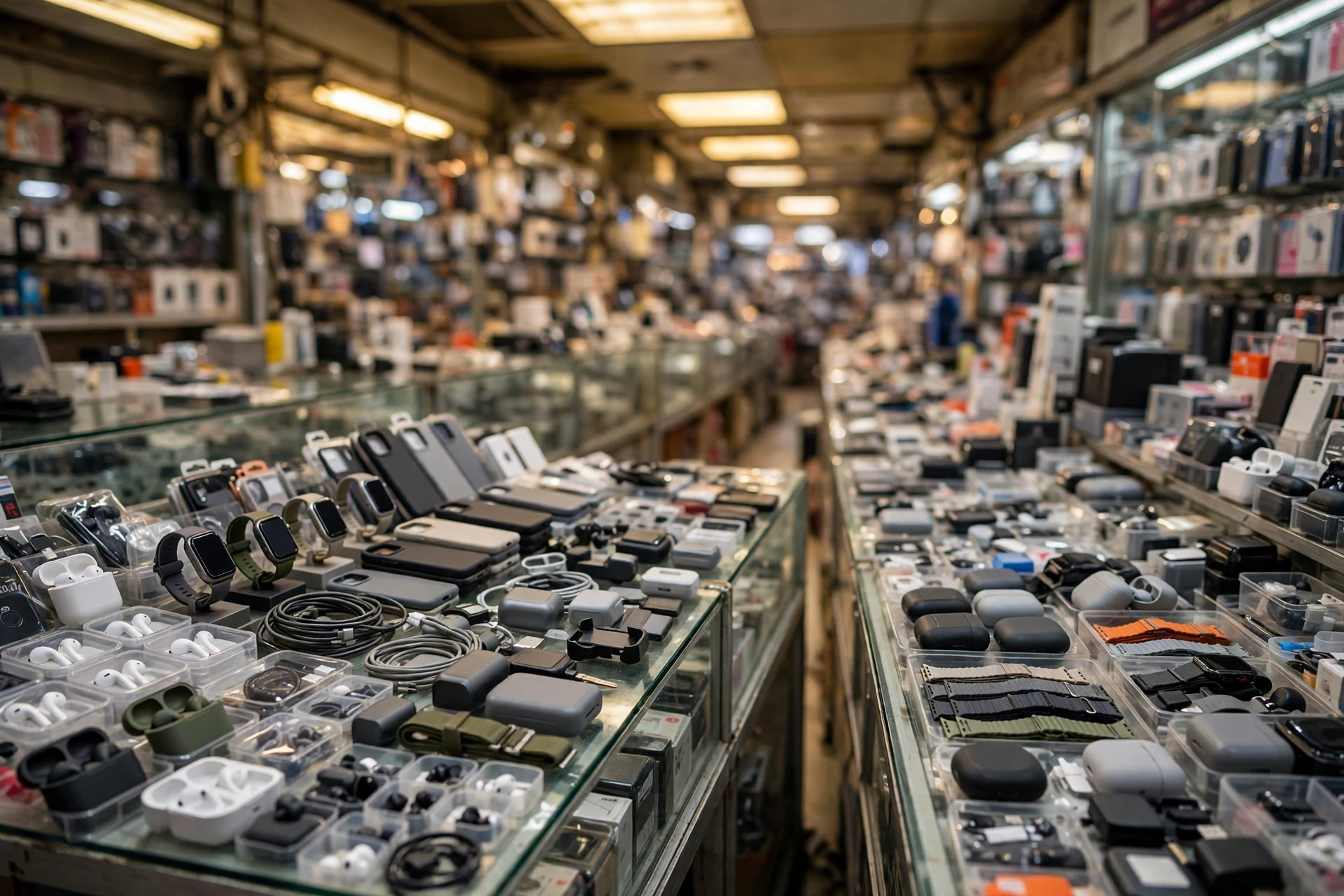
Go to Huaqiangbei, in Futian District. It is the largest electronics market district in the world — about 1.45 square kilometres, 35 professional markets and more than 115,000 merchants — and it is where almost everything electronic in Shenzhen is bought and sold. Inside the district, pick your building by what you need: SEG Plaza for components and PC parts, Huaqiang Electronics World for finished gadgets and AI hardware, and Feiyang Times Building for used iPhones and repair parts. Go between 14:00 and 18:00, bring Alipay or WeChat Pay plus ¥500–1,000 in cash, and do not go to Mingtong looking for electronics — it has been a cosmetics market since 2017.
Huaqiangbei at a glance
Huaqiangbei is not one market. It is a whole district of markets packed into about 1.45 square kilometres around Huaqiang North Road, in Futian District. A 2026 Futian district report puts the scale at 35 professional markets, more than 115,000 registered businesses and over ¥480 billion in annual trade. The nearest metro stops are Huaqiangbei Station (Lines 2 and 7) and Huaqiang Road Station (Line 1).
What makes it different from an ordinary shopping district is density: a buyer can compare the same component across a dozen stalls in one morning, and a hardware founder can find a part, a casing and an assembly shop within a few blocks. As of November 2026 the district is running hot — foreign buyers number roughly 8,000–12,000 a day (different reports give different figures), and AI products accounted for 61% of the district's electronics sales in January–July 2026, with AI glasses sales doubling year on year. APEC week in mid-November pushed it further: foreign buying groups of 30–50 people were reported in the markets, and some AI glasses shops said overseas customers were 80% of their trade.
The district is also where new hardware gets prototyped fast. A hardware maker hub opened in the central district in early November 2026, where visitors can build a small AI gadget in 10–20 minutes with 3D-printed shells and laser engraving on site — the operator says it serves about 1,000 visitors a day, 30–40% of them foreign. (Single source: China Daily Asia, 2026-11-22; the exact building and floor were not stated, so we do not list them.)
The buildings that matter
Four buildings cover almost everything a buyer needs. A fifth — Mingtong — is the trap: most English guides still list it as an electronics market, and it is not.
SEG Plaza — components, PC parts, phone accessories. SEG Plaza, at 1002 Huaqiang North Road, is the oldest market in the district — the market opened in 1988 — with more than 3,000 stalls on floors 1–10. What is verified across multiple sources: the 1st floor is electronic components (resistors, capacitors, batteries, power supplies, charging accessories); the 4th floor is brand computers (Dell, Huawei, HP, Samsung, Lenovo); and the 5th–6th floors are DIY hardware — graphics cards, memory, USB drives, SD cards, power supplies — plus computer repair benches. The middle and top floors vary between sources, so treat SEG by zones — components low, brand computers mid, DIY and repair higher — and check the floor directory on the day. Next door, the SEG Communications Market (SEGCOM, 1st–4th floors of Baohua Building) is the place for phone cases and accessories: the 3rd–4th floors are phone cases, iPad covers and screen protectors. Opening hours are roughly 09:30–18:30, with most stalls open after 10:30.
Huaqiang Electronics World — finished gadgets and AI hardware. Founded in 1998, this is the most foreign-buyer-friendly market in the district: many stall owners speak English, and some stalls on the 2nd floor of Store 1 accept foreign bank cards. It has two main buildings, each six floors: Store 1 (north building, 1001–1015 Huaqiang North Road) and Store 2 (south building, 1019 Huaqiang North Road, inside Huaqiang Plaza). The verified layout: the 1st floor is a brand experience zone — Huawei, DJI, HP, Lenovo, Apple and Xiaomi stores, plus game consoles — with high list prices, so browse but do not buy there; the 3rd floor is photography, live-streaming and e-sports gear (Sony, Canon, DJI and Insta360 cameras, live-streaming equipment, second-hand camera trade-in and repair); the 4th floor is DIY computers and IT accessories; the 5th floor is the global LED trading centre. The 2nd floor was upgraded in late October 2026 into a trendy digital wholesale centre aimed at cross-border sellers — earphones, power banks, drones, VR/AR glasses, smart robots, AI robot dogs, projectors and sports cameras — and the 6th floor is a components trading centre with authorised distributors; both of those floors rest on a single local guide, so confirm on site. Doors open around 09:30, stalls mostly open after 10:00, and the busiest window is 13:30–17:30.
Feiyang Times Building — used iPhones and repair parts. At 66 Huafa South Road, this four-floor building is China's largest used-Apple wholesale market, and the most precisely documented building in the district. The 1st floor is small electronics and accessories (watches, earphones, phone cases, screen protectors, cables) — aimed at walk-in buyers, with higher prices. The 2nd floor is phone repair parts: screens, batteries, mainboards, cameras and casings — "you can build a whole phone from a single screw", as the local saying goes. The 3rd floor is the main floor for used domestic iPhones, iPads, Apple Watches and AirPods, with the widest selection. The 4th floor is overseas versions — US, Japanese and Korean models, locked and unlocked. Feiyang opens late: trading floors open at 14:00, most stalls open after 14:00–15:00, the busiest hours are 17:00–21:00, and the building stays open until 23:00. Do not go in the morning. Almost nothing here is "brand-new sealed" — it is used, officially refurbished, or overseas stock; for brand-new phones, local buying guides point to Yuanwang Digital Mall instead. Small mixed batches of 5–10 units are usually possible, and single units can be bought on floors 1–3.
Mingtong Digital City — do NOT go here for electronics. This is the correction most guides get wrong. Mingtong has been a cosmetics wholesale market since 2017 — now China's largest cosmetics wholesale hub, with more than 1,400 shops open 10:00–02:00, selling MAC, Chanel, Dior, YSL, La Mer, Lancôme, SK-II and Estée Lauder. It switched because domestic phone brands squeezed electronics margins and intellectual-property enforcement tightened; by 2016 half of some floors were empty, and by 2020 the conversion to cosmetics was complete. Yet most English guides — including some updated in October 2026 — still describe it as the biggest all-electronics mall. Do not go to Mingtong for electronics. For phone cases go to SEGCOM or Huitong; for phones go to Yuanwang.
What to buy where
| You need | Go to | Notes |
|---|---|---|
| Electronic components, chips, resistors, capacitors | SEG Plaza 1F; Huaqiang Electronics World 6F | SEG 1F is the verified anchor; the 6F components floor rests on a single local guide |
| PC parts, graphics cards, memory, SSDs | SEG Plaza 5–6F; Huaqiang Electronics World 4F | Check prices at 3–5 stalls first — the same card can vary widely |
| Brand laptops and computers | SEG Plaza 4F | Dell, Huawei, HP, Samsung, Lenovo |
| Phone cases, screen protectors, accessories | SEGCOM 3–4F; Feiyang 1F | SEGCOM is wholesale; Feiyang 1F is walk-in retail |
| Gadgets, AI glasses, drones, smartwatches, earphones | Huaqiang Electronics World 1–2F | 1F list prices are high — buy on 2F or compare elsewhere |
| Cameras, live-streaming and e-sports gear | Huaqiang Electronics World 3F | Second-hand camera trade-in and repair here too |
| LED screens and lighting | Huaqiang Electronics World 5F | Engineering and commercial buyers gather here |
| Used iPhones, iPads, Apple Watches | Feiyang 3F (domestic); Feiyang 4F (overseas versions) | Check carrier lock and iCloud status before paying — see below |
| Repair parts: screens, batteries, mainboards | Feiyang 2F | Almost every removable Apple part is sold here |
| Brand-new phones | Yuanwang Digital Mall | Feiyang sells used and overseas stock, not new sealed phones |
When to go and how to pay
Most buildings open around 09:30–10:00, but most stalls only open after 10:30, and the best window across the district is 14:00–18:00. Feiyang is the exception — it opens at 14:00 and peaks 17:00–21:00. Sundays are quieter: many family-run stalls close, so go on a weekday if you can.
Payment is Alipay or WeChat Pay — both can be linked to a foreign Visa or Mastercard — plus ¥500–1,000 in cash as backup. Most stalls do not accept foreign credit cards, and some older components and repair stalls take cash or domestic transfer only. One practical note for US buyers: the $800 de minimis exemption for small parcels ended in 2025, so samples and small orders shipped to the US now go through customs declaration and full duty — factor that into the landed cost before you buy.
English is limited. Outside Huaqiang Electronics World, assume almost no one speaks English beyond "hello" and "cheap price" — use a translation app and a calculator for bargaining. For orders worth several thousand yuan, or anything involving certification and shipping, hiring a translator or sourcing agent for the day costs about ¥400–800.
How to bargain and not get burned
Bargaining is expected. For electronics, start at 30–40% of the quoted price; for accessories, about 50%. Compare the same item at 3–5 stalls before buying. The same-looking product can hide a different chip inside, and the price can differ by 50–200% — so a price that looks too good usually means a cheaper chip.
Counterfeits, refurbished goods and genuine stock often sit on the same counter. Always power the product on and test every function before paying, and never accept "we will unlock it later". Ask for a receipt. Power banks must carry the 3C mark or they cannot go on a domestic flight.
For used phones at Feiyang, the checks are specific: confirm iCloud is signed out and activation lock is off, with no hidden Apple ID; check the screen on pure white and pure black backgrounds for dead pixels, light leakage and yellowing; check battery health in settings and cross-check it against a third-party tool, since battery data is sometimes faked; check the IMEI by dialling *#06# for the serial number, activation date and warranty; and test Face ID, both cameras, speakers, compass and the charging port. Check the carrier lock in Settings → General → About — "No SIM restrictions" means unlocked; "SIM locked" means a locked phone. US models often have no physical SIM slot. After the sale, ask the stall to stick its own label on the phone — that label is the only warranty proof, usually 3 days (some stalls say 3–7 days), and it only counts if the label is intact. Do not peel it off or open the phone yourself; take it back to the stall if there is a problem. Used phones contain lithium batteries, which are Class 9 dangerous goods — do not ship them by ordinary postal parcel; use a DHL, FedEx or UPS battery channel (with MSDS and UN38.3 documents) or a dedicated air/sea line with customs clearance included.
What we charge
Our own Huaqiangbei guide days are listed at $299 per day, $599 for two days, and $2,499 per person for a four-day founder group — reference pricing, to be confirmed, as of November 2026; final rates are confirmed before booking. If you want that kind of help, send your list through our Sourcing Inquiry form: what you need, how many days you have, and what you want to buy.
FAQ
Which place in Shenzhen is popular for electronics? Huaqiangbei, in Futian District — about 1.45 square kilometres, 35 professional markets and more than 115,000 merchants. It is the largest electronics market district in the world, and the nearest metro stops are Huaqiangbei Station (Lines 2 and 7) and Huaqiang Road Station (Line 1).
Where to go in Shenzhen for technology? For components and PC parts, SEG Plaza. For finished gadgets and AI hardware, Huaqiang Electronics World. For used iPhones and repair parts, Feiyang Times Building. All three are inside Huaqiangbei, within walking distance of each other.
Is Huaqiangbei cheaper than buying online? Usually yes for components, accessories and small batches — a handheld game console with tens of thousands of games was reported at $20 and smartwatches at $10–20 during APEC week (NBC, November 2026) — but the price depends on the chip inside, so compare 3–5 stalls and test before paying.
Is Huaqiangbei worth visiting? If you buy hardware, yes. It is the one place where you can compare components, gadgets and used phones in a single afternoon, and where a prototype can go from idea to physical product in days. Go between 14:00 and 18:00, bring Alipay or WeChat Pay plus cash, and skip Mingtong — it sells cosmetics now.
Can I buy a single unit, or do I need to buy wholesale? Single units are possible at most stalls. At Feiyang, floors 1–3 usually sell single phones; the 4th floor's big wholesalers often ask for 5–10 units minimum. Small mixed batches of 5–10 units are a normal way to test a market.
Is Mingtong still an electronics market? No. Mingtong has been a cosmetics wholesale market since 2017 — China's largest, with 1,400+ shops selling MAC, Chanel, Dior and similar brands. Most English guides still list it as electronics; they are out of date.
What time should I go to Huaqiangbei? The best window is 14:00–18:00. Feiyang opens at 14:00 and peaks 17:00–21:00. Go on a weekday — many family stalls close on Sundays.
Do stalls take credit cards? Mostly no. Pay with Alipay or WeChat Pay (both accept foreign Visa/Mastercard) and carry ¥500–1,000 in cash. Some older stalls take cash or domestic transfer only.
How we report prices
All prices here are the operators' own published prices or reported market prices as of November 2026, or attributed to their source. They are orientation figures, not quotes — prices move, pages change, and the cheapest listing is not always the price charged. Check the price on the day and confirm what is included before you buy. Our own figures are reference pricing, to be confirmed (November 2026).