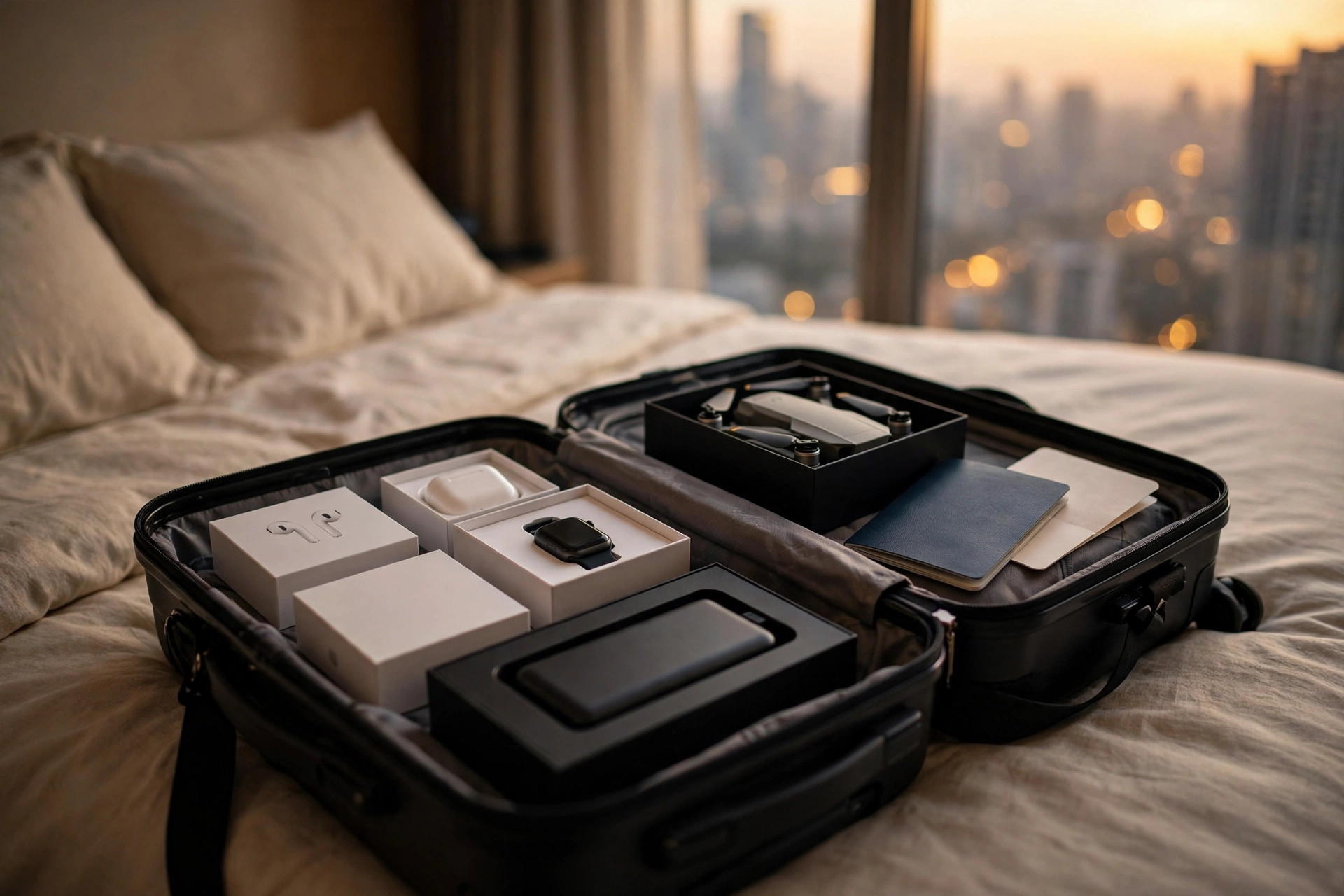
Can I Bring Electronics Bought at the Huaqiangbei Electronics Market Through Customs? Do I Have to Pay Tax? (2026 Guide)
The short answer
Yes — you can bring electronics bought at the Huaqiangbei electronics market through customs, and for a normal traveller's bag it is usually duty-free. Whether you pay tax comes down to three things: how much the goods are worth, whether they are for your own use, and whether you carry them in your luggage or mail them home. The luggage rules still work the way they always have. The postal rules do not: the United States ended its $800 duty-free parcel allowance, so anything you ship home now goes through customs and pays duty. Keep your receipts, stay inside your home country's traveller allowance, and declare anything over it.
The one distinction that decides everything: luggage vs. parcel
Customs treats the same phone two different ways depending on how it travels.
In your luggage, with you on the plane, it is a traveller's personal purchase. Every major country gives returning travellers a duty-free allowance for goods bought abroad — the United States, the European Union, the United Kingdom and Australia all still do, and the figures are in the table below. Stay inside your allowance, and you pay nothing.
In a parcel, shipped separately, it is an import. There is no traveller allowance for parcels, and in the United States the old $800 duty-free parcel rule — de minimis — is gone entirely (see the US section below). A parcel now needs a customs entry and pays full duty, even if it is only worth $40.
So the first decision is practical, not legal: if you can carry it home in your bag, carry it. If you have to ship it, budget for duty and paperwork.
What you can bring in duty-free — by country
These are the traveller allowances for goods in your accompanied luggage, as of November 2026. All four apply only to goods for your own use or as gifts — not to goods for resale.
| Arriving in | Duty-free allowance (other goods) | If you go over |
|---|---|---|
| United States | $800 per returning resident | Duty is charged only on the amount over $800; the next $1,000 is charged at a flat 3% rate |
| European Union | €430 by air or sea, €300 by land; €150 for travellers under 15 | Duty and VAT on thefull value of the item that exceeds the limit — you cannot split one item's value |
| United Kingdom | £390 (£270 if you arrive by private plane or boat) | Tax and duty on thetotal value of the goods, not just the excess |
| Australia | A$900 for adults 18+, A$450 for under-18s and crew | Duty and tax onall your general goods, not just the excess |
Three details that catch people out:
The United States counts the trip, not just the bag. The $800 exemption applies to a returning resident whose goods accompany them, for personal or household use, and it does not cover anything bought for sale or on commission. Under the underlying rule, the trip abroad must have lasted at least 48 hours and the exemption must not have been used in the previous 30 days. Families living in one household and returning together can combine their exemptions on one declaration.
The EU, UK and Australia tax the whole item, not the excess. A €900 phone is over the EU's €430 limit on its own, and duty and VAT are charged on €900 — not on the €470 above the limit. The same logic applies in the UK (£390) and Australia (A$900). The United States is the exception: duty is charged only on the amount over $800.
Your home country is the one that matters. Chinese customs does not tax you for taking personal-use electronics out of China. The bill, if there is one, is waiting at the airport where you land. If your country is not in the table, check its customs website before you fly — the pattern is the same everywhere, only the number changes.
The United States problem: de minimis is gone
This is the change that matters most for Huaqiangbei buyers, and it is the one most articles still get wrong.
The old rule was simple: parcels worth $800 or less entered the United States duty-free and with almost no paperwork. That rule — de minimis — is finished:
- 2 May 2025: goods from mainland China and Hong Kong lost de minimis.
- 29 August 2025: goods from every country lost it.
- 24 June 2026: US Customs and Border Protection (CBP) issued an interim final rule suspending the exemption indefinitely.
- 1 July 2027: the exemption is repealed by statute (Pub. L. 119-21).
- 20 February 2026: the US Supreme Court ruled that the International Emergency Economic Powers Act could not be used as the basis for tariffs — but that ruling did not restore de minimis.
What replaced it for parcels: since 24 July 2026, postal parcels worth $2,500 or less go through a new "postal informal entry" process, which requires a 10-digit HS code, a bonded declaration and monthly duty payment. Mail that needs a formal entry has a compliance deadline of 20 January 2027. CBP has also proposed tightening the declaration rules for low-value shipments of $2,500 or less, with public comments due 7 December 2026.
The practical result for a Huaqiangbei buyer: samples, small top-up orders and anything mailed directly to the United States now has to be declared and now pays full duty — the most-favoured-nation rate plus Section 301 and Section 232 duties stacked on top. The "small $40 parcel, no duty, no paperwork" model no longer exists. Carrying the same goods in your luggage, inside the $800 traveller exemption, is now the cheapest legal way to get them home.
At the airport: declare, and keep the receipts
Customs does not know what you paid unless you can show it. Three habits make the arrival smooth:
Keep every receipt, and keep the boxes. A stamped receipt showing the model, the serial number and the price is your proof of value. In Huaqiangbei, ask the stall for a stamped receipt with the model, serial number and warranty terms written on it before you pay — and test the goods on the spot, on power, before you hand over money. Never accept a promise to "unlock it later". A receipt is also the only thing that proves the value you declare is the value you paid.
If you are over the allowance, use the red channel and declare. The green channel is for nothing to declare; the red channel is for declaring. Declaring costs you the duty on the excess. Not declaring can cost you the goods: in the United Kingdom, the government states plainly that goods can be seized if you do not declare them, and the same logic applies everywhere else. If you are unsure, declare — the officer decides, and a declared item is never a smuggling problem.
Personal use is the test, not the receipt. Ten identical phones in sealed boxes does not look like personal use, even with receipts. Customs officers in every country apply the same question: does the type and quantity suggest these goods are for resale? A couple of gadgets for yourself and gifts for family is personal use. A carton of the same item is a commercial import, and it will be treated as one — with duty, and possibly a requirement to use a formal import entry. If you are buying in bulk for your business, ship it as a commercial import through a forwarder instead of carrying it in a suitcase.
Batteries: what can fly and what cannot
Electronics from Huaqiangbei almost always means lithium batteries, and aviation rules for batteries are stricter than customs rules.
Power banks go in your hand baggage — never in checked luggage. The International Air Transport Association (IATA) classifies power banks as spare batteries: they must be carried in carry-on baggage only, and if your hand baggage is taken at the gate to go in the hold, you must take all lithium devices and batteries out first. The same applies to spare, uninstalled batteries of any kind.
Size limits apply. Batteries up to 100 watt-hours need no airline approval — that covers almost every phone, laptop, camera and power bank a traveller carries. Batteries from 100 to 160 watt-hours need the airline's approval, with a limit of two spares per passenger. Anything over 160 watt-hours is prohibited on passenger flights. Check the watt-hour rating printed on the battery; if the rating cannot be verified, the airline may refuse to carry it.
In China, a power bank also needs the 3C mark to board a domestic flight. A power bank without China's compulsory 3C certification mark cannot be taken on a domestic flight in China. Check for the mark before you buy, especially on cheap no-brand power banks — it is the single most common reason a power bank is confiscated at a Chinese airport.
Used phones are a different problem when shipped. A used phone contains a lithium battery, which is Class 9 dangerous goods for transport. Do not send used phones by ordinary postal small packets. Use a DHL, FedEx or UPS battery channel with MSDS and UN38.3 documents, or a dedicated air or sea line that includes customs clearance and tax. This matters most for buyers at Feiyang Times Building, where the trade is second-hand phones.
The China side: leaving Shenzhen, and getting tax back
Leaving China is usually the easy part. As of November 2026, we found no published rule that stops a traveller carrying personal-use electronics out of China. The checks that bite are at the other end — and two things at the buying end that protect you later:
Buy goods with a clear provenance. Counterfeit and stolen goods are the real risk at customs. In November 2026, ahead of the APEC summit in Shenzhen, the Financial Times reported that the city cleared markets linked to smuggled chips and overseas iPhones, and stalls selling overseas iPhones at Feiyang Times Building were emptied. A phone that cannot be shown to be legitimately sourced can be seized as counterfeit or stolen, whatever you paid for it. Buy from stalls that give proper receipts, and be suspicious of any "new" phone sold far below the going rate.
Claim the departure tax refund before you leave. Huaqiangbei has departure tax-refund self-service terminals, so visitors can process the refund without leaving the area — the "instant refund on departure" system. Ask the shop whether it handles tax refunds and keep the invoice; foreign visitors' tax-refund applications rose 366% in the first half of 2026, so the system is now widely used. The refund is a bonus, not a right on every purchase — it depends on the shop being registered for it.
What we charge
Our own Huaqiangbei guide days are listed at $299 per day, $599 for two days, and $2,499 per person for a four-day founder group — reference pricing, to be confirmed, as of November 2026; final rates are confirmed before booking. If you want that kind of help, send your list through our Sourcing Inquiry form: what you need, how many days you have, and what you want to buy.
FAQ
Can I bring electronics bought at Huaqiangbei through customs? Yes. Electronics bought at the Huaqiangbei electronics market are ordinary goods — there is no ban on bringing them through customs. What matters is the value, whether they are for your own use, and whether you carry them in your luggage or ship them. Inside your home country's traveller allowance, you pay nothing.
Do I have to pay tax on electronics from Huaqiangbei? Only if the total value of what you are bringing in goes over your home country's duty-free allowance: $800 in the United States, €430 by air in the European Union, £390 in the United Kingdom, A$900 in Australia. Under the allowance, you pay nothing. Over it, you pay duty and tax — in the EU, UK and Australia on the full value of the item, in the United States only on the amount over $800.
Does the US $800 exemption still work after de minimis ended? Yes — they are two different rules. De minimis covered parcels sent by post, and that is gone. The $800 returning-resident exemption covers goods you carry in your luggage with you, and that still exists. The end of de minimis makes carrying your purchases home more attractive, not less.
Can I mail my Huaqiangbei purchases home instead of carrying them? You can, but for the United States it is now expensive and slow: every parcel needs a customs entry and pays full duty, and postal parcels of $2,500 or less use a new informal entry process that requires a 10-digit HS code and a bonded declaration. For other countries, parcels are treated as imports with no traveller allowance at all. Carry it if you can.
Can I put power banks and spare batteries in checked luggage? No. Power banks and spare lithium batteries must go in your hand baggage, on every airline, under IATA rules. Batteries over 160 watt-hours are prohibited entirely, and 100–160 watt-hour batteries need the airline's approval. In China, a power bank also needs the 3C mark to board a domestic flight.
Can I get a tax refund on what I buy at Huaqiangbei? Huaqiangbei has departure tax-refund self-service terminals, so you can process the refund without leaving the area. It depends on the shop being registered for tax refunds, so ask before you pay and keep the invoice.
How we report prices and rules
Allowances and rules here are from the issuing authority's own publications as of November 2026, or attributed to their source. They are orientation figures, not legal advice — customs rules change, pages update, and the officer at the airport has the final word. Check the official customs page of your home country on the day you fly, and confirm what is included before you travel. Our own figures are reference pricing, to be confirmed (November 2026). We are not customs brokers; for a commercial shipment, use a licensed broker or forwarder.