How Do I Pay at Huaqiangbei as a Foreigner? (2026 Guide)
The short answer
Link a foreign Visa or Mastercard to WeChat Pay or Alipay before you travel, and bring ¥500–1,000 in cash as well. In the Huaqiangbei electronics market, the two apps are how most stalls expect to be paid; a foreign credit card handed across the counter usually does not work. Cash is the backup that saves the purchase when an app fails or a stall takes cash only.
Before you travel: link your card at home
Both Alipay and WeChat Pay can be linked to a foreign Visa or Mastercard. That is the single most useful fact in this guide, and it is confirmed across multiple sources. Do the linking before you travel, not at the stall. A market stall is the worst place to set up a payment method for the first time: you are standing in a crowd, the seller is waiting, and you have no time to fix anything that goes wrong.
Set it up while you still have time, a stable connection and your own bank within reach. If something about the setup needs your bank, it is far easier to sort out from home than from a stall in Huaqiangbei. And set it up even if you plan to pay mostly in cash — the apps are how most stalls expect to be paid, and a working app gives you a second way to pay when cash runs short.
We do not give step-by-step instructions here, because the exact screens, the identity checks and the limits are not verified in our research files. What is verified is the principle: link a foreign card before you travel, and do not leave it until the day you arrive.
Set up both apps if you can, not just one. Each is accepted at most stalls, and having both means a problem with one does not leave you unable to pay. That is the practical reason for two apps rather than one.
What you can pay with at the stalls
Alipay and WeChat Pay are the main ways to pay. Across multiple sources, the rule is consistent: the stalls in the Shenzhen electronics market take Alipay or WeChat Pay, both of which can be linked to a foreign Visa or Mastercard before you travel. If you have one of the two apps working, you can pay at most stalls in the district.
Most stalls do not accept foreign credit cards. Handing over a foreign Visa or Mastercard at a stall usually does not work. The card itself is not the problem — the stall's payment setup is. Do not assume a stall takes cards because it takes mobile payments. Asking first costs nothing; discovering it at the moment of payment costs you the deal.
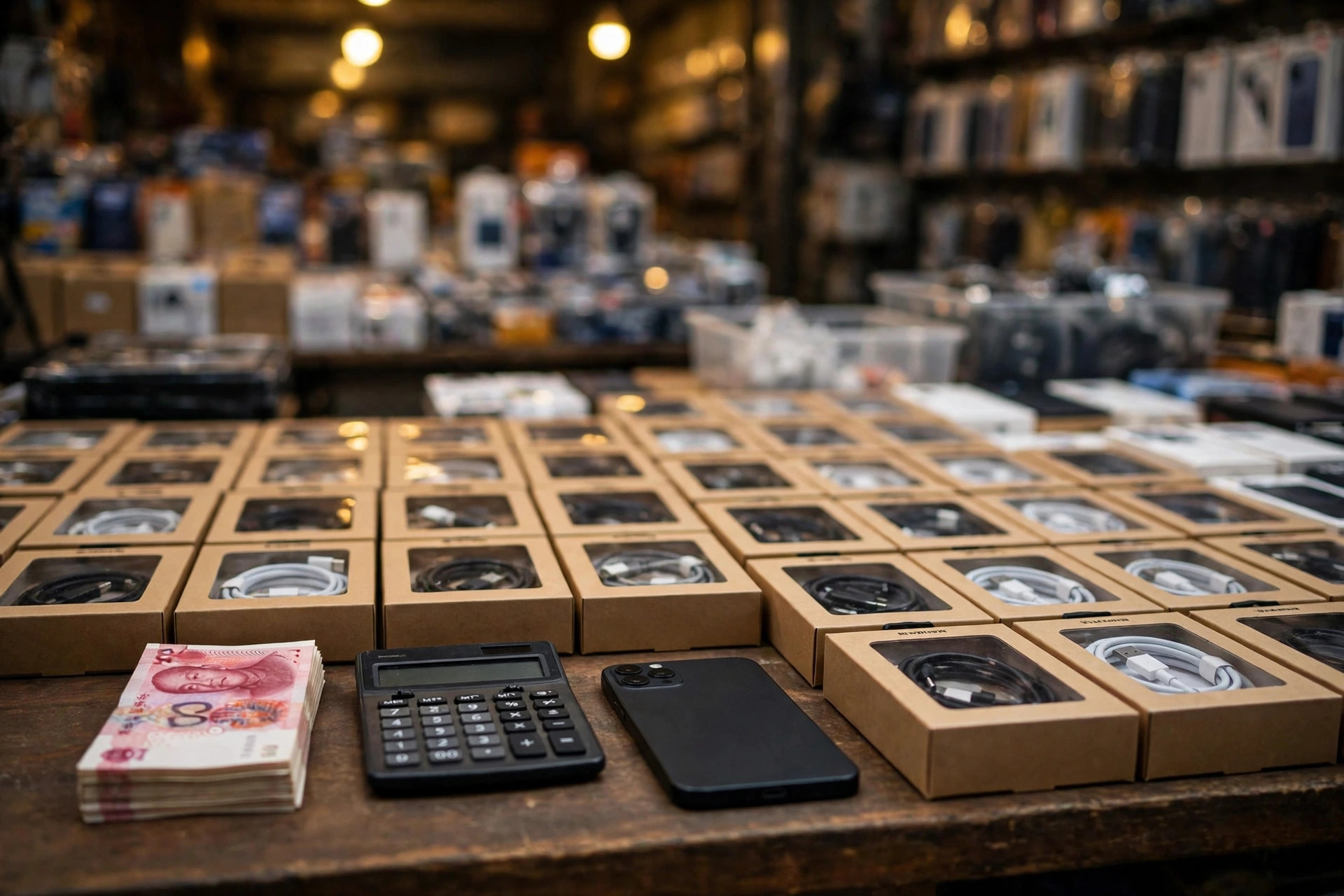
Cash still works, and you should carry it. Bring ¥500–1,000 in cash. That figure is confirmed across multiple sources, and it is the right size for a day in the markets: enough to cover stalls that only take cash, small purchases, and the moments when an app does not go through. Cash is not a leftover habit in Huaqiangbei. It is a working payment method, and on some stalls it is the only one.
Some stalls take cash or a domestic transfer only. According to a November 2026 local sourcing guide, some of the older component and repair stalls only accept cash or a domestic bank transfer. That is a single-source report, so treat it as a warning rather than a rule for every stall — but it is the reason the cash backup matters. A domestic transfer is not something a visiting buyer can usually make, so at those stalls cash is your only option.
What is changing: more stalls are starting to take foreign cards
The picture is moving. According to TVB News on November 17, 2026 — a single source, so read it as a trend rather than a settled fact — several shops in Huaqiangbei have started accepting international credit cards and other overseas electronic payments. The same report quotes a smart-glasses shop saying overseas tourists made up 80% of its customers in the preceding days.
That matches what is happening in the district more broadly. Foreign buyers are arriving at a rate of roughly 8,000–10,000 a day, and the markets are adapting to them. But "several shops" is not "most stalls", and a trend is not a guarantee. The safe way to read it is this: the situation is improving, and it is worth asking at a stall whether a foreign card works there now — but do not plan your trip around it. Link your card to Alipay or WeChat Pay before you travel, and bring the cash backup, exactly as before. If a stall takes your foreign card directly, that is a bonus, not the plan.
According to a November 2026 local sourcing guide, some stalls on the second floor of Huaqiang Electronics World — one of the most foreign-buyer-friendly markets in the district — accept foreign cards and offer multilingual service. That is a single-source report about one floor of one building, not a district-wide rule.
Feiyang: the strictest payment rule in the district
Feiyang Times Building, at 66 Huafa South Road, is the market for second-hand Apple products, and it has the strictest payment rule in Huaqiangbei. According to the 2026 Feiyang guide from the local sourcing team huaqiangbeimarket — a single source, but one that agrees with the district-wide rule — Feiyang stalls accept only WeChat Pay or cash, and most do not accept international credit cards or PayPal.
If you are buying phones at Feiyang, that rule shapes your whole visit. Make sure WeChat Pay is the app you have working before you go, and make sure your cash is enough for the purchase you plan to make. Do not walk into Feiyang counting on a foreign card or PayPal.
Feiyang's trading floors do not open until 14:00, and the busiest time is 17:00–21:00, so do not go in the morning. The building runs four floors, from small accessories on the ground floor to repair parts, second-hand China-market Apple devices, and overseas-version devices higher up. Whatever floor you buy on, the payment rule is the same: WeChat Pay or cash.
Paying without English
Assume almost nobody at the stalls speaks English beyond "hello" and "cheap price". That is confirmed across multiple sources. For payment, it barely matters: the seller shows you a payment code or types a price on a calculator, and you scan or pay. Bring a translation app for anything more complicated, and use the calculator on your phone to agree prices — the seller types a price, you type a lower one. For anything involving certificates, shipping or a large order, translation is part of a guided trip, not something to improvise at a stall.
When a payment does not go through
It happens, even with everything set up in advance. The principle for that moment is simple: have a second way to pay ready before you need it.
- Cash is the first fallback. This is why the ¥500–1,000 matters. A failed app payment at a stall that takes cash is a ten-second problem, not a lost purchase.
- The other app is the second fallback. If you have both Alipay and WeChat Pay set up before you travel, a problem with one does not leave you with nothing.
- Ask the stall what it takes. Some stalls take one app and not the other, and some take cash only. Asking before you agree on a price avoids the awkward moment of agreeing a deal you cannot pay for.
- Do not let a payment failure rush you. A seller may offer a workaround on the spot. Take a moment, check your second payment method, and only proceed when you are sure how you are paying and what you are paying for. A receipt matters: for expensive samples, ask for a stamped receipt stating the model, serial number and warranty terms.
We do not list specific error messages or fixes in this guide, because none are verified in our research files. If a payment method fails repeatedly, the practical answer is the fallback you already brought — cash, or the other app — not a fix attempted at the stall.
Tax refunds: get money back before you leave
Huaqiangbei has departure tax-refund self-service terminals, so visitors can process refunds without leaving the district, according to CCTV+ on November 18, 2026. If you are buying goods to take home, that matters twice: the refund is real money back, and you do not have to make a separate trip to claim it.
The scale of the trend is large. In the first half of 2026, the number of foreign travellers applying for departure tax refunds rose 366% year on year, and both refund sales and refund amounts grew 69%, according to Xinhua in English on October 2, 2026, citing Ministry of Commerce data. Keep your receipts — a refund claim starts with proof of purchase, and a stamped receipt stating the model and price is the proof that counts.
Before you leave the stall: check what you paid for
Payment and checking the goods go together. The rule confirmed across multiple sources is to test expensive samples on the spot, in full, before you pay — and to ask for a stamped receipt stating the model, serial number and warranty terms. A receipt is not paperwork for its own sake. It is your proof of what you bought, your basis for any follow-up with the stall, and the document a departure tax refund starts from.
- Test before you pay. Power the item on and run through its main functions at the stall. For second-hand devices, check that the previous owner's account is logged out and the activation lock is off before money changes hands.
- Get the receipt before you walk away. A stamped receipt stating the model, serial number and warranty terms is the standard to ask for on expensive samples. Keep every receipt, not just the big ones.
- Keep the seller's contact. The receipt and the stall's contact details are what let you follow up after you leave — for a missing part, a faulty unit, or a repeat order.
Where you will be paying
You do not need a floor-by-floor map to pay. Work by zones. At SEG Plaza, the verified zones are 1F for components, 4F for branded computers, and 5–6F for DIY hardware and repair. The full floor tables for SEG disagree across sources, so this guide does not print one — the zones are enough to find what you need, and the payment rules are the same on every floor.
Huaqiang Electronics World, founded in 1998, is one of the most foreign-buyer-friendly markets in the district: two buildings, six floors each, at 1001–1015 and 1019 Huaqiangbei Road. One building to skip: Mingtong. Mingtong stopped being an electronics market in 2017. It is now a cosmetics wholesale market. Most English guides still list it as an electronics market, and they are wrong — including some updated as recently as October 2026. Do not go to Mingtong to buy electronics, and do not plan a payment setup around it.
Most buildings in the district open around 10:00–10:30 and close around 18:30, and the best window is the afternoon, 14:00–18:00. That is when the stalls are fully open and the day's trading is at its busiest — and it is also when a payment problem costs you the most, because the seller you need may close before you can come back.
Guided help
If you want the payment setup handled with you on the day, our guided Huaqiangbei days include WeChat Pay and Alipay setup help, on-site sample buying with translation, and supplier contacts and receipts collected for you. The three tiers are a one-day guided sourcing day at $299, two days with factory visits at $599, and a four-day founder group at $2,499 per person — reference pricing, to be confirmed, as of November 2026; final rates are confirmed before booking. If you want that kind of help, send your list through our Sourcing Inquiry form: what you need, how many days you have, and what you want to buy.
FAQ
How do I pay at Huaqiangbei as a foreigner? Link a foreign Visa or Mastercard to WeChat Pay or Alipay before you travel, and bring ¥500–1,000 in cash. In the Huaqiangbei electronics market, the two apps are how most stalls expect to be paid, and a foreign credit card handed across the counter usually does not work.
Cash, card, WeChat Pay, or Alipay — which one should I use? WeChat Pay or Alipay first, cash as backup. A foreign card on its own is the weakest option: most stalls in the Shenzhen electronics market do not take one directly. Set up both apps before you travel so one is a fallback for the other.
Can I pay with a foreign credit card in Huaqiangbei? At most stalls, no. Some shops have started accepting international credit cards, according to TVB News on November 17, 2026, but that is a recent trend at several shops, not a district-wide rule. Plan on the apps and cash.
How much cash should I bring to Huaqiangbei? ¥500–1,000 for a day in the markets. That covers stalls that only take cash, small purchases, and the moments when an app does not go through.
Can I pay by PayPal at the stalls? At Feiyang, most stalls do not accept PayPal, according to the 2026 Feiyang guide from the local sourcing team. Across the district generally, the stalls take Alipay, WeChat Pay or cash. Do not plan on PayPal.
What if my payment fails at a stall? Use your fallback: cash first, the other app second. Ask the stall what it takes before you agree on a price, and do not let a failed payment rush you into a workaround you are not sure about.
Can I claim a tax refund on what I buy? Huaqiangbei has departure tax-refund self-service terminals, so you can process refunds without leaving the district, according to CCTV+ on November 18, 2026. Keep your receipts — they are the basis of the claim.
Can I pay with cash only, without setting up either app? Cash works at the stalls, and some stalls take cash only. But the apps are how most stalls expect to be paid, and cash-only travel leaves you with one way to pay and no fallback. Set up at least one app before you travel, and bring the cash as well.
About the facts in this guide
All facts here are as of November 2026. Multi-source facts are stated plainly; single-source facts are attributed in the text to their source. We do not publish step-by-step app setup instructions, transaction limits, card-linking fees or error-message fixes, because none of those are verified in our research. If a number in this guide has moved since November 2026, check it on the day before you travel.