The short answer
Huaqiangbei is the world's largest electronics market — about 35 specialised markets and more than 115,000 merchants packed into 1.45 square kilometres of downtown Shenzhen — and the one thing a first-timer must know is that it is not one market but a district of separate buildings, each with its own speciality, hours and rules. Go to the wrong building and you waste half a day; go to the right floor and you can buy a single AI gadget before lunch.
What Huaqiangbei is
Huaqiangbei (pronounced "hwa-chyang-bay") sits on Huaqiangbei Road in Shenzhen's Futian District. The official figures, from a February 2026 Futian district report carried by EIN Presswire: about 1.45 square kilometres, 115,000+ registered market entities, 35 specialised electronics markets, annual trade of more than ¥480 billion, and about 780,000 people passing through every day. Today it is where the world's hardware gets bought, copied, repaired and prototyped.
Why Huaqiangbei is suddenly famous
Two things happened in November 2026. First, Shenzhen hosted the APEC leaders' meeting on November 18–19, and Huaqiangbei was the showcase: NBC News sent its anchor Tom Llamas to walk the markets on November 19–20. Second, the numbers are real: since October 15, reports put daily foreign buyers at roughly 8,000–12,000 — CCTV News said over 12,000 a day, CCTV+ said over 10,000, other reporting put the usual figure near 8,000. The sources disagree, so treat the range as the fact. The deeper story is AI: AI products now account for 61% of the district's electronics sales, up from 41% in 2025, and in the first seven months of 2026 AI glasses sales doubled while drone and robot sales rose 60–70%.
What foreign buyers are actually buying
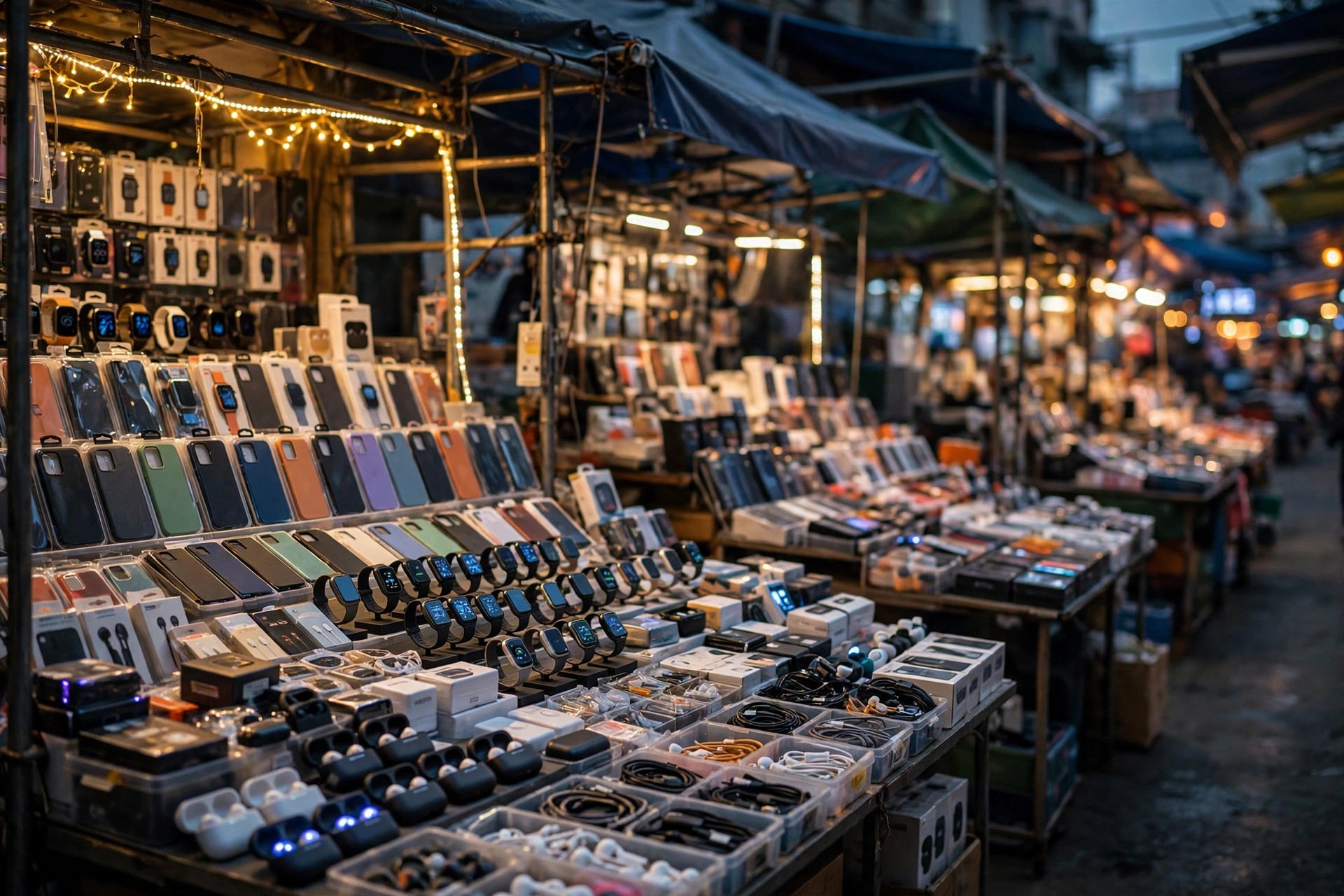
The crowds in November 2026 were not there for graphics cards. The hottest categories, from on-the-ground reporting, are AI glasses, AI toys and robot dogs, drones, translation devices and massage guns. The hottest item was an AI robot dog at about ¥390 (about $55): one AI toy shop said foreign customers had risen from about 20% to more than 40%. A French customer bought two drones at ¥158 each (€100 back in France); a Peruvian delegate spent about $400 on AI glasses and a massage gun. Second-hand phones are a market of their own: damaged iPhone 13 Pro and 14 Pro models go for about ¥1,000–2,000 each (Agence France-Presse, November 19). Hardware founders: the new Maker Hub opened in early November in the district's central area (China Daily Asia, single source; exact building not published).
The four buildings that matter
1. SEG Plaza — components, brand computers, DIY hardware
SEG Plaza, at 1002 Huaqiangbei Road, is where most first-timers should start. The electronics market occupies floors 1–10 (offices sit above), with 3,000+ stalls, since 1988. Don't memorise a floor table — at least three different plans circulate. Use zones: the lower floors are components, batteries and power supplies; a middle floor is brand-name computers (Dell, Huawei, HP, Samsung, Lenovo); the upper market floors are DIY hardware — graphics cards, memory, USB drives and power supplies — plus repair benches.
2. Huaqiang Electronics World — the biggest all-round market
Founded in 1998, Huaqiang Electronics World is the most foreign-buyer-friendly market in the district. It has two main buildings, each six floors: the North Building (1001–1015 Huaqiangbei Road) and the South Building (1019 Huaqiangbei Road, inside Huaqiang Plaza). Caution: the layout changed in late 2026, so older guides are out of date. As of November 2026, ground floor up: brand zone (high prices, look but don't buy), trendy digital, cameras and live-streaming, DIY computers, LED, components. The 2nd, 4th and 6th floors rest on a single November 2026 local guide — check the signs on the day.
3. Feiyang Times Building — used Apple devices, and different hours
Feiyang Times Building, at 66 Huafa South Road, is China's largest wholesale market for second-hand Apple products. Four floors: accessories, phone repair parts, second-hand China-market Apple devices, overseas-version devices. The hours are different here: trading floors open at 14:00, busiest 17:00–21:00, open until 23:00 — don't go in the morning. Know the rules: almost nothing is "brand-new sealed"; US models may be carrier-locked; check functions first, then software, and only then pay; get the stall's label on the phone — your only after-sales proof, usually 3 days.
4. Mingtong Digital City — the trap: it is NOT an electronics market anymore
Read this before you go: Mingtong stopped being an electronics market in 2017. It is now a cosmetics wholesale market — one of China's largest, with 1,400+ shops open 10:00 to 02:00 the next day. Most English guides still get this wrong — as of an October 2026 update, shenzhen-trip.com still calls Mingtong the biggest all-electronics mall. Go to Mingtong for electronics and you will waste half a day. For phone cases go to the SEG Communications Market; for phones, go to Yuanwang.
How to shop Huaqiangbei
Hours and getting there. Most buildings open around 10:00–10:30 and close around 18:30; the best window is 14:00–18:00, and Sundays are quiet. Feiyang is the exception: 14:00 to 23:00. Take the metro to Huaqiangbei Station (Lines 2 and 7); Huaqiang Road Station (Line 1) sits at the southern edge.
Money and language. Bring ¥500–1,000 in cash. Most stalls take Alipay or WeChat Pay — link one to a foreign card before you travel — but many do not accept foreign credit cards at all. Almost nobody speaks English beyond "hello" and "cheap price": use a translation app and the phone calculator to haggle. For big orders, hire a translator for the day (about ¥400–800, per one local guide).
Bargaining. Never accept the first price. For electronics, open at 30–40% of the quote; for accessories, around 50%. Compare 3–5 stalls — the same-looking product can differ 50–200% in price because the chip inside is different, so ask what chip it uses. Check Amazon or Taobao first — if the Huaqiangbei quote is above the online price, walk away.
Fakes. Genuine, refurbished and counterfeit goods often sit on the same counter. Test everything powered on, on the spot — every function, not just power-on — and never accept "it will be unlocked later". Ask for a receipt with the model, serial number and warranty terms. Power banks must carry the 3C mark or you cannot take them on a domestic flight in China. Beware prices far below the market — an RTX 5080 was about ¥14,000 in mid-November, nearly double the official ¥8,299 guide price.
Shipping and customs. Buy 5–10 units to test a market before committing to volume. Anything with a lithium battery (phones, power banks, drones) is dangerous goods for shipping: use a DHL, FedEx or UPS battery channel (MSDS and UN38.3 paperwork) or a dedicated line that handles customs and tax. US buyers: the $800 duty-free exemption is gone — de minimis for goods from China ended May 2, 2025, and for all countries on August 29, 2025.
Do you need a guide?
If you only want to look around, no. If you are buying samples, negotiating, or visiting factories, a local English-speaking guide usually pays for itself in the first hour. Guide fees run from $90–150 (shenzhen-trip.com) and $99 for 2.5 hours (hqbguide.com) to $225 for 3 hours (GetYourGuide) and $299–$2,499 per person (szhardwareguide.com, booked into Q1 2027), and $3,000–$3,500 for a six-day founder tour (thefuturefactory.ai). Those are each operator's own published prices. What you pay for is someone who knows which floor, stall and question to ask. If you want that kind of help, send your list through our Sourcing Inquiry form.
FAQ
What should a first-time buyer buy in Huaqiangbei? AI glasses, AI toys and robot dogs, drones, translation devices and massage guns — the AI robot dog at about ¥390 was the hottest item in November 2026.
Can I buy a single item in Huaqiangbei, or is it wholesale only? You can buy a single item. Most stalls will sell one unit, especially on the retail-oriented floors; the wholesale-oriented floors may ask for 5–10 units as a minimum.
How do I bargain in Huaqiangbei? Open at 30–40% for electronics, around 50% for accessories, and expect to meet in the middle. Compare 3–5 stalls, ask what chip is inside, and haggle on the phone calculator.
How do I pay in Huaqiangbei as a foreigner? Set up WeChat Pay or Alipay with a foreign card before you travel, and bring ¥500–1,000 in cash. Most stalls do not accept foreign credit cards.
How do I avoid fakes in Huaqiangbei? Test everything powered on, on the spot. Assume genuine, refurbished and counterfeit goods can sit on the same counter. Ask for a receipt with the model, serial number and warranty terms.
Is one day enough for Huaqiangbei? For a first look, yes: SEG, then Huaqiang Electronics World, then Feiyang after 14:00. For serious buying, plan two days.
How we report prices
All prices are orientation figures from November 2026 reporting; prices move weekly, so always check on the day.