How Do I Check Quality and Avoid Fake Products at Huaqiangbei? (2026 Guide)
The short answer
At the Huaqiangbei electronics market, genuine, refurbished and copy products often sit on the same counter — so the check happens before you pay, not after. Power the item on in front of the vendor and test every function, compare the same item at three to five stalls, get a stamped receipt that lists the model, serial number and warranty terms, and walk away from any "unlock it later" promise. If a price is far below every other stall, the difference is usually in the chip inside, not in the bargain.
What "fake" actually means at Huaqiangbei
Three kinds of goods share the counters here, and only one of them is what most buyers mean by "fake".
Genuine goods. Brand stores and authorised distributors sell genuine products — at genuine prices. The brand experience zone on the first floor of Huaqiang Electronics World, for example, is priced high and is not the place to do your main buying. Genuine does not mean cheap here.
Refurbished and used goods. A large part of the market trades in used and refurbished devices, and this is normal, not a scam — as long as you know what you are buying. Feiyang Times Building, the used-Apple wholesale market, sells used, official-replacement, refurbished and overseas-version phones, and vendors there say there are almost no genuinely new sealed units in the building. A "brand-new sealed" iPhone at Feiyang should set off alarm bells, not excitement.
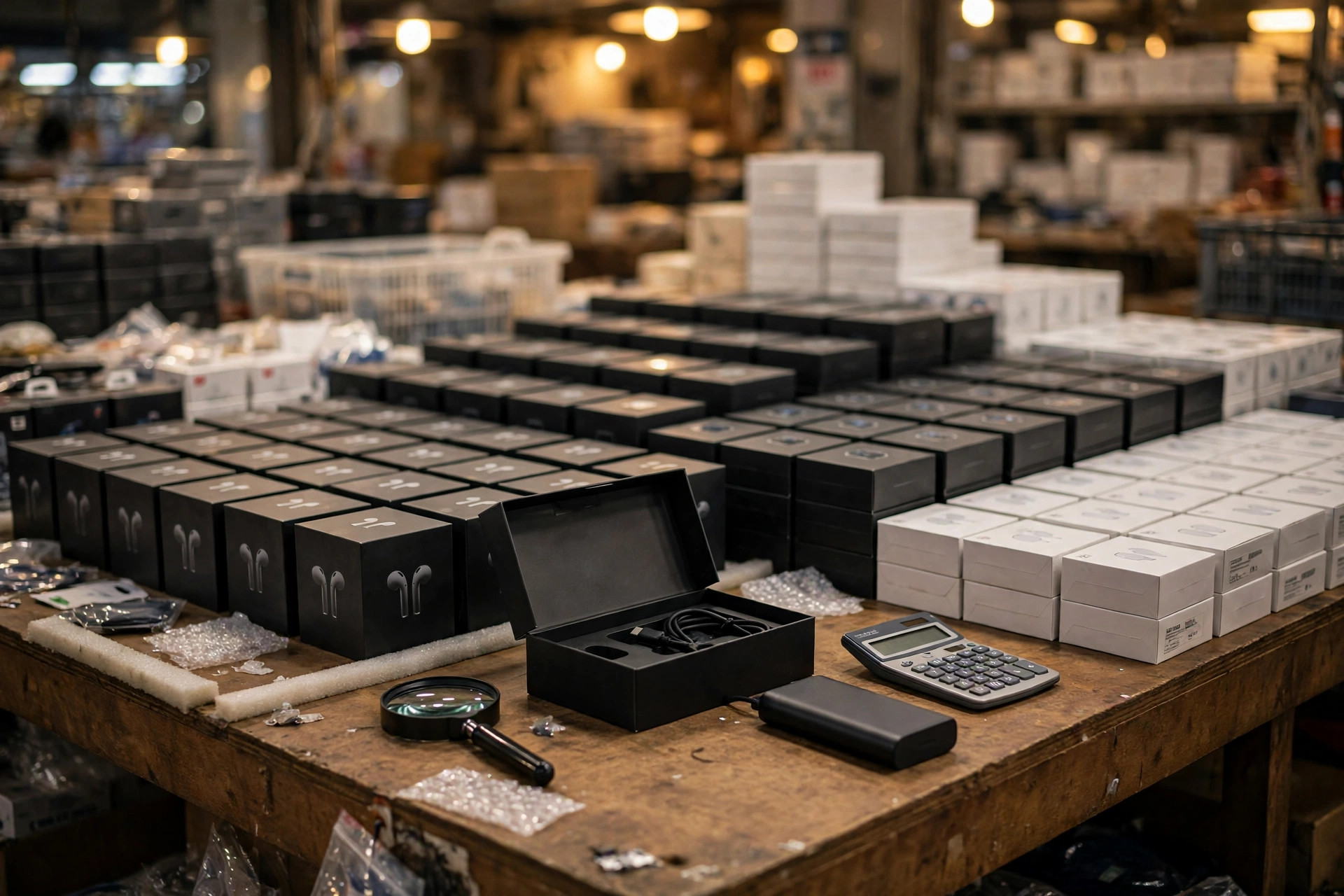
Copies and white-label goods. Many stalls sell look-alike products: the outside looks identical to a branded item, but the chip inside is different, and the price can differ by 50–200% for what looks like the same product. NBC's reporting from the market in November 2026 put it plainly: many goods are cheap because they copy brand designs, and the reporters questioned their durability. A copy sold at a copy price is a fair deal. A copy sold at a genuine price is the fraud to watch for.
The market does not label these for you. The same counter can hold all three. So you check the item, not the stall.
The golden rule: test everything before you pay
This is the one rule that matters most. Once you leave the stall, your leverage is gone.
Power it on at the stall and test every function. Screen, cameras, speakers, charging port, Face ID, buttons, Bluetooth and Wi-Fi. Never accept "unlock it later", "activate it at home" or "test it at the hotel". A vendor who will not let you power the item on is a vendor to walk away from.
For used iPhones at Feiyang, run the full check. The local buying guide for the building lists the sequence: check functions first, then run software diagnostics, and pay only after everything is confirmed. If you open the phone or run a diagnostic tool before checking, a return gets messy.
- Confirm iCloud is signed out, Activation Lock is off, and there is no hidden Apple ID.
- Check the screen on pure white and pure black backgrounds for light leakage, dead pixels and yellowing.
- Check battery health in Settings (maximum capacity), then cross-check with Aisi Assistant or Shalou Assistant whether the battery is original. Watch out for faked battery-health data — a top-grade unit should show 90–100%, and a faked number is a known trick.
- Check the IMEI by dialling *#06# — serial number, activation date, warranty.
- Test every function: Face ID, front and rear camera focus, speakers, compass, charging port.
- Look at the liquid-contact indicator inside the SIM tray: red means water exposure.
- Know the grades: A+ is near-new, A is excellent (no screen scratches, never opened for repair), B is light wear, C is heavy wear or damage. In local slang, a "liang ji" is near-new and a "xiao hua ji" has light wear.
For power banks, check the 3C mark. A power bank without the 3C mark cannot be taken on a domestic flight in China. Check the mark before you buy, not at the airport.
For earphones, smartwatches, speakers and AI gadgets, test the real thing. Pair them, charge them, press the buttons, listen to the sound. Then compare the same item at three to five stalls before you buy — the same look with a different chip inside is the most common surprise in this market.
Get the vendor's label on the item. After the sale, ask the vendor to stick their own shop label on the item. That label is the only after-sales proof: it is typically valid for about 3 days (some stalls say 3–7 days), and only while the label is intact. If something goes wrong, do not tear the label off and do not open the device yourself — take it back to the stall.
The receipt is your only paper trail
Ask for a stamped receipt that lists the model, serial number and warranty terms. Add the vendor on WeChat so you have a contact for follow-up and after-sales. Reputable electronics and computer hardware at the market often carry about a one-year stall warranty, according to the 2026 local buying guide — but that warranty only means something if you have the receipt and the label to prove where you bought it. Keep both until you are home and the item has survived a few days of use.
Price checks: compare before you buy
- Haggle from 30–40% of the quoted price for electronics, and from about 50% for accessories. Then compare the same item at three to five stalls before you buy.
- The same look with a different chip inside can mean a price difference of 50–200%. If one stall is far cheaper than all the others, the difference is usually inside the product.
- The brand zone on the first floor of Huaqiang Electronics World is priced high — use it to see products, not to buy them.
- Price anchors from November 2026 on-the-ground reporting, not quotes: NBC saw a handheld console with tens of thousands of games for $20 and smartwatches for $10–20. AFP reported damaged iPhone 13 Pro and 14 Pro units at about ¥1,000–2,000 each in the used-phone trade. Use these as a sense of the market, not as prices you will be charged.
Where the risk concentrates
Feiyang Times Building (four floors, opens at 14:00, busiest 17:00–21:00) is China's largest used-Apple wholesale market, and the place where the checks above matter most. The first floor sells small electronics and accessories at tourist prices; the second floor sells phone repair parts; the third floor is the main floor for used domestic iPhones, with the widest selection; the fourth floor sells overseas versions — US, Japanese and Korean models, locked and unlocked. Single units are usually fine on the first three floors; fourth-floor wholesalers often want 5–10 units minimum. Small mixed batches of 5–10 units are possible. Payment is WeChat Pay or cash only — most stalls do not take international cards or PayPal.
SEG Plaza is the computer-hardware building: low floors for components, mid floors for brand computers, high floors for DIY hardware and repair — graphics cards, memory, storage and power supplies, with repair benches on the fifth and sixth floors. Floor layouts here vary between sources, so check the signs on the day rather than trusting a fixed floor map.
Huaqiang Electronics World has two main buildings of six floors each. The first floor is a brand experience zone (high prices), the third floor covers cameras, livestreaming and e-sports gear, the fifth floor is an LED trading centre, and the sixth floor is a components trading centre. The 2026 layout of this building changed recently, so treat any floor list as a guide, not a guarantee.
Mingtong Digital City is not an electronics market. Since 2017 it has been a cosmetics wholesale market — now China's largest cosmetics wholesale hub. Do not go there looking for electronics: most English guides still list it as an electronics market, and they are out of date.
Enforcement has tightened in 2026. In June 2026 the district ran a "617" special operation against smuggled and stolen phones, according to a local report, and before the APEC summit in November 2026, stalls selling overseas iPhones were cleared at Feiyang, according to the Financial Times. No official announcement or seizure figures were published, and some vendors expected the rules to loosen after the summit. The practical takeaway: buy from stalls that will give you a stamped receipt and a shop label, and be extra careful with phones that have no clear origin. A more formal alternative for used phones is PaiJiTang Mall, a self-service used-phone market run by ATRenew (Aihuishou).
Red flags: walk away when you see these
- "Pay now, unlock it or activate it later" — or "test it at the hotel".
- No receipt, or a receipt without the model and serial number.
- A "brand-new sealed" iPhone at Feiyang — the building sells used, official-replacement, refurbished and overseas-version phones.
- A price far below every other stall for the same item — the difference is usually the chip inside.
- Pressure to pay in full before testing, or a vendor who will not let you power the item on.
- A phone with iCloud still signed in, Activation Lock on, or a red liquid indicator in the SIM tray.
- A stall that will not put its own label on the item or give you a WeChat contact for after-sales.
When to pay for a professional check
If the order is large or the item is expensive, hire a third-party check instead of trusting your own eyes. Published prices from chicksourcing, captured on 22 November 2026: sample evaluation $49, supplier verification $49 online or $149 on site, pre-shipment inspection $149. A $49 check that finds a bad supplier is the cheapest money you will spend in China. For a first order with a new supplier, start with a sample order.
Getting it home: batteries and shipping
Used phones contain lithium batteries, and standalone batteries are Class 9 dangerous goods. Do not ship them by ordinary postal parcel. Use a DHL, FedEx or UPS battery channel (with MSDS and UN38.3 documents) or a dedicated air or sea line with customs clearance and tax included. And remember the power-bank rule: no 3C mark, no domestic flight. On the way out, Huaqiangbei has self-service departure tax-refund terminals — "buy now, refund now" without leaving the area.
What we charge
Our own Huaqiangbei guide days are listed at $299 per day, $599 for two days, and $2,499 per person for a four-day founder group — reference pricing, to be confirmed, as of November 2026; final rates are confirmed before booking. If you want that kind of help, send your list through our Sourcing Inquiry form: what you need, how many days you have, and what you want to buy.
FAQ
How do I check quality at Huaqiangbei? Power the item on at the stall and test every function before you pay — screen, cameras, speakers, charging port, Face ID. Never accept "unlock it later". Compare the same item at three to five stalls.
How do I avoid fake products at Huaqiangbei? Genuine, refurbished and copy goods often share the same counter. Check the item, not the stall: test it powered on, get a stamped receipt with the model and serial number, and walk away from prices far below every other stall — the difference is usually the chip inside.
Is everything at Huaqiangbei fake? No. The market sells genuine, refurbished, used and copy goods side by side. Brand zones and authorised distributors sell genuine goods; Feiyang sells mostly used and refurbished phones; many stalls sell honest white-label goods at low prices. The risk is a copy sold at a genuine price — which the on-the-spot checks above are designed to catch.
Can I buy a brand-new iPhone at Huaqiangbei? Almost certainly not at Feiyang — the building sells used, official-replacement, refurbished and overseas-version phones, and vendors there say there are almost no genuinely new sealed units. For a new phone, buy from a brand store instead.
Do I need the 3C mark on a power bank? Yes, if you plan to fly within China: a power bank without the 3C mark cannot be taken on a domestic flight. Check the mark before you buy.
What should a receipt from Huaqiangbei show? A stamped receipt listing the model, serial number and warranty terms, plus the vendor's own shop label stuck on the item — the label is the only after-sales proof, typically valid for about 3 days.
Should I pay for a professional inspection? For a first order or an expensive item, yes. Published third-party prices: sample evaluation $49, pre-shipment inspection $149 (as of November 2026). A $49 check that finds a bad supplier is the cheapest money you will spend in China.
Can I ship phones home by regular post? No. Used phones contain lithium batteries, which are Class 9 dangerous goods. Use a DHL, FedEx or UPS battery channel with MSDS and UN38.3 documents, or a dedicated air or sea line.
How we report prices
All prices here are the operators' own published prices as of November 2026, or attributed to their source. They are orientation figures, not quotes — prices move, pages change, and the cheapest listing is not always the price charged. Check the price on the day and confirm what is included before you book. Our own figures are reference pricing, to be confirmed (November 2026).