Where Is China's Biggest Electronics Market? (2026 Guide)
The short answer
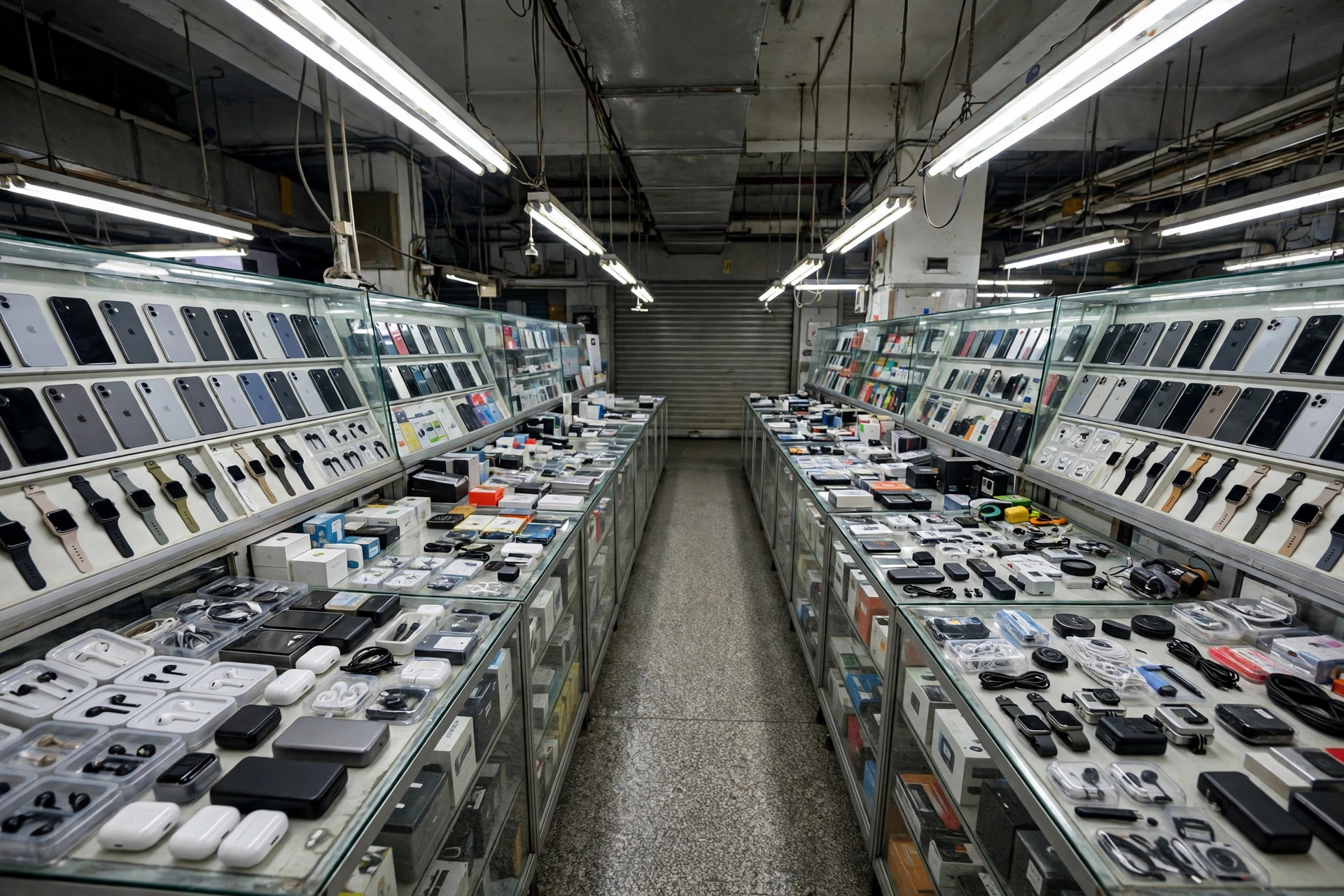
China's biggest electronics market is Huaqiangbei (华强北), in Futian District, Shenzhen — a district of about 1.45 square kilometres around Huaqiangbei Road, with 35 professional electronics markets, more than 115,000 merchants, and over ¥480 billion in annual trade. Get off at Huaqiangbei Station (Metro Lines 2 and 7) and you are in the middle of it. NBC News called it the world's largest electronics market when its anchor reported from there during the APEC summit week in November 2026.
Where exactly is it?
Huaqiangbei is not one building. It is a whole shopping district in central Shenzhen, roughly 1.45 square kilometres around Huaqiangbei Road in Futian District, Guangdong. The practical way to find it:
- Metro: Huaqiangbei Station, Lines 2 and 7, is the core station — most market buildings are a short walk from its exits. Huaqiang Road Station, Line 1, sits at the southern edge of the district.
- What to type into a map app: "Huaqiangbei Road, Futian District, Shenzhen" or "SEG Plaza, 1002 Huaqiangbei Road" — SEG Plaza is the district's best-known landmark and a good first meeting point.
- How big: 35 professional markets and more than 115,000 registered market businesses, with annual trade above ¥480 billion (Futian District report, February 2026, via shenzhendecoded.com). Daily foot traffic is about 780,000 people, and the district says more than 1 billion parcels a year leave Huaqiangbei, about 40% of them to 183 countries and regions.
Those figures are why "Huaqiangbei electronics market" is the search term buyers actually use — about 720 searches a month — and why the district, not any single mall, is the answer to "where is China's biggest electronics market?"
Why it is the biggest
Three things make Huaqiangbei different from any other electronics market in China: scale, foreign buyers, and speed.
Scale. No other Chinese electronics market comes close on the official numbers: 35 professional markets, 115,000+ merchants, ¥480 billion-plus in yearly trade. One note on the numbers: a second official figure counts 22 professional markets rather than 35, so the count depends on how the district defines a market — the 35 figure is the one the district published in February 2026.
Foreign buyers. About 8,000 foreign buyers a day visit Huaqiangbei on an ordinary day, rising past 10,000 during big events, according to the district's own figures. Chinese state media reported higher numbers after the APEC summit — over 12,000 foreign buyers a day since mid-October 2026, up about 80% year on year — so treat the range as roughly 8,000–12,000 a day as of November 2026, not a single fixed number. Foreign trade now accounts for more than 60% of most merchants' sales. The district has added tax-refund self-service terminals so visitors can claim refunds without leaving the area.
Speed. The district's own pitch, repeated by a Shenzhen tourism volunteer during APEC week, is that within one kilometre of Huaqiangbei you can have an idea in the morning and a product by the afternoon. That is not a slogan for tourists: in early November 2026 the district opened a Hardware Maker Hub in the centre of the area where visitors can build a small AI gadget — a voice assistant or a translator — in 10–20 minutes, with 3D-printed shells and laser engraving on site. The hub's manager says it gets more than 1,000 visitors a day, 30–40% of them foreign, and that the local supply chain can take a concept to a physical product in as little as 20 days. That figure is from a single report (China Daily Asia, 2026-11-22) and the hub's exact building and floor were not stated, so treat the location as "in the centre of the district" until it is confirmed on the ground.
What changed in 2026. The 33rd APEC Leaders' Meeting was held in Shenzhen on 18–19 November 2026, and Huaqiangbei was one of the places the world's cameras went. NBC's Nightly News anchor Tom Llamas reported from the market on 19–20 November, calling it the world's largest electronics market: a red handheld console loaded with tens of thousands of games for $20, smartwatches for $10–20, "thousands of merchants, 100+ shopping centres". NBC also noted the other side of the low prices — many products are cheap because they imitate brand designs — and questioned how long they last. AI products are now the district's growth story: in January–July 2026, AI products accounted for 61% of the district's electronics sales, up from 41% in 2025, with AI glasses sales doubling and drone and robot sales up roughly 60–70%.
The four buildings that matter
Huaqiangbei is a district of dozens of markets, but a first-time buyer only needs four buildings — three to visit, and one to avoid.
1. SEG Plaza (赛格广场) — components and computers
- Address: 1002 Huaqiangbei Road. Metro: Huaqiangbei Station (Lines 2 and 7); Huaqiang Road Station (Line 1) is about a 5-minute walk.
- What it is: the district's oldest market, opened in 1988, with the electronics market on floors 1–10 and more than 3,000 stalls. Offices and company headquarters sit above.
- What to buy, by zone: the low floors are electronic components (1F is the consensus floor for components, batteries and power accessories); the middle floors are brand computers — Dell, Huawei, HP, Samsung and Lenovo on 4F; floors 5–6 are DIY hardware (graphics cards, memory, storage, power supplies) and computer repair. The floor-by-floor layout is the most disputed of the four buildings: sources disagree on floors 2, 3 and 7–10, so shop by zone, not by an exact floor number, and follow the signs on the day.
- Next door: the SEG Communication Market (SEGCOM, Baohua Building B, floors 1–4) is where phone cases, screen protectors and straps live — phone cases retail for about ¥3–15, wholesale from about ¥1.5.
- Hours: sources disagree, roughly 9:30–18:30, with most stalls only fully open after 10:30.
2. Huaqiang Electronics World (华强电子世界) — the best first stop for foreign buyers
- Address: Store 1 (north building), 1001–1015 Huaqiangbei Road; Store 2 (south building), 1019 Huaqiangbei Road, inside Huaqiang Plaza, floors 1–6. Metro: Huaqiangbei Station (Lines 2 and 7), Exit E2, about 100 metres on foot.
- What it is: founded in 1998 by the Huaqiang Group, two six-floor buildings, about 40,000 square metres and about 3,339 merchants (the operator's own figure, not independently verified). It is the market where foreign buyers concentrate most, and the one where stallholders are most likely to speak some English — some stalls on 2F of Store 1 offer multilingual service and accept foreign cards.
- What to buy, by floor (Store 1, as of November 2026): 1F is brand experience stores (Huawei, DJI, HP, Lenovo, Apple, Xiaomi) plus game consoles — prices here are high, so look, don't buy; 2F is the trendy digital wholesale centre, upgraded in late October 2026, aimed at cross-border sellers and bulk buyers (earphones, power banks, massage guns, gimbals, drones, VR/AR glasses, smart robots, robot dogs, tablets, Bluetooth speakers, projectors, action cameras); 3F is photography, live-streaming and gaming gear; 4F is DIY computers and IT accessories; 5F is the LED trading centre; 6F is electronic components, where authorised distributors concentrate. Store 2 follows a similar pattern. One caution: the market was reorganised in 2026, and older floor guides circulating online (components on 1–2F, second-hand laptops on 4F, LCDs on 5F, warehousing on 6F) are out of date — use the November 2026 layout above, and note that the full floor table rests on a single local guide.
- Hours: doors open about 9:30, stalls mostly open after 10:00 and fully open by 11:30–12:00; busiest 13:30–17:30.
3. Feiyang Times Building (飞扬时代大厦) — used Apple products
- Address: 66 Huafa South Road. Metro: Huaqiangbei Station (Lines 2 and 7); Huaqiang South Station (Lines 7 and 11) is the closer stop according to the most detailed local guide.
- What it is: four floors, and China's largest wholesale market for second-hand Apple products — the most thoroughly verified building of the four.
- What to buy, by floor: 1F is small electronics and accessories (watches, earphones, phone cases, screen protectors, cables) — mostly for walk-in visitors, prices higher, not the main buying floor; 2F is phone repair parts (screens, batteries, motherboards, cameras, shells — the local saying is you can build a whole phone from a single screw); 3F is the main floor for second-hand domestic iPhones, iPads, Apple Watches and AirPods, with the widest selection; 4F is overseas versions (US, Japanese, Korean), locked and unlocked, plus MacBooks.
- Hours — the trap: the trading floors do not open until 14:00. Do not go in the morning. Stalls mostly open 14:00–15:00, busiest 17:00–21:00, and the building stays open until 23:00.
- Buying rules: almost nothing here is "brand new, sealed" — expect second-hand, official refurbished, or overseas versions. Check the carrier lock (Settings → General → About → Carrier Lock: "No SIM restrictions" means unlocked), confirm iCloud is signed out and Activation Lock is off, check battery health in Settings and cross-check it, check the IMEI, and test every function before paying. Small batches of 5–10 units are possible; single units are usually sold on floors 1–3. Second-hand phones contain lithium batteries — do not ship them by ordinary postal parcel; use a DHL/FedEx/UPS battery channel or a dedicated air/sea line.
4. Mingtong Digital City (明通数码城) — do NOT go here for electronics
This is the correction most English guides still get wrong, so it needs saying plainly: Mingtong is no longer an electronics market. Since 2017 it has been a cosmetics wholesale market — now China's largest cosmetics wholesale hub, with 1,400+ shops selling MAC, Chanel, Dior, YSL, La Mer, Lancôme, SK-II, Estée Lauder and other beauty brands, open 10:00–02:00. The switch happened because domestic brands such as Huawei and Xiaomi squeezed electronics margins and intellectual-property enforcement tightened; by 2016 parts of the building were half empty, and by 2020 the conversion to cosmetics was complete.
Most English-language guides still list Mingtong as an electronics market — including shenzhen-trip.com, whose guide was updated in October 2026 and still calls it the biggest all-electronics mall. That advice is out of date. If you want phone cases and accessories, go to the SEG Communication Market; if you want phones, go to Feiyang. Do not waste a morning at Mingtong looking for electronics.
What to buy in Huaqiangbei
The hottest categories as of November 2026, from on-the-ground reporting during and after APEC week:
- AI glasses — the single most-mentioned product; some shops say overseas customers are 80% of their traffic.
- AI toys and robot dogs — an AI robot dog at about ¥390 was one of the best sellers; foreign customers' share at one AI toy shop rose from about 20% to over 40% after APEC.
- Drones — a French buyer paid ¥158 for a small drone and said the same one cost €100 in France.
- Translation devices, massage guns, smartwatches and earphones — the small, light gadgets that fit in a suitcase. NBC's report priced smartwatches at $10–20.
- Second-hand phones — buyers from Africa and Bangladesh buy dozens at a time, even with cracked screens; damaged iPhone 13 Pro / 14 Pro models go for about ¥1,000–2,000 each (AFP, 2026-11-19).
- Components and DIY parts — chips, resistors, capacitors, connectors, graphics cards and memory at SEG and Huaqiang Electronics World, where the district's prototyping reputation comes from.
Two warnings that apply to everything on this list. First, the same product can look identical and cost 50–200% more or less depending on the chip inside — compare 3–5 stalls before buying. Second, genuine, refurbished and counterfeit goods often sit on the same counter: test the product on the spot, never accept "we'll unlock it later", and get a receipt.
How to get there and how to shop
- Best time to go: most buildings open about 10:00–18:30, but stalls are often not fully open until 10:30, and the best window is 14:00–18:00. Sundays are quieter — many family-run stalls are closed. Feiyang is the exception: it opens at 14:00 and peaks in the evening.
- Payment: Alipay and WeChat Pay are the norm, and both can be linked to a foreign Visa or Mastercard. Most stalls do not accept foreign credit cards directly. Bring ¥500–1,000 in cash as backup — some older components and repair stalls take cash or domestic transfer only.
- Language: by default, almost nobody speaks English beyond "hello" and "cheap price". Use a translation app and a calculator for bargaining. For orders over a few thousand yuan, or anything involving certification and shipping, hiring a translator or sourcing agent for a day costs about ¥400–800.
- Bargaining: start at 30–40% of the quoted price for electronics, about 50% for accessories, and compare 3–5 stalls for the same item before you buy. Bulk orders and mixed-product orders have more room to negotiate.
- Fakes and checks: test every function on the spot, check the battery, and ask for a stamped receipt with the model, serial number and warranty terms. Power banks must carry the 3C mark or they cannot go on domestic flights in China.
- Getting around: the district is walkable, and the four buildings above are all within a short walk of Huaqiangbei Station. For a first visit, start at Huaqiang Electronics World Store 1 — it is the most foreign-buyer-friendly — then cross to SEG for components, and go to Feiyang after 14:00 if you want used Apple products.
Is Huaqiangbei worth visiting?
Yes — if you are buying electronics, prototyping hardware, or sourcing products to sell. It is the densest concentration of electronics sellers anywhere in China, and in November 2026 it is also where AI hardware — glasses, robot dogs, drones — reaches the market first. It is not a sightseeing trip: expect crowded aisles, hard bargaining, and products that need checking before you pay. For a casual tourist who just wants a cheap gadget, an hour at Huaqiang Electronics World is enough. For a hardware founder or a buyer, plan a full day, start after lunch, and bring a translator or a guide if you are placing a real order.
What we charge
Our own Huaqiangbei guide days are listed at $299 per day, $599 for two days, and $2,499 per person for a four-day founder group — reference pricing, to be confirmed, as of November 2026; final rates are confirmed before booking. If you want that kind of help, send your list through our Sourcing Inquiry form: what you need, how many days you have, and what you want to buy.
FAQ
Where is China's biggest electronic market? Huaqiangbei, in Futian District, Shenzhen — around Huaqiangbei Road, about 1.45 square kilometres, with 35 professional electronics markets and 115,000+ merchants. The nearest metro stop is Huaqiangbei Station (Lines 2 and 7).
What is the largest electronics market in China? Huaqiangbei in Shenzhen. No other Chinese electronics market matches its official figures: 35 professional markets, 115,000+ merchants, over ¥480 billion in annual trade, and about 8,000–12,000 foreign buyers a day as of November 2026.
Is Huaqiangbei the biggest electronics market in the world? It is widely described that way — NBC News called it the world's largest electronics market in its November 2026 report from the APEC summit week. On the published figures (35 markets, 115,000+ merchants, ¥480 billion-plus in yearly trade) no other single electronics district comes close.
What is Huaqiangbei known for? Electronics of every kind, and since 2026, AI hardware above all: AI glasses, AI toys and robot dogs, drones, translation devices and smartwatches — plus components, DIY computer parts and second-hand Apple products. It is also known for speed: the local claim is that an idea in the morning can become a product by the afternoon.
What are some good things to buy in Huaqiangbei? AI glasses, AI robot dogs (about ¥390), small drones (about ¥158), translation devices, massage guns, smartwatches ($10–20) and earphones. For business buyers: components, DIY parts and second-hand phones. Compare 3–5 stalls first — the same-looking product can cost 50–200% more or less depending on the chip inside.
Which place in Shenzhen is popular for electronics? Huaqiangbei, in Futian District. Within the district, start at Huaqiang Electronics World (most foreign-buyer-friendly), then SEG Plaza for components and computers, and Feiyang Times Building after 14:00 for second-hand Apple products.
Where do I go in Shenzhen for technology? Huaqiangbei for buying electronics and components. For factory visits and prototyping, the wider Shenzhen hardware ecosystem — including the Maker Faire (12–13 December 2026) and the new Hardware Maker Hub in the centre of Huaqiangbei — is the next step.
Is Huaqiangbei cheaper? Usually yes, but with conditions. Street prices are far below Western retail — a small drone that costs €100 in France was ¥158 in Huaqiangbei in November 2026 — but the price depends on bargaining (start at 30–40% of the quote for electronics), on the chip inside the product, and on whether the item is genuine, refurbished or a copy. Test before you pay.
Can I still buy electronics at Mingtong Digital City? No. Mingtong has been a cosmetics wholesale market since 2017 — China's largest, with 1,400+ beauty shops. Many English guides still list it as an electronics market; that information is out of date. Go to SEG Communication Market for phone accessories and Feiyang for phones.
When is the best time to visit Huaqiangbei? Afternoons: 14:00–18:00, when stalls are fully open. Most buildings run about 10:00–18:30. Feiyang opens at 14:00 and peaks 17:00–21:00. Avoid Sunday mornings — many stalls are closed.
How we report facts
All figures here are from sources published in 2026, checked in November 2026: the Futian District report (February 2026) for the district's scale; China Daily Asia, CCTV, NewsPim and AFP for November 2026 foot traffic and buying trends; NBC News (19–20 November 2026) for the "world's largest" description and street prices; and local buying guides for floor layouts and hours. Where sources disagree — the market count (35 vs 22), the daily foreign-buyer figure (8,000 vs 12,000+), SEG's floor layout and opening hours — we give the range and say so, rather than picking one number. Floor layouts change: the Huaqiang Electronics World layout above is the November 2026 version, and older guides are out of date. Check the signs on the day. Our own prices are reference pricing, to be confirmed (November 2026).