Is Huaqiangbei Worth Visiting? (2026 Guide)
The short answer
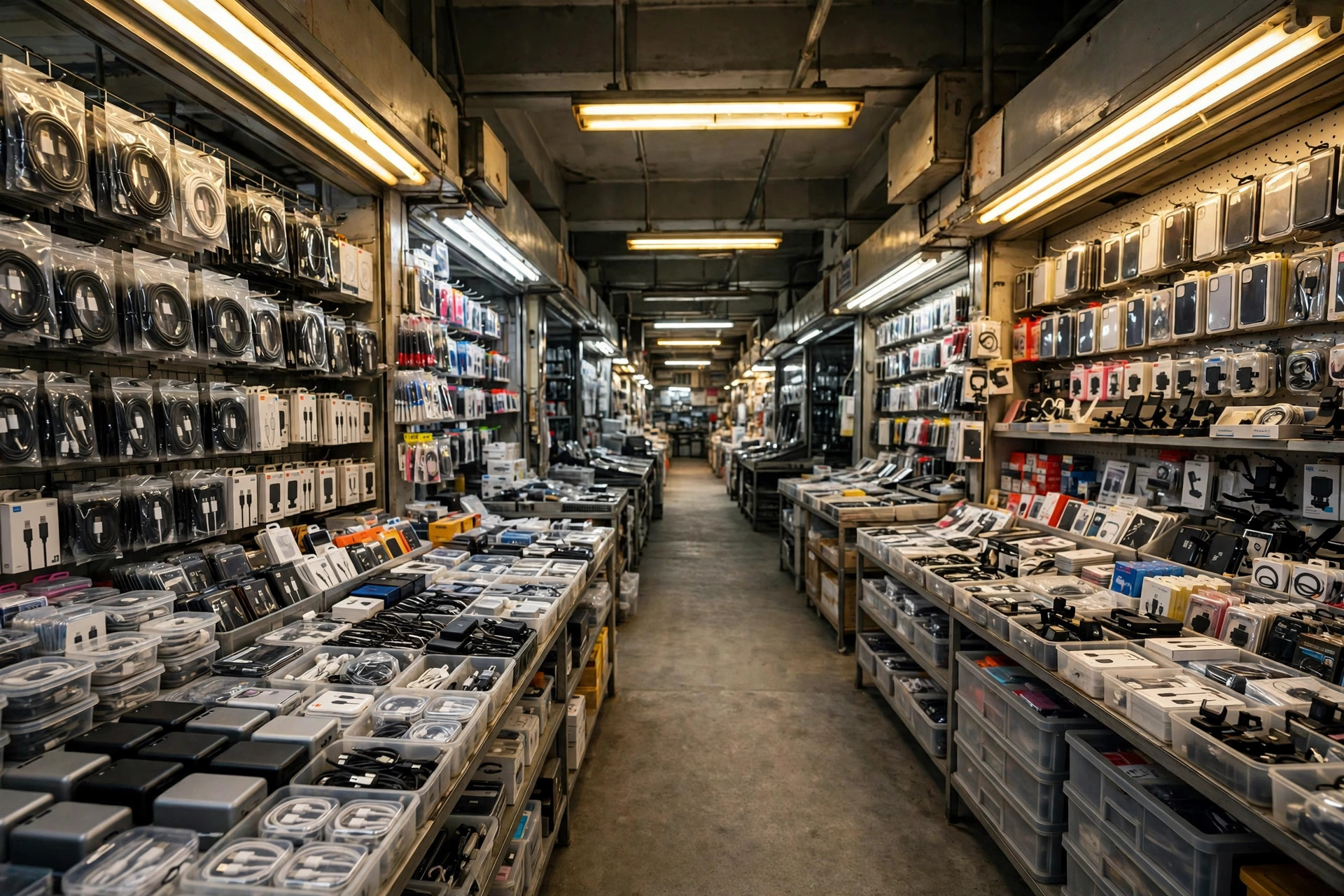
Yes — if you buy, build or sell hardware. Huaqiangbei electronics market is the densest electronics market on earth: 35 professional markets, more than 115,000 merchants, and over ¥480 billion in annual trade (official Futian district figures, September 2026). For a hardware founder, a small-batch buyer or a geek, one afternoon there teaches you more about the supply chain than a month of emails. If you only want a cheap branded phone or a polished shopping-mall experience, no — go to a shopping mall instead. Huaqiangbei is a working wholesale market, not a tourist attraction.
Who it is worth it for — and who should skip it
Go, if you are:
- A hardware founder or AI hardware team checking what is actually available, at what price, before you commit to a design. The new Hardware Maker Hub in the district lets visitors build a small AI gadget in 10–20 minutes, and the market claims a concept can become a physical product in as fast as 20 days.
- A small-batch buyer sourcing components, accessories or unbranded gadgets. This is where the stalls are.
- A second-hand phone trader. Feiyang Times Building is China's largest second-hand Apple wholesale market.
- A geek who wants to see the supply chain with their own eyes. One kilometre of market, and an idea in the morning can be a product by the afternoon — that is how a Shenzhen tourism volunteer described it in November 2026.
Skip it, if you are:
- Looking for a brand-new, sealed iPhone at a bargain price. There is almost no such thing here, and the second-hand trade is under pressure after a pre-APEC cleanup in which overseas iPhones were no longer allowed to sell in Feiyang.
- Expecting fixed prices, English-speaking staff and card payment everywhere. Almost nobody speaks English by default, most stalls do not take foreign credit cards, and every price is negotiable.
- On a tight tourist schedule with no buying plan. Without a list, you will spend the day looking at ten thousand nearly identical stalls.
What you can actually buy there
Four things dominate the market in November 2026, and they are not the same as five years ago.
AI gadgets. This is the biggest change. AI products now make up 61% of the district's electronics sales, up from 41% in 2025 (official figures, January–July 2026). AI glasses sales doubled year on year; drones and robots grew 60–70%. After the APEC summit in Shenzhen on 18–19 November 2026, foreign visitors were buying drones, AI glasses, AI toys and massage guns as souvenirs. A French customer bought two small drones at ¥158 each and said the same drone costs €100 in France; a member of the Peruvian delegation spent about $400 on AI glasses and a massage gun; the hottest item in one AI toy shop was an AI robot dog at about ¥390. NBC News, reporting from the market on 19–20 November 2026, filmed a red handheld games console at $20 and smartwatches at $10–20.
Components and DIY hardware. SEG Plaza's lower floors are components — resistors, capacitors, connectors, batteries — and its 5th–6th floors are DIY computer hardware: graphics cards, memory, storage and repair benches. Huaqiang Electronics World's 4th floor is DIY computer and IT accessories, and its 6th floor is a components trading centre. If you build hardware, this is the reason to come.
Phone accessories and repair parts. SEG Communications Market (next to SEG Plaza) sells phone cases, screen protectors, straps and power banks. Feiyang's 2nd floor is phone repair parts: screens, batteries, mainboards, cameras — "from a single screw you can assemble a whole phone", as the local saying goes.
Second-hand Apple devices. Feiyang's 3rd floor is second-hand domestic iPhones, iPads, Apple Watches and AirPods; the 4th floor is overseas versions (US, Japanese, Korean) and MacBooks. AFP reported on 19 November 2026 that buyers from Africa and Bangladesh buy dozens of second-hand phones at a time, and damaged iPhone 13 Pro / 14 Pro models go for about ¥1,000–2,000 each. Small batches of 5–10 units are possible.
Are electronic goods cheaper in China?
Yes — for most things, but not for everything, and the gap is smaller than the headlines suggest.
Genuinely cheaper: unbranded and generic gadgets, accessories, components and anything that comes straight out of Shenzhen's supply chain. The ¥158 drone that costs €100 in France is a real example from November 2026. Phone cases, cables, power banks, smartwatches and small AI gadgets are typically a fraction of the price you would pay at home. On-the-ground prices recorded in Huaqiang Electronics World between March and October 2026 include a hair straightener at about ¥95, a magnetic power bank at about ¥95, a high-speed fan at about ¥45, and a smartwatch at ¥170–200.
Not cheaper right now: flagship graphics cards and memory. An RTX 5080 was about ¥14,000 in Huaqiangbei on 15 November 2026 — down from about ¥20,000 in late October, but still nearly double its official guide price of ¥8,299. An RTX 5090 was about ¥46,000–51,000 in mid-November, depending on the day. Memory has surged the other way: a 32GB DDR5 kit went from ¥900 to ¥3,800 within a year (+322%). If you come for a GPU, check the price on the day — it moves daily.
The fine print on "cheap": three things eat into the saving. First, the price is negotiable, not fixed: start at 30–40% of the quoted price for electronics and about 50% for accessories, compare 3–5 stalls, and remember that two identical-looking products with different chips inside can differ in price by 50–200%. Second, cheap often means no brand, no warranty and no after-sales service — and genuine, refurbished and knockoff goods can sit on the same counter. Third, the landed cost is no longer the stall price: the US $800 de minimis exemption is gone, so small parcels to the US now need formal customs clearance and full tariffs. As of November 2026, the postal-channel formal declaration compliance deadline is 20 January 2027.
How to plan the visit
When to go. Most buildings open around 10:00–18:30, but stalls are only fully open after 10:30. The best window is 14:00–18:00. Feiyang is different: its trading floors open at 14:00, are busiest 17:00–21:00, and the building stays open until 23:00 — do not go there in the morning. Sundays are quieter; many family-run stalls close.
Where to go. Start at Huaqiang Electronics World (two six-floor buildings on Huaqiangbei Road) for mainstream gadgets and components, then SEG Plaza (1002 Huaqiangbei Road, market floors 1–10) for components and DIY hardware, then Feiyang Times Building (66 Huafa South Road) if you want second-hand Apple devices. The metro stop is Huaqiangbei Station (Lines 2 and 7); Huaqiang Road Station (Line 1) is on the southern edge of the district.
How to pay. Alipay and WeChat Pay are the main payment methods, and both can be linked to a foreign Visa or Mastercard. Most stalls do not accept foreign credit cards directly, so keep ¥500–1,000 in cash. Feiyang stalls generally take WeChat Pay or cash only. Huaqiangbei has tax-refund self-service terminals, and an "instant refund on purchase" service was in place during APEC.
How to communicate. Almost nobody speaks English beyond "hello" and "cheap price". Use a translation app and a calculator for haggling. For orders over a few thousand RMB, or anything involving certification and shipping, hiring a translator or sourcing agent for the day costs about ¥400–800.
How not to get burned. Test everything on the spot — never accept a promise to "unlock it later". Ask for a receipt. A power bank must carry the 3C mark or it cannot go on a domestic flight. For second-hand phones, check the carrier lock (Settings → General → About → Carrier Lock should say "No SIM restrictions"), confirm iCloud is signed out and the activation lock is off, check battery health in Settings, and dial *#06# for the IMEI. In Feiyang, the seller's own sticker on the device is your only warranty — usually 3 days — so do not remove it and do not open the phone yourself.
The one market you should NOT go to: Mingtong
This is the mistake most English-language guides still make. Mingtong Digital City has not been an electronics market since 2017. It is now China's largest cosmetics wholesale hub: more than 1,400 shops selling MAC, Chanel, Dior, YSL, La Mer, Lancôme, SK-II and Estée Lauder, open 10:00–02:00 every day of the year. The switch happened because competition from Huawei and Xiaomi crushed electronics margins and intellectual-property enforcement tightened; by 2016 some floors were 50% empty, and by 2020 the transformation was complete.
Yet most English guides — including some updated in October 2026 — still describe Mingtong as the biggest all-electronics mall. Do not go there for electronics. For phone cases and accessories, go to SEG Communications Market; for phones, go to Yuanwang (Farhope) mall.
What a guided visit costs
If you want someone to walk the market with you, the market range in November 2026 runs from a 2.5-hour guided walk at $99 per person to a 3-hour small-group tour at $225 per person and private half-day orientations at $500–1,500. Our own Huaqiangbei guide days are listed at $299 per day, $599 for two days, and $2,499 per person for a four-day founder group — reference pricing, to be confirmed, as of November 2026; final rates are confirmed before booking. If you want that kind of help, send your list through our Sourcing Inquiry form: what you need, how many days you have, and what you want to buy.
One timing tip: if you are coming in late November, the China Hi-Tech Fair (CHTF) runs 26–28 November 2026 at the Shenzhen World Exhibition & Convention Center in Bao'an, with 5,000+ exhibitors. Free pre-registration closes at noon on 25 November and saves the ¥120 ticket. It pairs well with a Huaqiangbei visit.
FAQ
Is Huaqiangbei worth visiting? Yes, if you buy, build or sell hardware. It is the densest electronics market in the world — 35 markets, 115,000+ merchants — and one afternoon shows you the supply chain in a way no website can. Skip it if you only want a cheap branded phone or a polished mall.
Are electronic goods cheaper in China? For generic gadgets, accessories and components, yes — often a fraction of the price at home. For flagship GPUs and memory, no: an RTX 5080 was about ¥14,000 in mid-November 2026, nearly double its official guide price, and DDR5 memory has risen more than 300% in a year. Haggling and the loss of the US de minimis exemption also change the final cost.
What can you buy at Huaqiangbei? AI gadgets (glasses, drones, robot dogs, translators), electronic components, DIY computer hardware, phone accessories and repair parts, and second-hand Apple devices. Brand-new sealed iPhones at bargain prices are not really a thing here.
Is Mingtong still an electronics market? No. Mingtong has been a cosmetics wholesale market since 2017 — more than 1,400 shops selling MAC, Chanel, Dior and other beauty brands. Most English guides still get this wrong. Do not go there for electronics.
When is the best time to go? 14:00–18:00 for most buildings. Feiyang's trading floors only open at 14:00 and are busiest 17:00–21:00. Avoid Sunday mornings and do not go to Feiyang before 14:00.
Can I pay with a foreign credit card? Mostly no, not directly at the stalls. Use Alipay or WeChat Pay linked to a foreign Visa or Mastercard, and keep ¥500–1,000 in cash. Feiyang stalls generally take WeChat Pay or cash only.
Will I get scammed? Not if you follow the basics: test everything on the spot, compare 3–5 stalls, start haggling at 30–40% of the quoted price for electronics, ask for a receipt, and never accept "unlock it later". Genuine, refurbished and knockoff goods can sit on the same counter — the check is yours to do.
How we report prices
All prices here are attributed market prices as of November 2026, or the operators' own published prices. They are orientation figures, not quotes — prices move daily, and the cheapest listing is not always the price charged. GPU and memory prices in particular change by the day; check the price on the day and confirm what is included before you buy. Our own figures are reference pricing, to be confirmed (November 2026).