Is Huaqiangbei Safe for Foreign Buyers? How Do I Avoid Scams? (2026 Guide)
The short answer
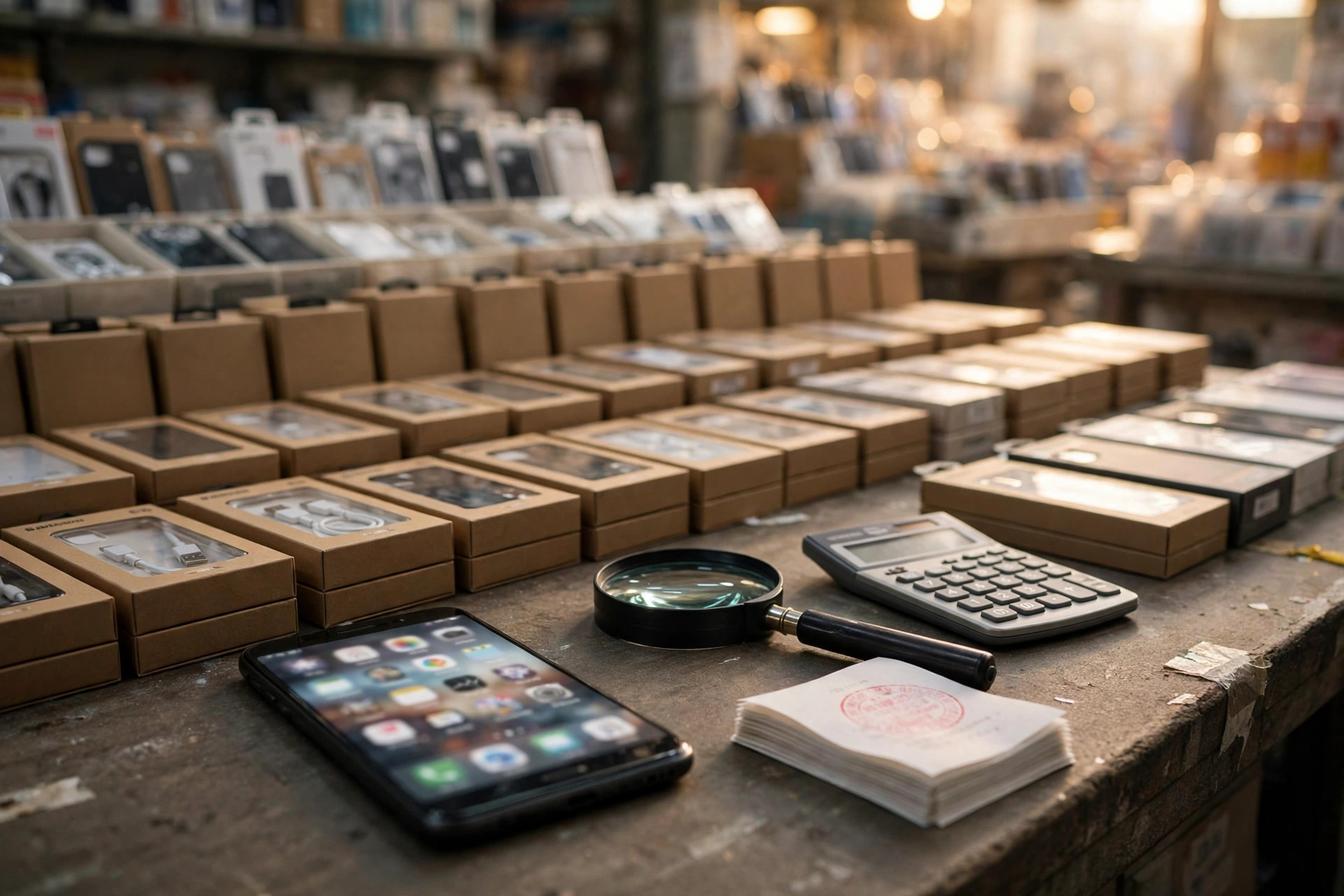
Yes, Huaqiangbei is safe for foreign buyers — in the normal sense of the word. It is a crowded, well-lit commercial district in central Shenzhen that takes in roughly 8,000–12,000 foreign buyers a day (different reports give different figures), and the November 2026 reporting we reviewed describes crowds, queues and bargaining, not street crime. The risk you actually face is commercial: fake, refurbished or misdescribed goods, prices that move after you agree them, and receipts that mean nothing when you come back. None of that is stopped by being careful about where you walk. It is stopped by testing the product before you pay and getting the terms in writing.
What "unsafe" really means at Huaqiangbei
First-time buyers picture the wrong danger. Huaqiangbei is not a place where you get robbed in an alley. It is a place where you pay new-phone money for a refurbished phone, or buy a power bank that cannot legally fly home with you, and discover it too late. The three real risks are:
1. The goods are not what they seem. Genuine, refurbished and counterfeit products often sit on the same counter. A phone can look new and be a reassembled second-hand unit. A chip can look identical to the real one and perform differently — the same-looking product can cost 50–200% more or less depending on the chip inside, so price alone tells you nothing.
2. The deal changes after you agree it. A price quoted at the counter, a promise to "unlock it later", a warranty that exists only in conversation. None of these is enforceable unless it is written on the receipt.
3. You cannot get the goods home legally. Second-hand phones contain lithium batteries, which are Class 9 dangerous goods. They must not go by ordinary postal parcel. And since 29 August 2025 the US de minimis exemption is gone — every country has lost the $800 duty-free threshold, and postal shipments now go through formal entry, with the compliance deadline for the postal channel set at 20 January 2027. Small parcels and samples now need a customs declaration and pay full tariffs.
Everything in this guide is aimed at those three risks.
Before you go: four things that cost nothing
Go at the right time. Most buildings open around 10:00 and stalls fill up after 10:30; the best window is 14:00–18:00. Feiyang Times Building, the second-hand iPhone building, does not open for trading until 14:00 — do not go in the morning. On Sundays many family stalls are closed and the choice is thinner.
Know which building sells what — and which one does not. SEG's lower floors are components, the fourth floor is brand-name computers, the fifth and sixth are DIY hardware and repairs. Huaqiang Electronics World runs six floors per building, with brand experience stores on the first floor and components on the sixth. Feiyang is four floors of second-hand Apple products. And do not go to Mingtong Digital City for electronics: it has been a cosmetics wholesale market since 2017, and most English guides still list it wrong. Going to the wrong building is the most common first-timer mistake, and it wastes the whole morning.
Bring the right payment. Alipay and WeChat Pay, linked to a foreign Visa or Mastercard before you travel, work at most stalls; stalls rarely accept foreign credit cards directly, so carry ¥500–1,000 in cash. Some older component and repair stalls take cash or domestic transfer only. If a stall will only take cash and cannot give you a receipt, that is a reason to walk away, not a reason to pay.
Put your requirements in writing first. At Feiyang, where most stallholders speak limited English, write the model, storage, carrier-lock status and iCloud status in your phone's notes app and show it to the seller. A written list prevents the most common misunderstanding in the building: you asked for an unlocked phone and got a locked one.
The seven checks: do all of them before you pay
These checks come from the local buying guides used across Huaqiangbei. They take a few minutes. Skipping them is how most buyers lose money.
1. Test everything powered on, at the stall. Power the unit on, check every function — Face ID, front and rear camera focus, speakers, compass, charging port — and never accept a promise to "unlock it later". If it cannot be tested now, do not buy it now.
2. Check the phone is really unlocked and really yours. For a second-hand iPhone, check Settings → General → About → Carrier Lock: it should say "No SIM restrictions". Confirm iCloud is signed out, Activation Lock is off, and there is no hidden Apple ID. Dial *#06# to check the IMEI, activation date and warranty status.
3. Check the battery is really original. Look at maximum capacity in Settings, then cross-check with a diagnostic tool such as iTools or Shalou Assistant — a high battery-health reading on a second-hand phone can be faked. Check the liquid-contact indicator inside the SIM tray: if it has turned red, the phone has been wet.
4. Know the grade you are buying. Second-hand phones are graded: A+ is near-new (battery health 90–100%), A is excellent (no screen scratches, never opened for repair), B has light signs of use, C is heavily worn or damaged. "Like-new" in the trade means near-new; "lightly used" means light signs of use. Ask which grade you are paying for, and check the phone matches it.
5. Get a stamped receipt, with the details on it. Ask for a receipt stamped by the stall, with the model, serial number and warranty terms written on it. A receipt that says nothing is worth nothing. At Feiyang, the seller will also stick the stall's own label on the phone — that label is the only proof of after-sales service. Do not tear it off, do not open the phone yourself, and take it back to the same stall if something goes wrong. The usual warranty is about 3 days (some stalls say 3–7 days), and it only holds while the label is intact.
6. Check the 3C mark on power banks. A power bank needs a 3C mark to be carried on a domestic flight in China. No 3C mark, no flight — check before you buy, not at the airport.
7. Compare three to five stalls before you buy. The same product at the next stall can cost 30–50% less. For electronics, buyers commonly open at 30–40% of the quoted price; for accessories, about 50%. Check the Amazon or Taobao price first so you have an anchor. A stall that will not let you compare, or pressures you to pay now, is telling you something.
Red flags: walk away when you see these
None of these proves a stall is dishonest on its own. Any one of them means stop, compare elsewhere, and do not pay yet.
- "It will be unlocked later" — or any promise that can only be kept after you have paid. If it cannot be done at the counter, it may never be done.
- No receipt, or a receipt with nothing on it. No model, no serial number, no warranty terms. If the seller will not write it down, the deal does not exist.
- A price far below every other stall. The cheapest listing is not always the price charged — and a phone far cheaper than its neighbours is usually a different phone: a locked unit, a refurbished unit, or a different chip.
- "Brand new, sealed" second-hand phones. At Feiyang there is almost no such thing as a brand-new, factory-sealed phone. What is sold is second-hand, officially refurbished, or overseas stock. If you want a genuinely new phone, go to Yuanwang, not Feiyang.
- Pressure to pay in full before any check. A legitimate stall expects you to test the product. Full payment demanded before testing is a reason to leave.
- No company name, no stall number, no label. If you cannot find the stall again, you cannot return the goods.
What has changed recently — and what it means for you
Two recent developments are worth knowing, because they change what you will find on the ground.
The pre-APEC cleanup. Before the APEC summit in Shenzhen in November 2026, the city cleared markets linked to smuggled chips and overseas iPhones. At Feiyang, the fourth-floor stalls were emptied after two months of renovation, and stallholders said overseas iPhones were no longer allowed to be sold. There is no official announcement and no published seizure figures, and some stallholders expected the rules to ease after the summit. Do not treat the cleanup as proof that every phone sold before was stolen — an earlier Financial Times investigation had described Feiyang as a hub for stolen iPhones in London and New York, but the November 2026 reporting only confirms that overseas phones stopped being sold, not that every unit was stolen. The practical point for buyers: the fourth floor is the most disrupted part of the market right now, and stock and prices there are the least predictable.
The June 2026 enforcement campaign. A local guide reports that in June 2026 Huaqiangbei ran a special enforcement campaign against smuggled and stolen phones, and that the market is recovering with compliance first. This is a single-source report — treat it as background, not as a guarantee. The direction is clear enough: the market is moving toward documented, compliant trade, and the stalls that cannot document their goods are the ones to avoid.
If something goes wrong
Go back to the same stall, with the receipt and the label intact. That is why the label matters — it is the only proof of where you bought it. Do not open the device yourself and do not tear the label off; either can void the short warranty.
If the stall will not help, get a second opinion first. Ask the neighbouring stalls what the problem is worth, and whether the phone you bought is what you were told it was. A second opinion costs nothing and tells you whether you have a warranty claim or a lesson.
For a larger order, do not go alone. If the order is worth several thousand yuan, or involves certification and shipping, hiring a translator or sourcing agent for a day costs about ¥400–800 and puts a professional between you and the stall. A sourcing agent also arranges the inspection before shipment and the customs paperwork — which matters more now that de minimis is gone and small parcels need formal declarations.
What we charge
Our own Huaqiangbei guide days are listed at $299 per day, $599 for two days, and $2,499 per person for a four-day founder group — reference pricing, to be confirmed, as of November 2026; final rates are confirmed before booking. If you want that kind of help, send your list through our Sourcing Inquiry form: what you need, how many days you have, and what you want to buy.
FAQ
Is Huaqiangbei safe for foreign buyers? Yes. The risk is commercial, not personal: fakes, refurbished goods sold as new, and deals that change after you pay. Test everything powered on at the stall, get a stamped receipt with the model, serial number and warranty terms, and compare three to five stalls before you buy.
How do I avoid scams at Huaqiangbei? Seven checks: test every function powered on; confirm the phone is unlocked and iCloud is signed out; cross-check the battery; know the grade you are paying for; get a stamped receipt; check the 3C mark on power banks; compare three to five stalls. Never accept "unlock it later".
Can I get a refund at Huaqiangbei? Usually not a refund — a replacement or a repair at the same stall, within a short warranty of about 3 days, while the stall's label is intact. That is why the receipt and the label matter: without them there is nothing to claim against.
Are the phones at Feiyang stolen? Do not assume that. An earlier Financial Times investigation described Feiyang as a hub for stolen iPhones, but the November 2026 reporting only confirms that overseas iPhones stopped being sold before APEC, with no official announcement and no seizure figures. Buy on the checks in this guide — unlocked, iCloud signed out, battery verified, receipt stamped — not on rumours about the building.
Is it safe to buy a second-hand iPhone at Huaqiangbei? It can be, if you run the checks: carrier lock status, iCloud and Activation Lock, battery cross-check, liquid indicator, grade, and a stamped receipt. Single units are sold at most stalls on the first three floors; the fourth floor's big wholesalers usually ask for 5–10 units.
Should I bring cash or card to Huaqiangbei? Both. Link a foreign Visa or Mastercard to WeChat Pay or Alipay before you travel, and carry ¥500–1,000 in cash — stalls rarely take foreign cards directly, and some older stalls take cash or domestic transfer only.
Can I ship what I buy back home? Yes, with the right channel. Second-hand phones contain lithium batteries (Class 9 dangerous goods) and must not go by ordinary postal parcel — use a DHL, FedEx or UPS battery channel, or a dedicated air or sea line. And since US de minimis ended in August 2025, small parcels need a customs declaration and pay full tariffs.
Do vendors at Huaqiangbei speak English? Mostly very little — beyond "hello" and "cheap price", do not count on it. Use a translation app and a calculator for prices. Huaqiang Electronics World is the exception: many stallholders there can communicate in English, and some stalls on the second floor of the first building accept foreign cards.
How we report prices
All prices here are the operators' own published prices as of November 2026, or attributed to their source. They are orientation figures, not quotes — prices move, pages change, and the cheapest listing is not always the price charged. Check the price on the day and confirm what is included before you book. Our own figures are reference pricing, to be confirmed (November 2026).