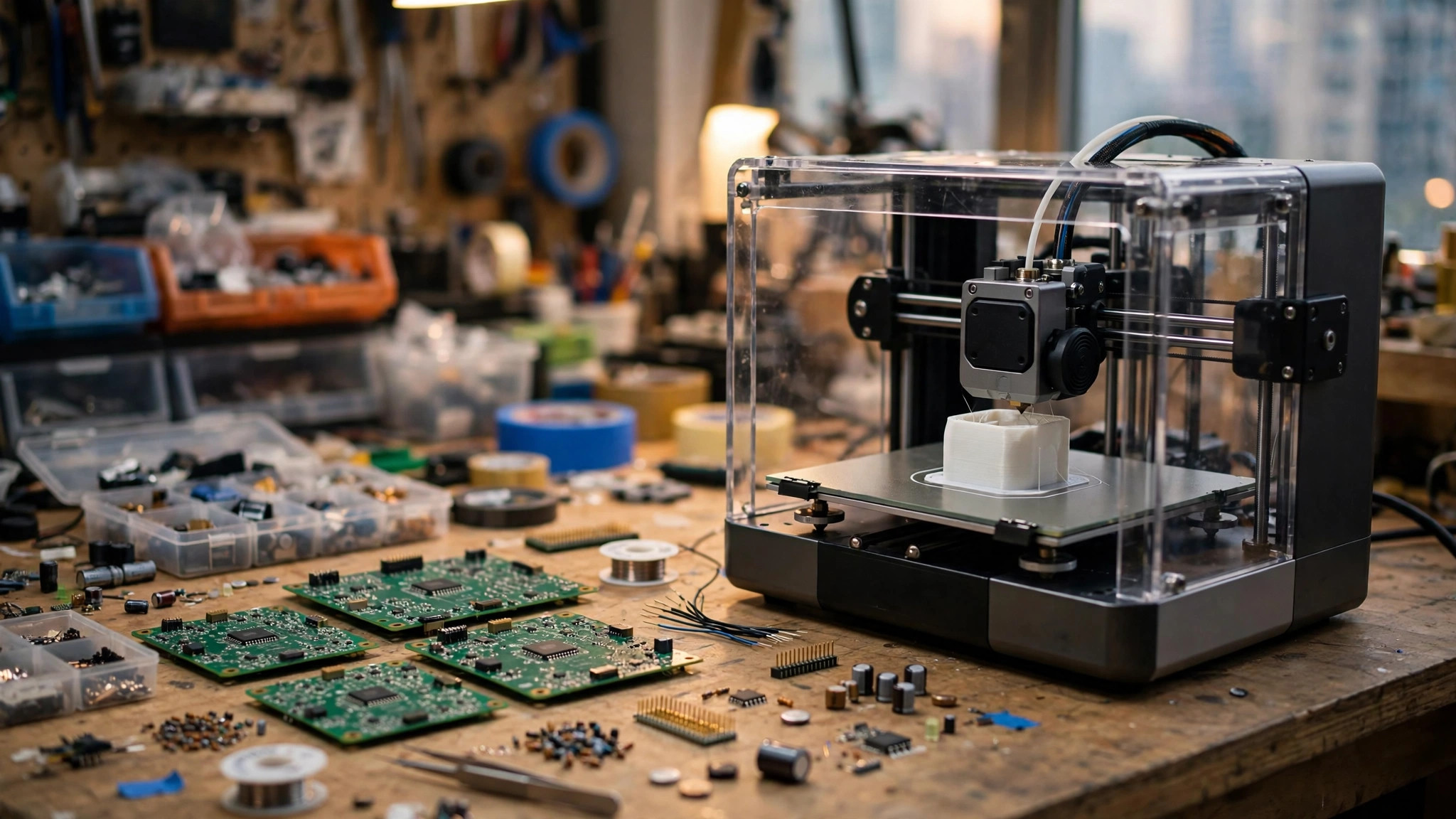
Shenzhen Rapid Prototyping: From an Idea to a Working Sample (2026–2027)
SEO title: Shenzhen Rapid Prototyping (2026–2027): PCB Prototyping, 3D Printing, Hand Models & Small-Batch Runs Meta description: How rapid prototyping works in Shenzhen: buy components the same day in Huaqiangbei, get a PCB prototype, a 3D print or a hand model made, test a small batch — with an English-speaking hardware guide. Reference rate from $299/day (to be confirmed, November 2026).
From an idea to a sample, in one district
Rapid prototyping in Shenzhen is not a single service. It is a chain of small steps that happen within a few square kilometres: you buy the components in the markets, you talk to the people who make the boards and the casings, and you hold a physical sample in your hands before you commit to a production run.
A Shenzhen tourism volunteer, Peng Wei, put it this way in a Threads post on November 19, 2026: within about one kilometre in Huaqiangbei, "an idea in the morning can become a product in the afternoon". That is her description of the district, not a measured result — no one has timed it, and no supplier in our research files promises a fixed turnaround. What is verifiable is the density behind the claim: the components, the board makers, the casing shops and the assembly lines all sit in the same city, often in the same district, and a guided day can take you through the whole chain in order instead of leaving you to find each link on your own.
This page explains that chain: what each kind of prototype is, where each step happens, how the ordering works, and what a guided prototyping trip looks like. It does not promise how fast a sample comes back or what it costs — those depend on your design, your quantities and the supplier, and they are confirmed per order, in writing, before you pay anything.
Who this is for
- Hardware founders with a sketch, a CAD file or a first circuit who need a physical sample before they raise money or place a production order.
- Amazon and DTC sellers who want to test a new electronics product with a small batch first, instead of ordering 5,000 units blind.
- Product and brand managers who need a prototype checked in person — size, feel, fit, function — before the design is locked.
If you only need a tour of the markets, the one-day guided sourcing trip is a better fit. If you need a sample in your hands, this is the trip.
Why Shenzhen, why now
- The world is watching Shenzhen again. Shenzhen hosted the APEC leaders' meeting on November 18–19, 2026, and NBC News broadcast from inside the markets on November 19–20. Foreign buyers are arriving at a rate of roughly 8,000–10,000 a day, and AI hardware — smart glasses, robot dogs, drones — is the hottest category of the season.
- AI hardware lives here. AI products are 61% of the district's electronics sales in 2026, up from 41% in 2025. If your product has a chip, a sensor or a battery in it, this is where its supply chain sits.
- "China Haul" is a real trend. Foreign visitors are coming to China to buy, not just to look: in January–July 2026, overseas visitors spent ¥263.6 billion in China, up 27.8% year on year, and China now offers visa-free entry to citizens of 50 countries. The people landing in Shenzhen this winter are buyers, not tourists.
- The manufacturing base is on show. NEPCON Asia 2026, held October 27–29 at the Shenzhen World Exhibition and Convention Center in Bao'an, drew more than 600 exhibitors across 100,000 square metres — PCBA, smart factories, semiconductor packaging and testing, optical modules, automotive electronics and embodied intelligence — with 70,000 professional visitors and more than 200 new product launches. The expo is over, but the factories and lines it showcased are still running in the same city.
- The rules changed for US buyers. The old $800 duty-free de minimis exemption for goods from China ended on May 2, 2025, and was suspended for all countries from August 29, 2025. Samples and small orders now need a customs declaration and full duties. A local guide who understands compliance — what ships, what needs paperwork, what channel to use — is no longer a luxury.
Huaqiangbei is the front door
About 35 specialized markets and more than 115,000 merchants packed into the Futian district, with annual trade over ¥480 billion, according to a February 2026 Futian district report. This is where prototyping starts: price discovery, component buying, and shortlisting the suppliers who will make your sample — before you spend a day at a factory. Most buildings open around 10:00–10:30 and close around 18:30; the best window is the afternoon, 14:00–18:00.
Components, the same day. The point of starting here is that ordinary electronic components are bought off the shelf, in person, the same day — no waiting for a parcel, no minimum order from a distant warehouse. At SEG Plaza, work by zones: 1F components, 4F branded computers (Dell, Huawei, HP, Samsung, Lenovo), 5–6F DIY hardware and repair (graphics cards, memory, storage, power supplies). Huaqiang Electronics World, founded in 1998, is the most foreign-buyer-friendly market in the district — two buildings, six floors each — and according to a November 2026 local sourcing guide, its top floor is a components trading centre where brand chips, resistors, capacitors and industrial components are sold by authorised agents and distributors, with offices, warehousing and spot stock in one place.
Casings and accessories. SEG's communications market, next door to SEG Plaza, covers phone cases, screen protectors and small accessories on its 3rd and 4th floors — the kind of small parts a prototype often needs alongside the electronics. If your product involves phones, Feiyang Times Building, at 66 Huafa South Road, is China's largest wholesale market for second-hand Apple products. Its four floors run from small accessories to repair parts, second-hand China-market Apple devices, and overseas-version devices. The trading floors don't open until 14:00 and the busiest time is 17:00–21:00, so don't go in the morning.
One building to skip for electronics: Mingtong. Mingtong stopped being an electronics market in 2017. It is now a cosmetics wholesale market — one of China's largest, with more than 1,400 shops. Most English guides still get this wrong — including some updated as recently as October 2026. Go there for electronics and you waste half a day.
What "rapid prototyping" means in Shenzhen
Four different kinds of sample, four different kinds of supplier. They are often confused; they are not the same job.
PCB prototyping. A small run of printed circuit boards made from your design files, so you can test whether the circuit actually works before you order in volume. This is the step that turns a schematic into hardware you can switch on. Board makers and assembly lines sit in Shenzhen and Dongguan; which one fits your board depends on the design, and it is confirmed per trip.
3D printing. A physical part printed from a CAD file — a bracket, a housing, a button, a clip — so you can check size, shape and fit before you pay for a mould. It is the fastest way to answer "does this part fit the other part", because the answer is in your hand, not on a screen.
Hand models. A hand-built mockup of the whole product — the casing, the buttons, the screen window, the way it sits in the hand — made to check look, feel and assembly. The Chinese term is shou ban, and the workshops that make them are part of the same Shenzhen supply chain as the board makers. A hand model is how you find out that a button is in the wrong place before the mould is cut, when fixing it is still cheap.
Small-batch runs. A short production run — tens or hundreds of units, not thousands — made on real production lines, so you can test the market, send review units, or fulfil a first crowdfunding batch. Buying 5–10 units of a mixed batch to test a market before committing to volume is normal practice in Huaqiangbei, and the same logic scales up: prove the product with a small batch, then order in volume.
No step above comes with a fixed time or a fixed price in this article, because none exists in the research files. Lead time and cost depend on the design, the materials, the quantities and the supplier's schedule — they are quoted per order, in writing, before production starts.
The process, step by step
1. Bring the design
Send your product list, specifications, drawings or CAD files, target price, quantities and timing before you travel. We shortlist the suppliers that actually make your kind of product — board makers, printing shops, hand-model workshops, assembly lines — and confirm the visits before you book. Get the basis of the quote in writing before you fly. If a supplier can't do your product, we say so now, not on the day.
2. Buy the parts
Day one in Huaqiangbei: components off the shelf, casings and accessories from the specialist markets, samples bought and tested on the spot. Test expensive samples in full before you pay, and ask for a stamped receipt stating the model, serial number and warranty terms. For electronics, open at 30–40% of the quote and expect to meet in the middle; compare the same item at 3–5 stalls. The same look with a different chip inside can cost 50–200% more or less.
3. Make the prototype
The board is made, the part is printed, or the hand model is built — by the supplier matched to your design, with translation throughout. You are there to answer the questions only the designer can answer: which tolerance matters, which finish matters, what can change and what cannot. A good prototyping visit takes two to three hours per supplier, including the meeting — plan for one or two suppliers a day, not four.
4. Test it, then revise it
Check the sample against the design: does it switch on, does it fit, does it feel right, does it survive being used the way a customer will use it. If it doesn't, you say so now — while the change is still a file edit or a single rework, not a production run. This is the whole point of prototyping: the cheap fix happens here.
5. Small batch, then production
Once the sample is right, a small batch proves the product in the market. Then the usual ordering sequence takes over: quote, then a proforma invoice, then a deposit, then production, then inspection, then the balance, then shipping. Every step in writing.
What to check before you pay
- Minimum order quantity. Confirm it per product, in writing. There is no standard number — it varies by factory and by product, and a supplier that makes your prototype at 50 units may quote 5,000 for a different one.
- Get the quote in writing with: unit price, MOQ, lead time, payment terms, warranty and defect policy, and shipping terms. If it isn't written down, it isn't agreed.
- Never pay in full before inspection. A pre-shipment check is cheap insurance on a first order — independent inspectors list it at around $149.
- Quality control. Incoming-material checks, in-line checks, pre-shipment inspection — who does them, and can you see the records? Ask how defects are handled, not just what the defect rate is.
- Certificates and compliance for your market. Ask which certificates they hold, and for which products — a certificate for one product does not cover another.
- Export experience. Have they shipped to your country, and who handles the paperwork? A supplier that has only sold domestically will cost you weeks.
- Batteries and shipping. Anything with a lithium battery — phones, power banks, drones — ships by a DHL, FedEx or UPS battery channel (MSDS and UN38.3 paperwork) or a dedicated air/sea line, never an ordinary postal parcel. And remember: samples shipped to the US now need a customs declaration and full duties.
The maker community: where prototypes get talked about
Shenzhen's maker scene is part of the prototyping infrastructure, not a sideshow. Chaihuo Maker Space, founded in 2011, is the city's best-known makerspace. SZDIY holds an open night every Thursday at 19:00 in Nanshan. TroubleMaker, founded in 2016, is an expat makerspace inside Huaqiangbei itself. If your trip falls in mid-December, Maker Faire Shenzhen runs December 12–13, 2026 at Vanke Design Commune in Nanshan, and muShenzhen Maker City runs November 20–December 18, 2026 at OCT-LOFT North. These are places to meet the people who build things in this city — and to sanity-check a design with someone who has shipped one before. Maker stops are arranged per trip and confirmed before you book.
A sample two-day programme
Day 1 — Huaqiangbei. SEG by zones, Huaqiang Electronics World, Feiyang after 14:00 if your product involves phones. Price discovery, component buying, supplier shortlist. Most buildings open around 10:00–10:30; the best window is 14:00–18:00.
Day 2 — Prototyping suppliers. One or two suppliers in Shenzhen or Dongguan — a board maker, a printing shop or a hand-model workshop, depending on your product — with translation throughout. Design review: what the supplier can actually make, its minimum orders and quality process, in plain English. Samples and quotes to take home.
Three flat rates. Pick one.
All prices are flat service fees for the guide and the programme described. Flights, hotels, visas, travel insurance, the cost of goods and samples, and shipping are not included — you pay those directly, at cost, with receipts.
Pricing below is reference pricing, to be confirmed — as of November 2026. Final rates are confirmed before booking.
Tier A — 9 / day (reference rate): Huaqiangbei Guided Sourcing Day
Best for: first-time visitors, sample buyers, anyone who wants one focused day in the markets.
- One-on-one, engineer-level English-speaking guide for a full day in Huaqiangbei's core electronics markets
- WeChat Pay and Alipay setup help, so you can actually pay at the stalls
- On-site component and sample buying with you — translating specs, comparing stalls, checking goods before you pay
- Supplier contacts, quotes and receipts collected for you to take home
Tier B — 9 / 2 days (reference rate): Huaqiangbei + Prototyping Suppliers
Best for: teams ready to move from a design to a physical sample. This is the prototyping tier.
- Everything in Tier A, over two days
- Plus visits to 1–2 prototyping suppliers in Shenzhen or Dongguan — board making, 3D printing or hand models, depending on your product — with translation throughout
- Supplier capability assessment: what the supplier can actually make, its minimum orders and quality process, in plain English
- Sample follow-up: we help you chase the samples and quotes after the visits
Supplier visits are arranged per trip and confirmed before you book — tell us what you need to make and we confirm it.
Tier C — ,499 / person (reference rate): 4-Day Hardware Founder Tour (small group)
Best for: hardware founders who want the full Shenzhen supply-chain picture in one trip.
- Four days, small group, guided by an English-speaking hardware specialist
- The full programme: Huaqiangbei deep dive, components and prototyping suppliers, factory visits across Shenzhen and Dongguan, and the maker community
- Group size is kept small so every founder gets time with the guide and the suppliers
How the pricing compares
For orientation, here is what comparable services publicly charge (November 2026 listings):
- A 2.5-hour Huaqiangbei walking tour: $99 per person (hqbguide.com, bookable online).
- A 3-hour private Shenzhen tech tour on Expedia: $90; 4.5 hours $125; 6 hours $180.
- An engineer-led one-day sourcing session on Peek.com: $299.
- A full-day factory tour (8 hours) with an engineer and translator: $350–450; a 3-day package $1,200–1,600 (china-sourcing-agents.com).
- Multi-day founder tours: 2 days $1,800–3,500; 5 days $4,500–7,500; 10 days $10,000–12,000 (movetosz.com). A 6-day December 2026 founder tour lists at $3,000 early-bird, $3,500 standard, and its itinerary includes a prototyping factory and a PCB assembly line (thefuturefactory.ai). A robotics study tour of 5–7 days lists at $3,200–5,500 per person; its 3-day Christmas special at $1,598 (chinastudytour.ai).
Our three tiers sit in the middle of that range: a full guided day for less than most half-day tours from the big platforms, and a two-day prototyping trip below the comparable multi-day programmes. The difference is that every tier is built around your product and your design — not a fixed sightseeing route.
Practical: when to come, visa, money, shipping
When to come. October–November and March–April, on a weekday afternoon (14:00–18:00). Late 2026 expo dates: China Hi-Tech Fair, November 26–28; DMP Greater Bay Area Industrial Expo, December 3–6; Maker Faire Shenzhen, December 12–13. Most buildings open around 10:00–10:30 and close around 18:30; Sundays are quiet.
Visa. Many nationalities — including the UK, EU, Australia, New Zealand, Japan and South Korea — can enter China visa-free for up to 30 days (waiver currently runs to 31 December 2026). Check your country's current status before you travel.
Money. Bring ¥500–1,000 in cash. Most stalls take Alipay or WeChat Pay — both can be linked to a foreign Visa or Mastercard before you travel — but many stalls do not accept foreign credit cards at all.
Language. Assume almost nobody speaks English beyond "hello" and "cheap price". Bring a translation app and use the calculator on your phone to haggle — the seller types a price, you type a lower one. For supplier meetings, translation is part of the tour.
Samples and shipping. Buy 5–10 units of a mixed batch to test a market before committing to volume. Test expensive samples on the spot, in full, and ask for a stamped receipt stating the model, serial number and warranty terms. Remember: samples shipped to the US now need a customs declaration and full duties. Huaqiangbei has departure tax-refund self-service terminals, so you can process refunds without leaving the district.
Frequently asked questions
Do I need an appointment to visit a prototyping supplier? Yes. These are working shops, not showrooms. Visits are arranged in advance and confirmed before you book — walk-ins don't work.
Can I prototype just one unit? That depends on the supplier and the process — a single hand model or a single printed part is a normal request, a single board depends on the board maker. Tell us what you need to make and we confirm it before you book.
How much does a prototype cost, and how long does it take? It depends on your design, your materials and your quantities — there is no standard price and no standard turnaround. That is why the quote comes first, in writing, before production starts. Any page that gives you one fixed number for every product is guessing.
Can you visit a supplier outside Shenzhen? Yes — Dongguan is the usual case for boards, printing and molding, included in Tier B and Tier C. Other cities are possible; tell us and we'll confirm feasibility and any extra cost before you commit.
What if my product isn't made in Shenzhen? Tell us before you book. If it's genuinely not a Shenzhen product, we'll say so rather than sell you a trip that wastes your time.
How do I pay you? The flat service fee is agreed in writing before the trip. Goods, samples and shipping are paid directly to suppliers, at cost, with receipts. We don't take commission from factories or stalls on your orders.
If you're planning a prototyping trip, tell us what you make, roughly how many, and when you need it — send it through the inquiry form at the bottom of this site's homepage. We'll come back with what a trip can cover and what it costs, before you commit to anything.