How Do I Bargain at Huaqiangbei? (2026 Guide)
The short answer
At Huaqiangbei electronics market, the first price is an opening offer, not a price tag. For electronics, open at 30–40% of the asking price; for accessories, open around 50%. Before you say a number, check the same item on Amazon or Taobao so you know what it is worth, then compare 3–5 stalls — the same item can cost 30–50% more or less from one counter to the next. Pay with Alipay or WeChat Pay, or cash, and test everything on the spot before you hand over money.
How bargaining works here
Huaqiangbei is not a shopping mall with fixed prices. It is a district of about 1.45 square kilometres with 35 professional markets and more than 115,000 registered businesses, and most stalls set their own asking price. That asking price is where the conversation starts, not where it ends. Foreign buyers are a normal sight — roughly 8,000–12,000 a day by the various reports from October and November 2026 — and stallholders are used to being haggled with. The rules below are the market's own norms, recorded across multiple buyer guides, not tricks: know the real price before you start, open low, compare stalls, and verify the goods.
Two things set the frame before you begin. First, the brand experience zone on the first floor of Huaqiang Electronics World carries high marked prices and is not the main buying place — do your bargaining on the wholesale floors, not there. Second, do not go to Mingtong to bargain for electronics: Mingtong has been a cosmetics wholesale market since 2017, and most English guides that still list it as an electronics market are out of date.
Before you open your mouth: get an anchor price
The single most useful bargaining tool is a price you already know. Check the same item on Amazon or Taobao before you walk in — the local buying guide's advice is to use those prices as your anchor, because the same item can differ 30–50% between stalls in Huaqiang Electronics World alone.
Recorded deal prices from one local buying guide (March–October 2026, single source — treat them as orientation, not current quotes) give a sense of the level:
- Hair dryer: ¥185–280 (top spec, 3C certified, 1,600W)
- Magnetic power bank: about ¥95
- Hair straightener: about ¥95
- High-speed cooling fan: about ¥45
- Budget smartwatch: ¥170–200
- Used Bose speaker: about ¥200
- Phone cases at SEG Communications Market: ¥3–15 retail, ¥1.5–6 in bulk
Street prices reported by visiting media in November 2026 point the same way: NBC's crew found a red handheld console for $20 and smartwatches for $10–20, and a French customer bought two small drones at ¥158 each — about €100 for the same drone in France. Use these as a sanity check, not a promise: prices move, and the number you are quoted on the day is the number that counts.
Step 1: open low — where to start
The market's own rule, confirmed across multiple buyer guides: for electronics, start your offer at 30–40% of the asking price; for accessories, start at about 50%. In Huaqiang Electronics World, the local guide puts it the same way for retail and small orders — start from 50% of the quote and meet in the middle.
That first number is not an insult; it is how the conversation is structured here. Never open with your real budget or your top price — once the stallholder knows what you will pay, the negotiation is over. If the stallholder laughs or shakes their head, that is part of the exchange, not the end of it. Expect two or three rounds before the price settles.
Step 2: compare 3–5 stalls before you buy
Do not buy at the first stall that has your item. Walk the floor, ask the price at three to five counters selling the same thing, and then come back to the cheapest. Two facts make this worth the walk:
- The same item can cost 30–50% more or less from one stall to the next in the same building.
- The same look does not mean the same product: identical-looking items can hide different chips inside, and the price can differ 50–200% for that reason alone. A cheaper counter is not always a better deal — it may be a different chip, a refurbished unit, or a copy.
That comparison is also your leverage. If a stallholder will not move after two rounds, thank them and move to the next counter — with three to five stalls selling the same item, the next counter is your best argument. There is no need to argue; the market is large enough that walking away costs you nothing.
Step 3: use volume — even small volume
You do not need a container order to get a better price. In Huaqiang Electronics World, a multi-category combined order has more room to negotiate than a single item — bundle the accessories with the main item and negotiate the whole basket. In Feiyang Times Building, small mixed batches of 5–10 units are normal, and single units are usually fine on floors 1–3; the big wholesalers on the 4th floor often ask for 5–10 units minimum.
So the sequence is: settle the unit price first, then ask what changes if you take five, or ten, or add the cables and cases. The volume question comes after the price question, not before — otherwise you are negotiating against your own order size.
Step 4: pay the Huaqiangbei way
Most stalls take Alipay or WeChat Pay, and you can bind an overseas Visa or Mastercard to either. Most stalls do not take foreign credit cards directly, so do not count on tapping your card. Keep ¥500–1,000 in cash as backup — some older component and repair stalls take cash or domestic transfer only, and in Feiyang the stalls take WeChat Pay or cash.
Practical points: set up Alipay or WeChat Pay before you go, not at the counter. Cash still helps at small stalls and speeds up small deals. And never pay the full amount before you have tested the goods — payment and inspection happen in that order, not the other way round.
Step 5: talk without English
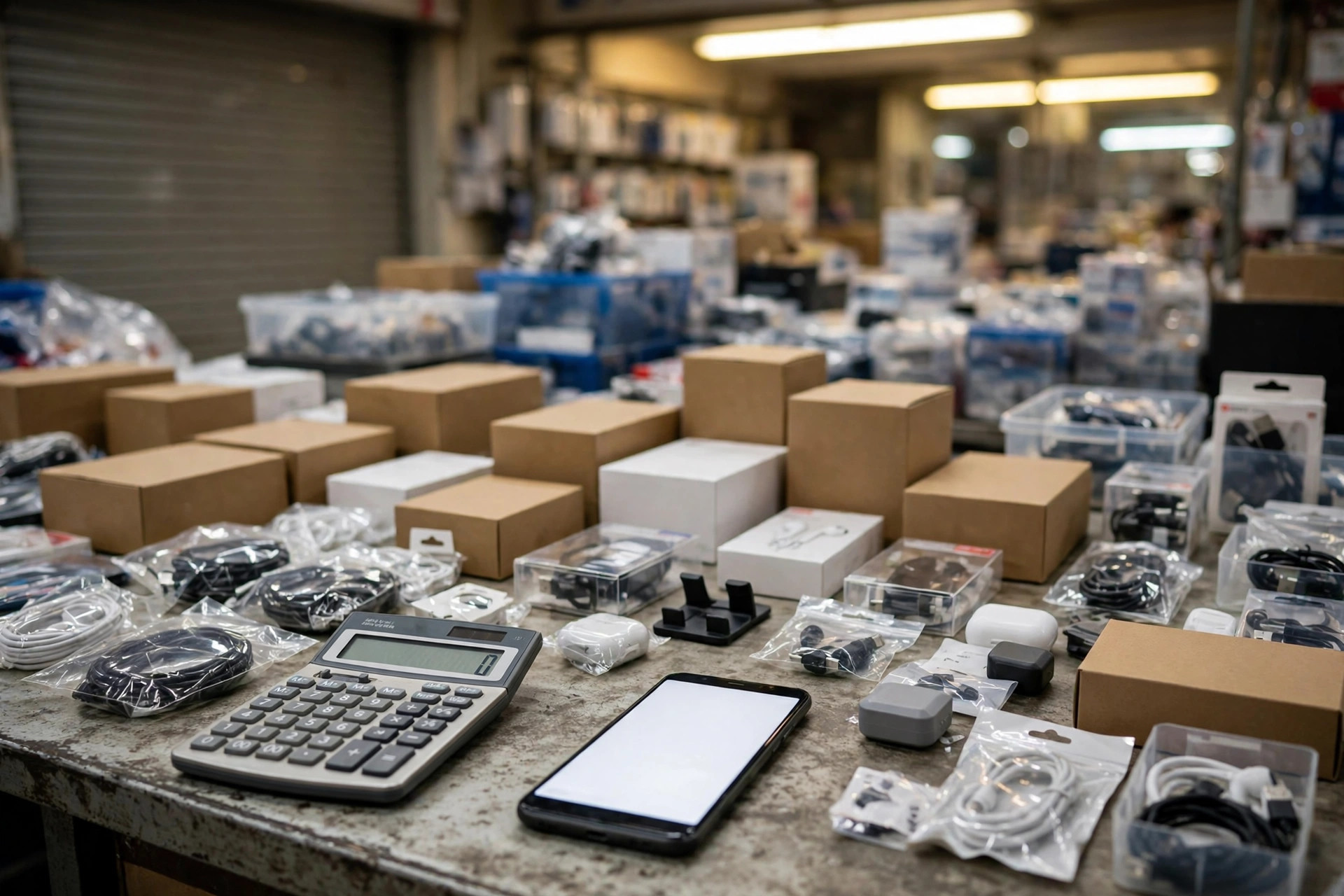
Expect almost no English. The usual range is "hello", "cheap price", and the calculator — beyond that, do not count on words. The negotiation runs on two tools: a translation app on your phone and the calculator. Type the number, show the screen, let them type theirs back. For anything specific, write the model, storage, and requirements in a phone memo first and show it to the stallholder — this is the standard advice for Feiyang's used-phone floors, and it works everywhere in the district.
In Huaqiang Electronics World, some stalls on the 2nd floor offer multilingual service and accept foreign cards, and the district has multilingual volunteers helping with translation, directions, payment and logistics — but treat that as a bonus, not a plan. For orders over a few thousand yuan, or anything involving certification and shipping, hiring a translator or sourcing agent for the day costs about ¥400–800 and is the normal way to handle it.
Step 6: verify before you pay
A good price on a dead product is not a bargain. Genuine, refurbished and counterfeit goods often sit on the same counter, so the check happens before the money moves:
- Power the item on and test every function on the spot. Never accept "unlock it later" or any promise that the check can happen after payment.
- Ask for a stamped receipt that states the model, serial number and warranty terms. Add the vendor on WeChat so you have a channel for follow-up and after-sales.
- Proper electronics and computer hardware from a regular stall typically carry about a year of stall warranty (one local guide's figure). In Feiyang, the warranty is the shop's own label stuck on the device — usually about 3 days — and the label must be intact for any claim.
- A power bank needs a 3C mark, or it cannot go on a domestic flight in China.
If you are buying used phones in Feiyang, the check list is longer: confirm iCloud is signed out and the activation lock is off, check the carrier lock in Settings (it should say "No SIM restrictions"), check battery health and cross-check it against a tool such as Aisi Assistant, verify the IMEI by dialling *#06#, and test Face ID, both cameras, speakers, compass and charging port. The floors use grade words you will hear: A+ is near-new, A is excellent with no screen scratches and never repaired, B is light signs of use, C is heavily worn or damaged — "liang ji" means near-new, "xiao hua ji" means light signs of use. Almost nothing there is a genuinely new sealed unit; what is sold is used, official-refurbished, or overseas-version stock.
The total cost after the bargain
The stall price is not the landed cost. The US de minimis exemption is gone — small parcels to the United States now need a declaration and full tariffs, and the postal formal-declaration compliance deadline is 20 January 2027. Budget for tariffs and shipping on top of whatever you negotiate, and check the rules for your destination before you buy in bulk.
Used phones carry their own shipping rule: a phone battery is a Class 9 dangerous good, so do not send them by ordinary postal parcel. Use a DHL, FedEx or UPS battery channel with MSDS and UN38.3 documents, or an air/sea line that includes customs clearance and tax. A cheap stall price is not cheap if the goods cannot legally travel.
When to bring a pro
If the order is large, the product needs certification, or the shipment is complicated, do not negotiate alone. A translator or sourcing agent for the day runs about ¥400–800, and a paid supplier check — $49 online or $149 on site, sample evaluation $49 — is the cheapest way to find out a supplier is bad before the money moves. That is the point at which bargaining stops being a market skill and becomes a procurement job.
What we charge
Our own Huaqiangbei guide days are listed at $299 per day, $599 for two days, and $2,499 per person for a four-day founder group — reference pricing, to be confirmed, as of November 2026; final rates are confirmed before booking. If you want that kind of help, send your list through our Sourcing Inquiry form: what you need, how many days you have, and what you want to buy.
FAQ
How do I bargain and negotiate prices at Huaqiangbei electronics market? Open at 30–40% of the asking price for electronics and around 50% for accessories, compare 3–5 stalls selling the same item, anchor on the Amazon or Taobao price first, and test everything on the spot before you pay.
How much can I actually save by bargaining? The same item can cost 30–50% more or less from one stall to the next, and identical-looking items with different chips inside can differ 50–200% in price — so the saving comes from comparing stalls as much as from haggling at one counter. Start from the market's own ranges (30–40% for electronics, about 50% for accessories) and treat recorded deal prices as orientation, not quotes.
Can I bargain at the brand stores on the first floor? The first-floor brand experience zone in Huaqiang Electronics World carries high marked prices and is not the main buying place. Do your bargaining on the wholesale floors, where the prices are negotiable.
Do I need cash, or can I pay by card? Use Alipay or WeChat Pay with an overseas Visa or Mastercard bound to it, and keep ¥500–1,000 in cash. Most stalls do not take foreign credit cards directly, and some older stalls take cash or domestic transfer only.
Can I buy just one item, or is it wholesale only? You can buy a single item. In Feiyang, single units are usually fine on floors 1–3, and small mixed batches of 5–10 units are normal; the big wholesalers on the 4th floor often ask for 5–10 units minimum.
What if the vendor will not move on price? Thank them and move to the next counter. With 3–5 stalls selling the same item, the next stall is your leverage — and if every stall quotes the same number, that number is probably the real market price for that item.
How do I know the cheap one is not fake? You often cannot tell by looking: genuine, refurbished and counterfeit goods sit on the same counter. Power the item on and test every function before paying, ask for a stamped receipt with the model, serial number and warranty terms, and never accept "unlock it later". For used phones, check the carrier lock, iCloud status, battery health and IMEI before you pay.
How we report prices
All prices here are recorded deal prices or stall price ranges from the sources named in the text, as of November 2026. They are orientation figures, not quotes — prices move, pages change, and the cheapest listing is not always the price charged. Check the price on the day and confirm what is included before you buy. Our own figures are reference pricing, to be confirmed (November 2026).