Shenzhen Tech Tour: Huaqiangbei, Tech Landmarks & the Maker Scene (2026–2027)
SEO title: Shenzhen Tech Tour (2026–2027): Huaqiangbei, DJI, Robotaxis, Drone Delivery & Maker Spaces Meta description: A practical Shenzhen tech tour for overseas visitors: ride a robotaxi, watch drone deliveries, walk Huaqiangbei's electronics markets, visit the DJI flagship store and meet the maker community — with an English-speaking hardware guide. Reference rate from $299/day (to be confirmed, November 2026).
This is not a sightseeing bus
A Shenzhen tech tour is a day — or two, or four — spent inside the city where the hardware you use every day is designed, prototyped and sold. You ride in a driverless taxi. A drone drops a delivery from the sky. You walk into a flagship store, try the newest drone or AI glasses, and then walk ten minutes to a market floor where the same technology is sold by the hundred, at wholesale prices, by people who will open the box and let you test it on the spot. That is the difference between Shenzhen and a tech museum: here, the future is for sale, and it is for sale today. The tour is built for people who want to touch it, not just photograph it — founders, engineers, buyers, and the simply curious who would rather spend a day in the world's hardware capital than another day in a conference hall.
Who this is for
- Hardware founders and engineers who want to see the supply chain with their own eyes before they commit to a design, a supplier or a production run.
- Tech-curious travellers who have read about robotaxis and drone delivery and want to try both in one afternoon, in the city where they actually run.
- Amazon and DTC sellers who want to see what is coming next — AI glasses, robot dogs, smart wearables — before it shows up on their competitors' listings.
- Makers and hobbyists who want to meet the community that builds here: the open nights, the shared workshops, the people who turn an idea in the morning into a prototype by the afternoon.
- Buyers who want context first. If you plan to source in Huaqiangbei, a tech tour is the fastest way to understand the market before you start spending.
If you only want a photo at a landmark, the platform tours are cheaper and faster. If you want to understand how Shenzhen makes things — and to bring something home that proves it — this is the trip.
Why Shenzhen, why now
- The world is watching Shenzhen again. Shenzhen hosted the APEC leaders' meeting on November 18–19, 2026, and NBC News broadcast from inside the markets on November 19–20. Foreign buyers are arriving at a rate of roughly 8,000–10,000 a day, and AI hardware — smart glasses, robot dogs, drones — is the hottest category of the season.
- AI hardware lives here. AI products are 61% of the Huaqiangbei district's electronics sales in 2026, up from 41% in 2025. If your product has a chip, a sensor or a battery in it, this is where its supply chain sits.
- "China Haul" is a real trend. Foreign visitors are coming to China to buy, not just to look: in January–July 2026, overseas visitors spent ¥263.6 billion in China, up 27.8% year on year, and China now offers visa-free entry to citizens of 50 countries. The people landing in Shenzhen this winter are buyers, not tourists.
- The rules changed for US buyers. The old $800 duty-free de minimis exemption for goods from China ended on May 2, 2025, and was suspended for all countries from August 29, 2025. Small purchases and samples now need a customs declaration and full duties. A local guide who understands what ships, what needs paperwork and what channel to use is no longer a luxury.
The tech landmarks
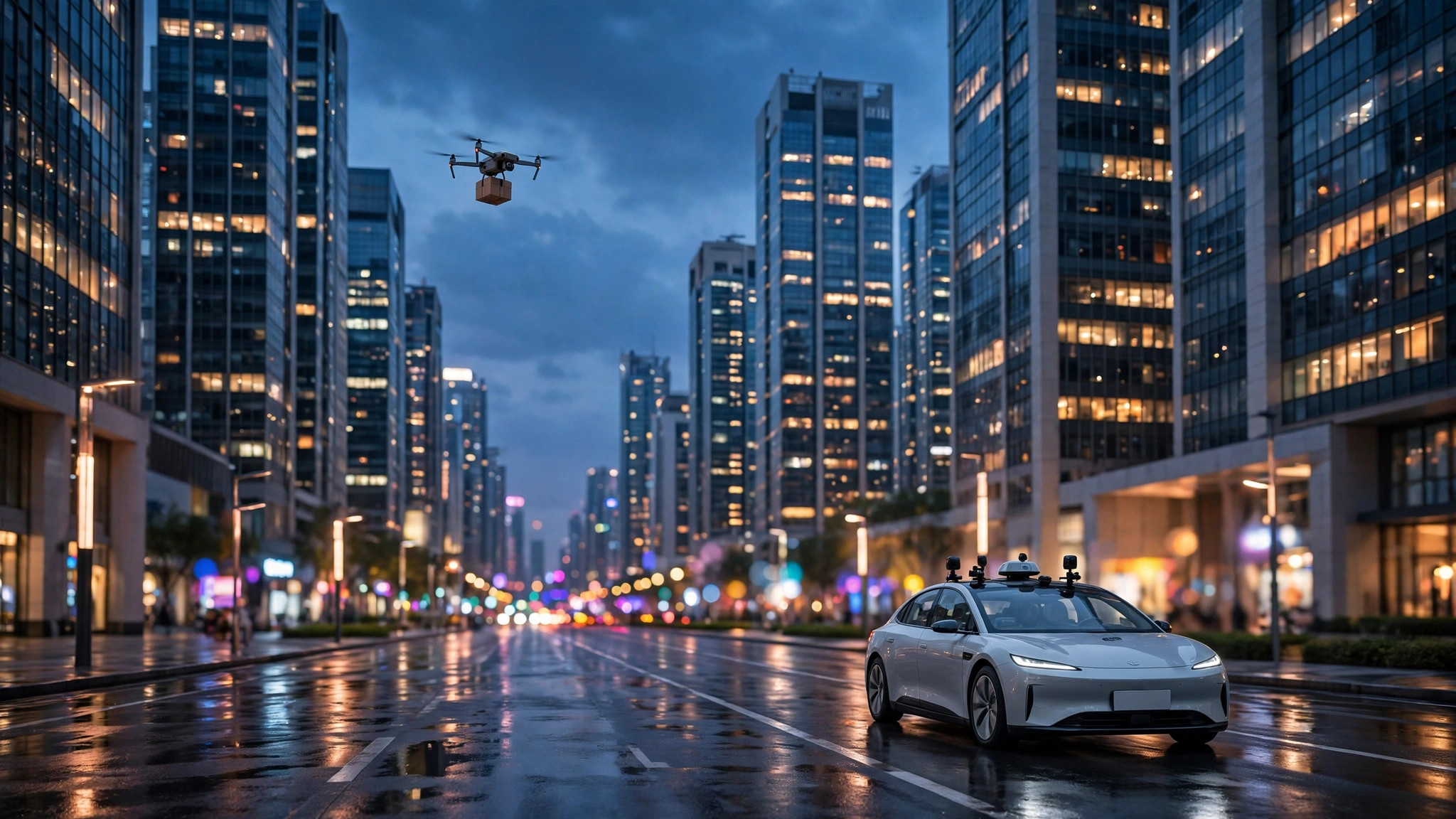
Ride a robotaxi. Driverless taxis run in Shenzhen, and a ride is the fastest way to understand how far the technology has come — no driver, no small talk, just a car that handles the traffic while you watch the city go by. It is the single most memorable hour of most visitors' trips, and it costs less than a taxi anywhere else.
Watch a drone delivery. Drones deliver food and small parcels in Shenzhen, dropping orders from the sky to designated points. On the tour you see a delivery happen, and your guide explains how the system works — the routes, the landing points, and why Shenzhen is the city where this is normal, not a demo.
DJI flagship store. DJI is the world's biggest drone maker, and its flagship store is the place to see the full range in one room — drones, handheld cameras, stabilisers — with staff who will walk you through what each one does. It is a shop, not a museum, and everything in it is for sale.
Lianhua Mountain viewpoint. From the viewing platform on Lianhua Mountain you get the classic Shenzhen panorama: the skyline, the dense towers of Futian, and the city laid out below. It is the best place to understand the scale of what you have been walking through all day.
Gangxia North Station and UpperHills. Four metro lines meet at Gangxia North, one of the busiest interchanges in the city — worth seeing as a piece of infrastructure in its own right, and how you get around fast once you know the network. UpperHills hosts robot demonstrations: machines that walk, dance, serve and interact with visitors. It is the most family-friendly stop on the tour, and the one that makes the best photos.
Huaqiangbei Museum. According to a July 2026 travelogue, Huaqiangbei now has its own museum, with display cabinets, circuit-board-themed walls — even the restrooms are circuit-themed. It is a small, charming stop that tells the story of how this district went from farmland to the world's electronics capital in under forty years. According to a Shenzhen travel volunteer on Threads, November 19, 2026, the district now has AI glasses, drones, robots and a multilingual holographic digital volunteer called "Xiaobei" on site, along with a brain–computer interface demonstration. It is a reminder that the technology here is not only for sale — it is also how the district welcomes its visitors.
Huaqiangbei: the market floor
The scale. About 35 specialized markets and more than 115,000 merchants packed into roughly 1.45 square kilometres in Futian district, with annual trade over ¥480 billion, according to a February 2026 Futian district report. This is the densest concentration of consumer electronics on earth.
When to go, and what you will see on the shelves. Most buildings open around 10:00–10:30 and close around 18:30; the best window is the afternoon, 14:00–18:00. Come in the morning and half the stalls are still shuttered. Sundays are quiet. NBC News, reporting from inside the markets on November 19–20, 2026, found a red handheld game console loaded with tens of thousands of games for $20, and smartwatches for $10–20. Those are the prices that make visitors stop and stare — and the reason a guide matters, because the same look with a different chip inside can cost 50–200% more or less.
The markets, by zone. Don't memorise floor tables — layouts change. At SEG Plaza, work by zones: 1F components, 4F branded computers (Dell, Huawei, HP, Samsung, Lenovo), 5–6F DIY hardware and repair (graphics cards, memory, storage, power supplies). Huaqiang Electronics World, founded in 1998, is the most foreign-buyer-friendly market in the district — two buildings, six floors each.
One building to skip for electronics: Mingtong. Mingtong stopped being an electronics market in 2017. It is now a cosmetics wholesale market — one of China's largest, with more than 1,400 shops. Most English guides still get this wrong, including some updated as recently as October 2026. Go there for electronics and you waste half a day.
Feiyang, if your product involves phones. Feiyang Times Building, at 66 Huafa South Road, is China's largest wholesale market for second-hand Apple products. Its four floors run from small accessories to repair parts, second-hand China-market Apple devices, and overseas-version devices. The trading floors don't open until 14:00 and the busiest time is 17:00–21:00, so don't go in the morning.
How to buy. For electronics, open at 30–40% of the quote and expect to meet in the middle; compare the same item at 3–5 stalls. Test expensive items on the spot, in full, and ask for a stamped receipt stating the model, serial number and warranty terms. Bring ¥500–1,000 in cash; most stalls take Alipay or WeChat Pay, which can be linked to a foreign Visa or Mastercard before you travel, but many stalls do not accept foreign credit cards at all. Assume almost nobody speaks English beyond "hello" and "cheap price" — bring a translation app, and use the calculator on your phone to haggle.
The maker scene
Shenzhen's maker community is where the tour turns from shopping into understanding. These are the workshops and open nights where prototypes are built, and visitors are welcome at most of them.
- Chaihuo Maker Space. Founded in 2011, Chaihuo is one of Shenzhen's oldest maker spaces — the community hub where hardware builders, engineers and visiting founders meet, share tools and show what they are working on.
- SZDIY open night. SZDIY in Nanshan holds a weekly open night on Thursdays at 19:00 — the easiest way for a visitor to walk into the maker scene, meet builders and see projects in progress.
- TroubleMaker. An expat maker space inside Huaqiangbei itself, founded in 2016 — the most convenient maker stop on a market day, and the one most likely to have someone who speaks your language.
- Tech in the Tropics. A monthly meetup in Futian, held at the Brasshouse bar — less a workshop, more a social night for the tech and maker crowd, and a good place to hear what people are actually building.
One name you will not find here: HAX. The hardware accelerator HAX was once based in Shenzhen, but it has since moved to New Jersey. Older guides still list it as a Shenzhen maker space; it is not anymore, so don't plan a visit around it. Maker stops are arranged per trip and confirmed before you book — open nights and workshops run on their own schedules, and we check what is actually on during your dates rather than promising a fixed list.
Expo and event calendar: late November to December 2026
If your dates are flexible, time your visit to one of these. All of them are in Shenzhen, and all of them are worth a half day or more.
- China Hi-Tech Fair (CHTF), November 26–28, 2026 — Shenzhen World Exhibition & Convention Center, Bao'an. China's biggest high-tech trade fair: the fullest single snapshot of what Chinese technology companies are launching this year.
- DMP Greater Bay Area Industrial Expo, December 3–6, 2026 — Shenzhen World Exhibition & Convention Center, Bao'an. Industrial manufacturing, automation and machinery — the production side of the Shenzhen story.
- Maker Faire Shenzhen, December 12–13, 2026 — Vanke Design Commune, Nanshan. The maker community's own fair: hands-on projects, workshops and the people who build them.
- muShenzhen Maker City, November 20 – December 18, 2026 — OCT-LOFT North Area. A 28-day pop-up maker city: day tickets $24–30, a week ticket $82, a full-run ticket $179 (early bird $149, student $89). The most visitor-friendly maker event of the season — you can walk in, join in, and build something. Already over: NEPCON Asia 2026 (October 27–29), the electronics manufacturing expo at the Shenzhen World Exhibition & Convention Center in Bao'an, with 600+ exhibitors across 100,000 square metres and 70,000 professional visitors. If you missed it, the next edition is the one to plan around — and the factories and suppliers it gathered are still here.
How a tour is arranged
1. Before you travel. Send your dates, your interests and anything you want to see or buy. We plan the route around your list — the landmarks, the market floors, the maker stops, the expos running on your dates — and confirm what is actually available before you book. If something on your list isn't possible on your dates, we say so now, not on the day.
2. On the tour day. An English-speaking hardware guide meets you in the morning and stays with you all day: translation at every stall, help setting up WeChat Pay and Alipay so you can actually pay, and honest advice on what is worth buying and what is not. You set the pace — linger at the robot show, skip the landmark you have already seen, spend an extra hour in the market that has your product.
3. After the tour. You keep every supplier contact, every quote and every receipt. If you bought samples, your guide helps with the follow-up: what to check when they arrive, and what to do if something isn't right. If the tour convinced you that you need a factory visit, that is a separate trip — arranged per visit, confirmed before you book.
A sample one-day programme
Morning — the future, live. Robotaxi ride, drone delivery viewing, DJI flagship store. The technology first, while the energy is high. Then Lianhua Mountain and Gangxia North: the panorama, then the metro interchange — the city at full scale, and the network that moves it.
Afternoon — Huaqiangbei. SEG by zones, Huaqiang Electronics World, Feiyang after 14:00 if phones are your thing. Price discovery, hands-on testing, sample buying. The best window is 14:00–18:00.
Evening — maker scene or robot show. SZDIY open night if it is a Thursday, the UpperHills robot show otherwise — the day ends with people building things, not just selling them. A two-day option adds the maker spaces in depth, the Huaqiangbei Museum, and a second market day for the categories you want to compare properly. A four-day option adds the expo calendar and factory visits in Shenzhen or Dongguan.
Three flat rates. Pick one.
All prices are flat service fees for the guide and the programme described. Flights, hotels, visas, travel insurance, the cost of goods and samples, and shipping are not included — you pay those directly, at cost, with receipts.
Pricing below is reference pricing, to be confirmed — as of November 2026. Final rates are confirmed before booking.
Tier A — 9 / day (reference rate): Shenzhen Tech Tour Day
Best for: first-time visitors, tech-curious travellers, anyone who wants one focused day in the city of the future.
- One-on-one, English-speaking hardware guide for a full day
- Robotaxi ride and drone delivery viewing, DJI flagship store, Lianhua Mountain viewpoint, Gangxia North Station
- Guided walk through Huaqiangbei's core electronics markets — SEG by zones, Huaqiang Electronics World
- WeChat Pay and Alipay setup help, so you can actually pay at the stalls, and on-site buying with you — translating specs, comparing stalls, checking goods before you pay
Tier B — 9 / 2 days (reference rate): Tech Tour + Maker Scene
Best for: makers, engineers and buyers who want the community as well as the markets.
- Everything in Tier A, over two days
- Plus the maker scene: Chaihuo, SZDIY open night, TroubleMaker, and the monthly meetup calendar, as available on your dates
- Plus the Huaqiangbei Museum, the UpperHills robot show, and a second market day for the categories you want to compare properly — with the same guide, the same translation, the same receipts
Maker stops are arranged per trip and confirmed before you book.
Tier C — ,499 / person (reference rate): 4-Day Shenzhen Tech & Hardware Founder Tour (small group)
Best for: hardware founders who want the full Shenzhen picture in one trip.
- Four days, small group, guided by an English-speaking hardware specialist
- The full programme: tech landmarks, Huaqiangbei deep dive, the maker community, expo visits on your dates, and factory visits across Shenzhen and Dongguan
- Group size is kept small so every founder gets time with the guide, the markets and the factories. Factory visits are arranged per trip and confirmed before you book — tell us what you need to see and we confirm it.
How the pricing compares
For orientation, here is what comparable services publicly charge (November 2026 listings):
- A 3-hour private Shenzhen tech tour on Expedia: $90; 4.5 hours (3-hour tech tour + 1 hour in Huaqiangbei) $125; 6 hours (plus 1 hour in a robot showroom) $180.
- A 2.5-hour Huaqiangbei walking tour: $99 per person (hqbguide.com, bookable online).
- A 3-hour small-group Huaqiangbei tour on GetYourGuide: $225 per person.
- An engineer-led one-day sourcing session on Peek.com: $299.
- A DJI flagship store + Huaqiangbei + Lianhua Mountain 4-hour tour: about $134–139 per person.
- Multi-day founder tours: 2 days $1,800–3,500; 5 days $4,500–7,500; 10 days $10,000–12,000 (movetosz.com). A 6-day December 2026 founder tour lists at $3,000 early-bird, $3,500 standard (thefuturefactory.ai). A robotics study tour of 5–7 days lists at $3,200–5,500 per person; its 3-day Christmas special at $1,598 (chinastudytour.ai).
Our three tiers sit in the middle of that range: a full guided day for less than most half-day tours from the big platforms, and a two-day maker trip below the comparable multi-day programmes. The difference is that every tier is built around your interests — not a fixed sightseeing route.
Practical: when to come, visa, money, shipping
When to come. October–November and March–April are the best months to visit Shenzhen. Come on a weekday afternoon (14:00–18:00) for the markets. Late 2026 expo dates: China Hi-Tech Fair, November 26–28; DMP Greater Bay Area Industrial Expo, December 3–6; Maker Faire Shenzhen, December 12–13; muShenzhen Maker City, November 20 – December 18.
Visa. Many nationalities — including the UK, EU, Australia, New Zealand, Japan and South Korea — can enter China visa-free for up to 30 days (waiver currently runs to 31 December 2026). Check your country's current status before you travel.
Money. Bring ¥500–1,000 in cash. Most stalls take Alipay or WeChat Pay — both can be linked to a foreign Visa or Mastercard before you travel — but many stalls do not accept foreign credit cards at all.
Language. Assume almost nobody speaks English beyond "hello" and "cheap price". Bring a translation app and use the calculator on your phone to haggle — the seller types a price, you type a lower one. For the whole day, translation is part of the tour.
Getting there. Metro to Huaqiangbei Station (Lines 2 and 7); Feiyang is a short walk from Huaqiangnan Station (Lines 7 and 11). Tour days include ground transport.
Samples and shipping. Buy 5–10 units of a mixed batch to test a market before committing to volume. Test expensive samples on the spot, in full, and ask for a stamped receipt stating the model, serial number and warranty terms. Remember: samples shipped to the US now need a customs declaration and full duties. Huaqiangbei has departure tax-refund self-service terminals, so you can process refunds without leaving the district.
Frequently asked questions
Is one day enough? For the landmarks and one market afternoon, yes. For the maker scene and a second market day, take two. For expos and factory visits, take four. The one-day tour is the most popular because it fits a stopover.
Can I buy things on the tour? Yes. Most stalls sell single units; 5–10 units in a mixed batch is normal for testing a market. Your guide helps you check goods before you pay and keeps your receipts.
Can I add a factory visit? Yes — that is Tier B's second day or Tier C's programme. Factory visits are arranged per trip and confirmed before you book. Tell us the product and we confirm what is possible.
What if my dates fall on an expo? Good. Tell us before you book and we build the expo into the programme — CHTF, DMP, Maker Faire or muShenzhen, depending on your dates.
If you're planning a Shenzhen tech tour, tell us your dates and what you want to see — send it through the inquiry form at the bottom of this site's homepage. We'll come back with what the tour can cover and what it costs, before you commit to anything.