SEO title: Shenzhen Hardware Tour (2026–2027): Huaqiangbei Markets, Factory Visits & Rapid Prototyping Meta description: A 4-day Shenzhen hardware tour for founders and product teams: Huaqiangbei's markets, PCB/SMT and molding factories, and rapid prototyping — with an English-speaking hardware guide. Reference rate from $299/day (to be confirmed, November 2026).
This is not a sightseeing tour
A Shenzhen hardware tour is a working trip. You come with a product list, a prototype, or a problem — a component you can't source, a factory you need to vet, a sample that has to be right before you order 5,000 units — and you spend four days inside the supply chain that builds most of the world's electronics.
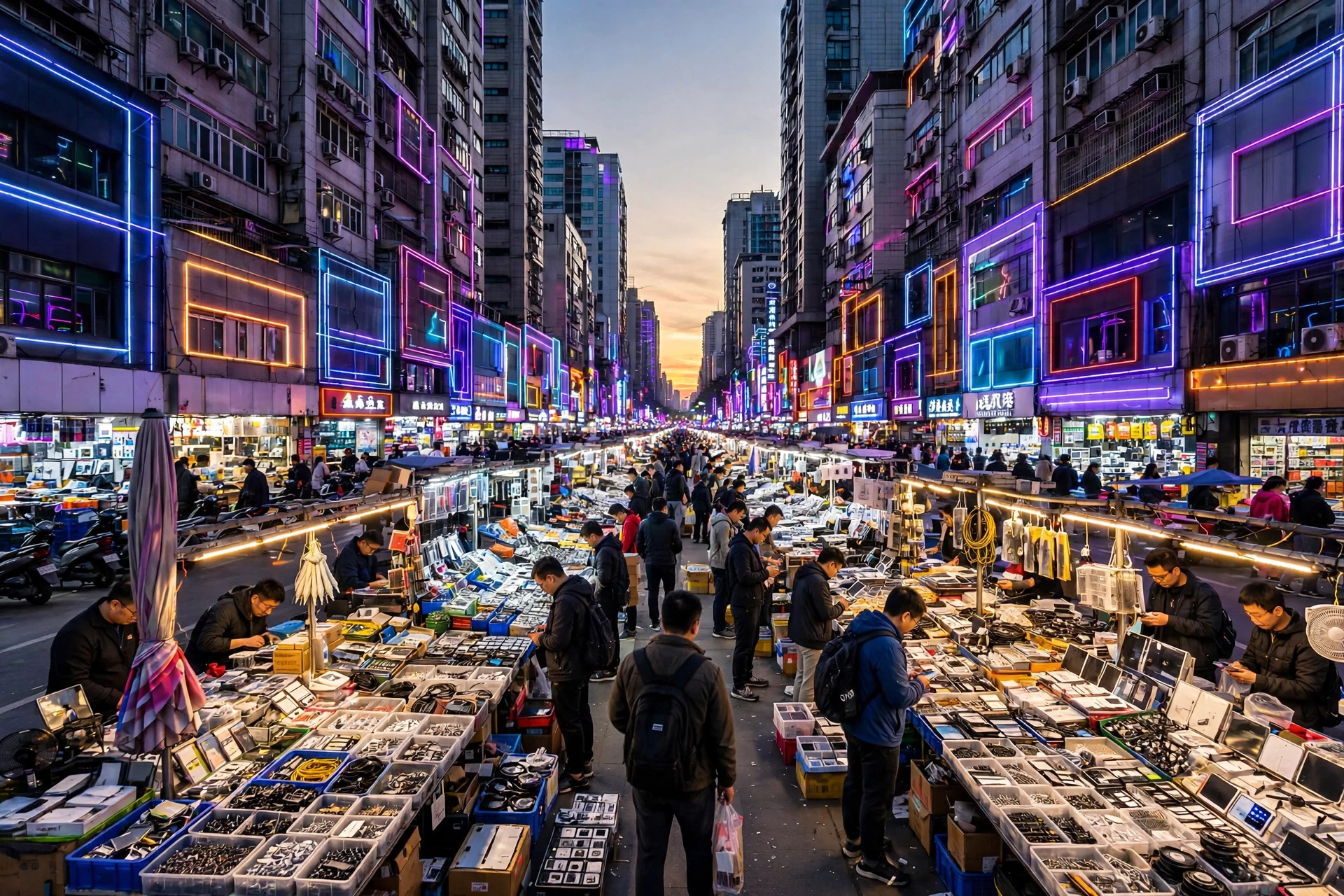
The core of it is Huaqiangbei, in Shenzhen's Futian District: about 35 specialized markets and more than 115,000 merchants packed into roughly 1.45 square kilometres, with annual trade over ¥480 billion, according to a February 2026 Futian district report. Around it sits the rest of the machine: PCB and SMT factories in Shenzhen and Dongguan, injection molding, rapid prototyping shops, and a maker community that has been doing this for over a decade. The tour connects those pieces in one trip, with an English-speaking guide who knows hardware — not a tour-bus guide reading from a script.
Who this is for
- Hardware founders who need to see components, compare suppliers and hold a working sample before committing to a production run.
- AI hardware teams — smart glasses, robots, drones, edge devices: AI products are 61% of the district's electronics sales in 2026, up from 41% in 2025. This is where your category lives.
- Amazon and DTC sellers sourcing electronics, accessories or smart-home products who need reliable suppliers and pre-shipment checks instead of a blind Alibaba order.
- Brand and product managers who need a factory visit done properly: translated, documented, and honest about what a factory can and cannot do.
If you want photos and a nice afternoon, the $90–225 platform tours are a better fit. If you want to know what you're actually buying and who is actually making it, this is the trip.
Why Shenzhen, why now
- The world is watching Huaqiangbei again. Shenzhen hosted the APEC leaders' meeting on November 18–19, 2026, and NBC News broadcast from inside the markets on November 19–20. Foreign buyers are arriving at a rate of roughly 8,000–10,000 a day, and AI toys, robot dogs and smart glasses are the hottest categories of the season.
- "China Haul" is a real trend. Foreign visitors are coming to China to buy, not just to look: in January–July 2026, overseas visitors spent ¥263.6 billion in China, up 27.8% year on year, and China now offers visa-free entry to citizens of 50 countries. The people landing in Shenzhen this winter are buyers, not tourists.
- The rules changed for US buyers. The old $800 duty-free de minimis exemption for goods from China ended on May 2, 2025, and was suspended for all countries from August 29, 2025. Samples and small orders now need a customs declaration and full duties. A local guide who understands compliance — what ships, what needs paperwork, what channel to use — is no longer a luxury.
- The market moves fast. Prices and availability change weekly — which is why you want someone on the ground this week, not a guidebook from last year.
What the tour covers
A typical four-day programme. The exact factories and stops are arranged per trip and confirmed before you book — tell us what you need to see on the free call.
Day 1 — Huaqiangbei, the markets
We start at SEG Plaza, then Huaqiang Electronics World, the most foreign-buyer-friendly market in the district. Don't memorise floor tables — layouts change. We work by zones: components downstairs, brand computers in the middle, DIY hardware and repair upstairs. According to a November 2026 local sourcing guide, the Huaqiang Electronics World layout runs from a brand experience zone on the ground floor through a rebuilt trendy-digital wholesale centre, photography and live-streaming gear, DIY computers, LED, and a components trading centre on the top floor.
After 14:00 we go to Feiyang Times Building, at 66 Huafa South Road — China's largest wholesale market for second-hand Apple products, and the most technical building in the district. Its four floors run from small accessories to repair parts, second-hand China-market Apple devices, and overseas-version devices. The trading floors don't open until 14:00 and the busiest time is 17:00–21:00, so don't go in the morning.
One building we will not take you to for electronics: Mingtong. Mingtong stopped being an electronics market in 2017. It is now a cosmetics wholesale market — one of China's largest, with more than 1,400 shops. Most English guides still get this wrong — including some updated as recently as October 2026. Go there for electronics and you waste half a day.
Day 2 — Components, prototyping, maker community
Day two goes deeper: the component floors for the parts on your list, prototyping suppliers, and the maker community that makes Shenzhen different from a pure trading city — Chaihuo Maker Space, founded in 2011, the SZDIY open night on Thursdays, and TroubleMaker, the foreign maker space inside Huaqiangbei. Schedules vary, so community stops depend on the week. Huaqiangbei also has its own museum now, a useful 30-minute stop if you want the history: in 1988, the story goes, a one-metre counter was enough to start a business here.
Day 3 — Factory visits
PCB assembly, SMT lines or injection molding in Shenzhen or Dongguan, depending on your product — with translation throughout. Factory visits are arranged per trip and confirmed before you book. You keep every supplier contact, every quote, and every receipt.
Day 4 — Samples, shipping, follow-up
Sample checks, re-orders, and getting everything home properly. Anything with a lithium battery — phones, power banks, drones — ships by a DHL, FedEx or UPS battery channel (MSDS and UN38.3 paperwork) or a dedicated air/sea line, never an ordinary postal parcel. Huaqiangbei has departure tax-refund self-service terminals, so you can process refunds without leaving the district.
Factories: what you will — and won't — see
We will take you into real working factories: PCB, SMT, injection molding and assembly, matched to your product. What we will not do is promise access we can't deliver. Some famous sites are showcases, not production lines. BYD's Shenzhen headquarters, for example, is a technology and business showcase, not a production line — even the big study-tour operators describe their BYD stop that way. If a factory visit matters to you, tell us on the free call and we confirm it before you book — or we tell you honestly that it isn't available.
Three flat rates. Pick one.
All prices are flat service fees for the guide and the programme described. Flights, hotels, visas, travel insurance, the cost of goods and samples, and shipping are not included — you pay those directly, at cost, with receipts.
Pricing below is reference pricing, to be confirmed — as of November 2026. Final rates are confirmed before booking.
Tier A — $299 / day (reference rate): Huaqiangbei Guided Sourcing Day
Best for: first-time visitors, sample buyers, anyone who wants one focused day in the markets.
- One-on-one, engineer-level English-speaking guide for a full day in Huaqiangbei's core electronics markets
- WeChat Pay and Alipay setup help, so you can actually pay at the stalls
- On-site component and sample buying with you — translating specs, comparing stalls, checking goods before you pay
- Supplier contacts, quotes and receipts collected for you to take home
Tier B — $599 / 2 days (reference rate): Huaqiangbei + Factory Visits
Best for: teams ready to move from samples to small-batch production.
- Everything in Tier A, over two days
- Plus visits to 1–2 partner factories in Shenzhen or Dongguan — PCB assembly, SMT lines or injection molding, depending on your product — with translation throughout
- Factory capability assessment: what the factory can actually make, its minimum orders, lead times and quality process, in plain English
- Sample follow-up: we help you chase the samples and quotes after the visits
Factory visits are arranged per trip and confirmed before you book — tell us what you need to see on the free call.
Tier C — $2,499 / person (reference rate): 4-Day Hardware Founder Tour (small group)
Best for: hardware founders who want the full Shenzhen supply-chain picture in one trip.
- Four days, small group, guided by an English-speaking hardware specialist
- The full programme above: Huaqiangbei deep dive, components and prototyping suppliers, factory visits across Shenzhen and Dongguan, and the maker community
- Group size is kept small so every founder gets time with the guide and the factories
How the pricing compares
For orientation, here is what comparable services publicly charge (November 2026 listings):
- A 2.5-hour Huaqiangbei walking tour: $99 per person (hqbguide.com, bookable online).
- A 3-hour small-group Huaqiangbei tour on GetYourGuide: $225 per person.
- A 3-hour private Shenzhen tech tour on Expedia: $90; 4.5 hours $125; 6 hours $180.
- An engineer-led one-day sourcing session on Peek.com: $299.
- Freelance sourcing agents: product sourcing $25–125, buying at 5% of order value, pre-shipment inspection $149 (chicksourcing.com).
- Multi-day founder tours: 2 days $1,800–3,500; 5 days $4,500–7,500; 10 days $10,000–12,000 (movetosz.com). A 6-day December 2026 founder tour lists at $3,000 early-bird, $3,500 standard (thefuturefactory.ai). A 5–7 day robotics study tour lists at $3,200–5,500 per person; its 3-day Christmas special at $1,598 (chinastudytour.ai).
Our three tiers sit in the middle of that range: a full guided day for less than most half-day tours from the big platforms, and a 4-day founder tour below the comparable 5–6 day programmes. The difference is that every tier is built around your product list — not a fixed sightseeing route.
Practical: when to come, visa, money, shipping
When to come. October–November and March–April, on a weekday afternoon (14:00–18:00). Late 2026 expo dates: China Hi-Tech Fair, November 26–28; DMP Greater Bay Area Industrial Expo, December 3–6; Maker Faire Shenzhen, December 12–13; muShenzhen Maker City, November 20 – December 18. Most buildings open around 10:00–10:30 and close around 18:30; Sundays are quiet.
Visa. Many nationalities — including the UK, EU, Australia, New Zealand, Japan and South Korea — can enter China visa-free for up to 30 days (waiver currently runs to 31 December 2026). Check your country's current status before you travel.
Money. Bring ¥500–1,000 in cash. Most stalls take Alipay or WeChat Pay — both can be linked to a foreign Visa or Mastercard before you travel — but many stalls do not accept foreign credit cards at all.
Language. Assume almost nobody speaks English beyond "hello" and "cheap price". Bring a translation app and use the calculator on your phone to haggle — the seller types a price, you type a lower one. For electronics, open at 30–40% of the quote and expect to meet in the middle.
Getting there. Metro to Huaqiangbei Station (Lines 2 and 7); Feiyang is a short walk from Huaqiangnan Station (Lines 7 and 11).
Samples and shipping. Buy 5–10 units of a mixed batch to test a market before committing to volume — this is normal practice in Huaqiangbei. Test expensive samples on the spot, in full, and ask for a stamped receipt stating the model, serial number and warranty terms. Remember: samples shipped to the US now need a customs declaration and full duties.
Frequently asked questions
Is four days too much? For a first look, one day in Huaqiangbei is enough. For serious buying plus factory visits, two days is the minimum — four days is the trip that answers "can this be made, by whom, at what cost".
Can I buy just one or two samples? Yes. Most stalls sell single units; 5–10 units in a mixed batch is normal for testing a market. Large wholesalers — for example on Feiyang's 4th floor — often ask for 5–10 units minimum.
Can I visit the BYD factory? BYD's Shenzhen headquarters is a technology and business showcase, not a production line — even the large study-tour operators describe their BYD stop that way. We don't promise production-line access we can't deliver. If a specific factory visit matters to you, ask on the free call and we confirm it before you book.
Can you visit a factory outside Shenzhen? Yes — Dongguan is the usual case for PCB, SMT and molding, included in Tier B and Tier C. Other cities are possible; tell us on the free call and we'll confirm feasibility and any extra cost before you commit.
What if my product isn't in Huaqiangbei? Tell us on the free call. If it's genuinely not a Huaqiangbei product, we'll say so rather than sell you a trip that wastes your time.
How do I pay you? The flat service fee is agreed in writing before the trip. Goods, samples and shipping are paid directly to suppliers, at cost, with receipts. We don't take commission from factories or stalls on your orders.