Do Vendors at Huaqiangbei Speak English? Do I Need an Interpreter or a Guide? (2026 Guide)
The short answer
Most vendors at the Huaqiangbei electronics market speak very little English. Beyond "hello", "cheap price" and the calculator, do not expect a conversation — as of November 2026, that is still the default across the market. You can buy small items on your own with a translation app and a calculator. Hire an interpreter or a guide when the order is large, when you need certification or shipping arranged, or when it is your first trip and you want to cover several buildings in one day.
How much English you will actually hear
The general rule
The working language of Huaqiangbei is Mandarin and Cantonese, plus the language of the calculator. A vendor who sells to foreign buyers every day may know product words — model names, "original", "copy", "wholesale" — but that is not a conversation. If your question needs more than a number, you will be pointing at a phone screen. This is the normal experience, not a bad one: roughly 8,000–12,000 foreign buyers a day pass through the area, depending on which report you read, and most of them manage without fluent English on either side.
Huaqiang Electronics World: the easiest building
If you speak no Chinese, start here. Huaqiang Electronics World is the most foreign-buyer-concentrated market in the area, and many vendors there can communicate in English; some use translation software at the counter. On the second floor of the first shop, some stalls advertise multilingual service and accept foreign cards — that detail comes from a single 2026 local sourcing guide, so treat it as a lead, not a guarantee. The building's ground floor is mostly brand showrooms with high marked prices, so do your buying on the upper floors.
SEG Plaza: patchy
SEG is the computer-hardware building — components on the lower floors, brand computers in the middle, DIY parts and repair upstairs. English here is patchy: the stalls that sell graphics cards, memory and laptop parts to foreign buyers know the product vocabulary, but do not count on full sentences. Bring the same phone tools as everywhere else.
Feiyang Times Building: the least English
Feiyang is the four-storey used-Apple building, and most vendors there speak limited English. This is the building where preparation matters most: before you go, write your requirements in your phone's notes app — exact model, storage size, carrier-unlocked or SIM-locked, iCloud signed out — and show the note to the vendor. The building's trading floors open at 14:00, not in the morning, so an early arrival wastes a trip.
Mingtong: do not go there for electronics
One warning that saves a wasted walk: Mingtong Digital City has been a cosmetics wholesale market since 2017, not an electronics market, even though many English guides still list it as one. Do not go there looking for electronics, and do not expect its vendors to talk tech with you in English.
Four tools that work when English does not
1. A translation app, downloaded before you arrive. This is the single most important tool. Download it and its offline Chinese language pack before you land — market Wi-Fi is not something to rely on. Type or speak your question, show the screen, and let the vendor type back. It is slow, but it works for prices, quantities and specifications.
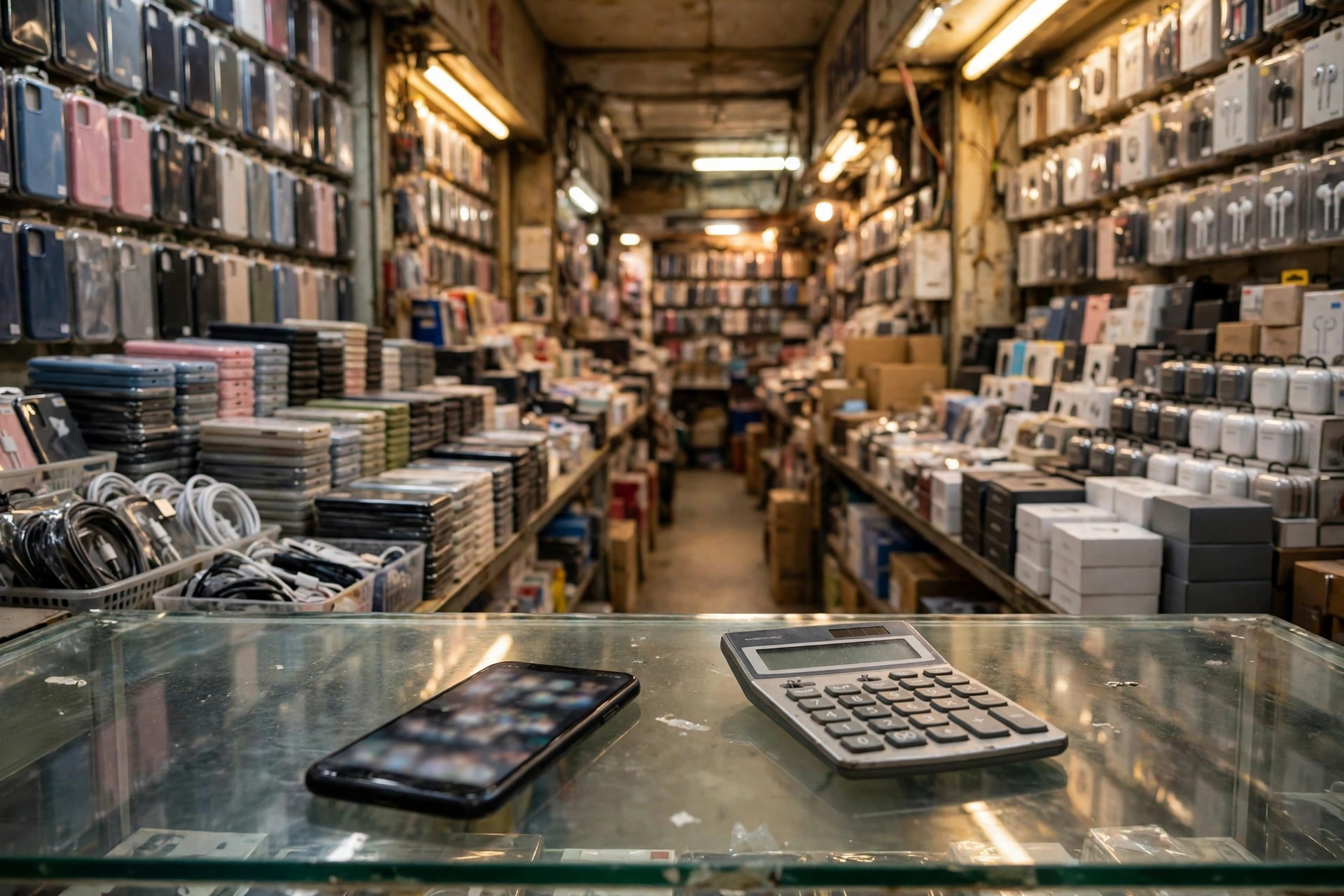
2. The calculator. Every stall has one. The vendor types a price, you type a counter-offer, and the haggling happens in numbers. For electronics, a first counter-offer around 30–40% of the quoted price is the normal starting point; compare the same item at three to five stalls before you buy, because the same-looking product can hide a different chip inside and cost 50–200% more or less.
3. A note on your phone with your exact requirements. Write it before you go, in English and in translated Chinese: model, storage, colour, quantity, unlocked or locked, and anything you must check. Show it to the vendor instead of explaining. At Feiyang, this note is the difference between getting the phone you asked for and getting a different one: model, storage, SIM-lock status and iCloud status, written down, shown, and checked before you pay.
4. Photos and model numbers. A photo of the exact item, or the model number copied from the manufacturer's page, removes more confusion than any sentence. Vendors recognise a model number instantly; a description does not translate.
When you need an interpreter — and when you do not
You do not need one if you are buying a few items for yourself, you know the exact models you want, and you have a translation app and a calculator. That covers most first-time visitors who come to look around and buy samples.
Hire one when any of these is true:
- The order is large. Once you are spending several thousand RMB, or ordering in bulk, the conversation stops being about price and starts being about specifications, defect rates, packaging, delivery times and payment terms. That is interpreter work.
- You need certification or shipping arranged. Anything involving certificates, customs paperwork or freight needs precise language. A mistranslated specification at this stage costs far more than a day of interpreting.
- It is your first trip and your time is short. A guide who knows which building sells what can save you a full day of wrong turns — including the Mingtong trap above. One Shenzhen travel guide puts it plainly: if you want someone to bargain in Cantonese or Mandarin and translate technical specifications, a local Huaqiangbei guide is worth booking.
- You are buying used phones at Feiyang. The checks there — SIM-lock status, iCloud lock, battery health, screen condition — are a conversation in themselves, and the cost of a mistake is a phone you cannot use.
What a guide or interpreter costs
Market prices as of November 2026, each from the operator's own published page:
- A freelance translator for a day in Huaqiangbei runs about ¥400–800, according to an independent foreign-buyer guide checked in late October 2026. That is the rate for language help, not for a full sourcing service.
- A 2.5-hour guided Huaqiangbei walk is published at $99 per person by one local operator.
- An engineer plus translator is published from $45 an hour by a sourcing firm, with a full-day factory tour at $350–450.
- A three-hour small-group Huaqiangbei tour on GetYourGuide is listed at $225 per person; a three-hour private Shenzhen tech tour on Expedia is listed at $90 per adult.
These are orientation figures from the operators' own pages, not quotes — check the price on the day and confirm what is included before you book.
What we charge
Our own Huaqiangbei guide days are listed at $299 per day, $599 for two days, and $2,499 per person for a four-day founder group — reference pricing, to be confirmed, as of November 2026; final rates are confirmed before booking. If you want that kind of help, send your list through our Sourcing Inquiry form: what you need, how many days you have, and what you want to buy.
Free help already on the ground
You do not always have to pay for language help. During the APEC week in November 2026, a field report noted multilingual volunteers inside the malls helping foreign buyers with translation, shopping guidance, payment, logistics and returns — look for volunteer desks and information points on the main street before you hire anyone. A Shenzhen travel volunteer also posted in November 2026 that the main street has a multilingual holographic digital volunteer called "Xiaobei" that visitors can ask for directions. Both are worth trying first; neither is guaranteed to be there on an ordinary weekday, so do not plan your trip around them.
The same APEC-week report noted the malls' tax-refund service operating as "buy now, refund on the spot" for departing visitors — if you are buying to take home, ask at the information desk before you leave the building.
Your first-visit checklist
- Download a translation app and its offline Chinese pack before you arrive.
- Save your shopping list as a note on your phone: exact model, storage, quantity, colour, unlocked or locked.
- Set up Alipay or WeChat Pay and link a foreign Visa or Mastercard before you go; most stalls do not take foreign credit cards, and it is worth carrying ¥500–1,000 in cash as well.
- Plan your hours: most buildings run about 10:00–18:30, stalls mostly open after 10:30, and the best window is 14:00–18:00. Feiyang opens at 14:00. Sundays are quiet — many family-run stalls are closed.
- Start at Huaqiang Electronics World if you speak no Chinese; it has the most English-friendly stalls.
- Compare the same item at three to five stalls, and test anything electronic on the spot before you pay. Never accept "unlock it later" as a promise.
FAQ
Do vendors at Huaqiangbei speak English? Most speak very little. Beyond "hello", "cheap price" and the calculator, expect to use a translation app. Huaqiang Electronics World has the most English-friendly stalls in the Huaqiangbei electronics market.
Do I need an interpreter for my first trip to Huaqiangbei? Not for a small shopping trip if you have a translation app and know your models. Hire one for a large order, certification or shipping, or if your time is short and you want to cover several buildings in one day.
Will a translation app be enough? For buying a few items, yes — with the offline Chinese pack downloaded, plus the calculator and a written note of your exact requirements. For negotiating specifications, defect rates or shipping terms, it is not enough.
How much does an interpreter or guide cost in Huaqiangbei? A freelance translator runs about ¥400–800 a day; a 2.5-hour guided walk is published at $99 a person; an engineer plus translator is published from $45 an hour. Prices as of November 2026 — check on the day.
Which building is easiest if I do not speak Chinese? Huaqiang Electronics World. It has the most foreign buyers of any building in the market, many vendors there can communicate in English, and some stalls on the second floor of the first shop offer multilingual service.
Can I pay by card if I do not speak Chinese? Most stalls take Alipay or WeChat Pay, which can be linked to a foreign Visa or Mastercard. Most stalls do not take foreign credit cards directly, so set up mobile payment before you go and carry ¥500–1,000 in cash.
What should I prepare on my phone before I go? A translation app with the offline Chinese pack, a note with your exact requirements (model, storage, quantity, SIM-lock and iCloud status for phones), and photos or model numbers of the items you want.
How we report prices
All prices here are the operators' own published prices as of November 2026, or attributed to their source. They are orientation figures, not quotes — prices move, pages change, and the cheapest listing is not always the price charged. Check the price on the day and confirm what is included before you book. Our own figures are reference pricing, to be confirmed (November 2026).